How to Set Up a Business as a Digital Nomad: LLC vs OÜ vs SRL Comparison (2026)
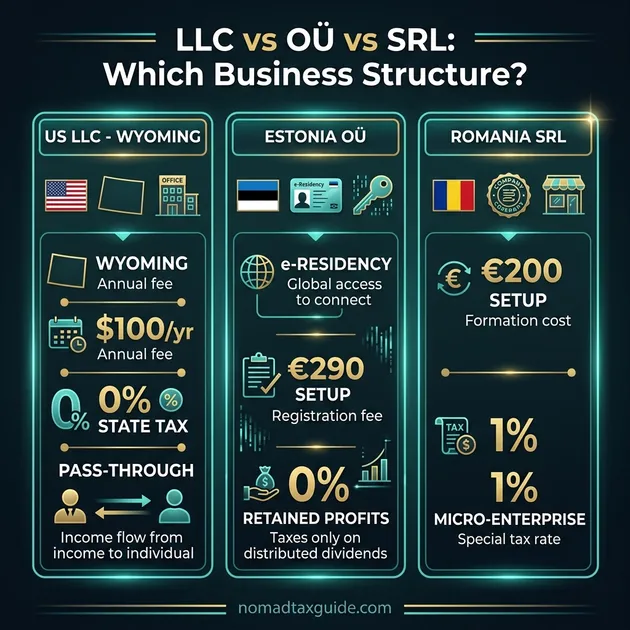
Choosing the right business structure is one of the most consequential decisions a digital nomad makes — yet most people default to whatever their home country offers without considering alternatives. The reality is that a freelance developer in Tbilisi, a marketing consultant in Lisbon, or a SaaS founder in Bali has access to business structures across multiple countries, each with radically different tax rates, formation costs, and administrative burdens. A Wyoming LLC can be formed for $100 with $0 state tax. An Estonian OÜ offers 0% corporate tax on retained profits. A Romanian SRL charges just 1% on revenue. The right choice depends on your income level, where your clients are, and how much administrative complexity you’re willing to tolerate.
TL;DR: For most digital nomads, the best business structures in 2026 are: US LLC (Wyoming) for simplicity and US client credibility ($100/year, pass-through taxation); Estonia OÜ for EU invoicing and profit retention (0% on retained profits, ~€1,500/year admin costs); Romania SRL for the lowest EU tax burden (1% revenue tax, ~14.7% effective rate); and Georgia IE for the absolute lowest tax (1% on revenue, setup in 3 days).
This guide compares the five most popular business structures for location-independent entrepreneurs — the US LLC, Estonia OÜ, Romania SRL, Georgia IE/LLC, and UK LTD — with step-by-step setup instructions, real cost breakdowns, banking options, and honest pros and cons for each. Whether you’re earning $30,000 or $300,000, this guide will help you choose the right structure. If you’re still deciding which country to base yourself in, start with our best digital nomad countries for 2026.
Quick Comparison: All Five Structures
Before diving into details, here’s a head-to-head comparison of the five main options:
| Feature | US LLC (Wyoming) | Estonia OÜ | Romania SRL | Georgia IE | UK LTD |
|---|---|---|---|---|---|
| Entity type | Limited Liability Company | Private Limited (Osaühing) | Limited Liability (Societate cu Răspundere Limitată) | Individual Entrepreneur | Private Limited Company |
| Corporate/revenue tax | $0 state tax (pass-through) | 0% retained / 20% distributed | 1% on revenue (with employee) | 1% on revenue | 25% (19% for profits <£250k) |
| Dividend tax | N/A (pass-through) | 20% (14% reduced) | 8% | N/A | 8.75–39.35% |
| Total effective rate | Depends on personal residence | ~20–25% on distributions | ~14.7% (with min salary) | ~1% | ~33–50% |
| Formation cost | $100–$500 | €385–€995 | €200–€800 | $50–$150 | £12–£100 |
| Annual admin cost | $100–$600 | €750–€3,100 | €960–€2,400 | $400–$1,500 | £500–£3,000 |
| Time to register | 1–3 days | 4–8 weeks (incl. e-Residency) | 3–7 business days | 1–3 days | 1 day (online) |
| EU company | ❌ | ✅ | ✅ | ❌ | ❌ (but wide treaty network) |
| Remote formation | ✅ 100% online | ✅ 100% online | ⚠️ Partial (notary needed) | ⚠️ In-person preferred | ✅ 100% online |
| Banking ease | ⚠️ Moderate (non-resident) | ⚠️ Moderate | ✅ Good | ✅ Easy (in-person) | ⚠️ Moderate |
| Best for | US clients; simplicity; pass-through | EU credibility; profit retention | Lowest EU tax; EU invoicing | Absolute lowest tax | UK/global clients; treaty access |
Option 1: US LLC (Wyoming or Delaware)
What Is a US LLC?
A Limited Liability Company (LLC) is a flexible US business entity that provides liability protection while offering pass-through taxation — meaning the LLC itself pays no federal income tax. According to the IRS, a single-member LLC is treated as a “disregarded entity” for federal tax purposes under IRS Revenue Procedure 2002-69, with all income and expenses passing through to the owner’s personal tax return.
For digital nomads who are non-US persons (non-resident aliens), a single-member LLC with no US-sourced income typically has $0 US federal tax obligation. This makes the Wyoming or Delaware LLC one of the most popular structures for location-independent entrepreneurs worldwide.
Why Wyoming?
Wyoming is the preferred state for nomad LLCs for several reasons, according to the Wyoming Secretary of State:
- $0 state income tax — Wyoming has no personal or corporate income tax
- $100 initial filing fee + $60/year annual report fee (one of the lowest in the US)
- Strong privacy — Wyoming does not require public disclosure of LLC members
- No franchise tax — Unlike Delaware ($300/year minimum), Wyoming charges nothing
- Asset protection — Wyoming’s LLC Act provides strong charging-order protection
- Lifetime proxy — Members can appoint a proxy to act on their behalf indefinitely
Why NOT Delaware?
Delaware is famous for large corporations, but for solo digital nomads, it’s usually inferior to Wyoming:
| Feature | Wyoming | Delaware |
|---|---|---|
| Formation cost | $100 | $90 |
| Annual report fee | $60 | $300 (franchise tax minimum) |
| State income tax | $0 | 8.7% CIT (if nexus exists) |
| Privacy | No public member disclosure | No public member disclosure |
| Registered agent | Required (~$50–$100/year) | Required (~$50–$150/year) |
Step-by-Step: Forming a Wyoming LLC
-
Choose your LLC name — Verify availability through the Wyoming Secretary of State business search portal. The name must include “LLC” or “Limited Liability Company.”
-
Appoint a registered agent — Required by law. A registered agent is a person or company with a physical Wyoming address that receives legal documents on your behalf. Services like Northwest Registered Agent, Incfile, or ZenBusiness charge $50–$150/year.
-
File Articles of Organization — Submit online through the Wyoming Secretary of State portal. Filing fee: $100. Processing: 1–3 business days. You’ll need your LLC name, registered agent details, and organizer information.
-
Obtain an EIN — Apply for a free Employer Identification Number (EIN) from the IRS. This is your LLC’s tax ID, equivalent to a social security number for the business. Non-US persons can apply by mail/fax using Form SS-4 (processing: 4–6 weeks) or through a third-party service.
-
Draft an Operating Agreement — While not filed with the state, an Operating Agreement is a legal document defining ownership, management, and profit distribution. It’s essential for opening bank accounts and establishing the LLC’s legitimacy.
-
Open a US business bank account — The most challenging step for non-residents (covered below).
-
Obtain any necessary licenses — Most freelancing and consulting activities don’t require special licenses, but verify for your specific industry.
US Banking for Non-Resident LLC Owners
Opening a US business bank account as a non-resident is possible but requires effort:
| Provider | Type | Non-Resident Friendly | Account Opening | Monthly Fee |
|---|---|---|---|---|
| Mercury | Neobank | ✅ Yes (fully online) | Online, 1–5 days | $0 |
| Relay | Neobank | ✅ Yes (online) | Online, 1–3 days | $0 |
| Wise Business | EMI | ✅ Yes | Online, 1–3 days | $0 |
| Payoneer | EMI | ✅ Yes | Online, 1–5 days | $0 |
| Chase Business | Traditional bank | ⚠️ In-person required | In-person, same day | $15 (waivable) |
| Bank of America | Traditional bank | ⚠️ In-person required | In-person, same day | $16 (waivable) |
[!TIP] Mercury has become the go-to bank for non-resident LLC owners. It offers fully online account opening for Wyoming and Delaware LLCs, a clean interface, integrations with accounting tools, and $0 monthly fees. Apply with your EIN, Articles of Organization, Operating Agreement, and passport.
US LLC Tax Obligations for Non-Residents
Per the IRS, a single-member LLC owned by a non-resident alien with no US-sourced income (meaning no US clients, no US employees, no US physical presence) has these filing requirements:
| Form | Requirement | Deadline | Penalty for Non-Filing |
|---|---|---|---|
| Form 5472 + Pro Forma 1120 | Annual information return reporting transactions with foreign owner | April 15 (extensions available) | $25,000 per failure |
| FBAR (FinCEN 114) | If US account balances exceed $10,000 at any point | April 15 (auto-extended to Oct 15) | Up to $12,909 per violation |
[!WARNING] The Form 5472 penalty of $25,000 for non-filing is not a typo. Many digital nomads incorrectly assume that because their LLC owes no US tax, they have no filing obligations. This is wrong. Even a zero-tax LLC owned by a non-resident must file Form 5472 annually. Use a US-based CPA familiar with non-resident LLCs — typical cost: $300–$800/year.
Pros and Cons: US LLC
Advantages:
- Lowest formation and maintenance costs ($160–$660/year total)
- $0 US federal/state tax for qualifying non-residents
- Excellent for US clients who prefer paying US entities
- Strong privacy (Wyoming) and liability protection
- 100% remote formation and management
- Widely recognized and trusted globally
Disadvantages:
- Not an EU company — EU clients may prefer local invoicing
- Banking can be challenging for non-residents
- Form 5472 filing is mandatory with severe penalties
- No built-in health insurance, pension, or social benefits
- Pass-through structure means personal tax depends entirely on your country of tax residence
Option 2: Estonia OÜ (via e-Residency)
What Is an Estonian OÜ?
An OÜ (Osaühing) is Estonia’s equivalent of a private limited company. Through Estonia’s e-Residency program — the world’s first government-issued digital identity for non-residents — anyone can register and manage an OÜ entirely online. According to Estonia’s official e-Residency dashboard, over 115,000 e-residents from 180+ countries have registered, and their companies have generated over €25 billion in economic activity.
The key attraction is Estonia’s unique corporate tax model: 0% tax on retained (undistributed) profits, per the Estonian Income Tax Act (Tulumaksuseadus). Tax is triggered only when profits are distributed as dividends (20%) or paid as salary (subject to 33% social tax). For a complete deep-dive, read our Estonia e-Residency guide.
Step-by-Step: Forming an Estonian OÜ
-
Apply for e-Residency — Submit your application online at e-resident.gov.ee. Fee: €120–€130. Processing: 3–8 weeks. Pick up your digital ID card at an Estonian embassy or partner location.
-
Choose a company name — Verify availability through the Estonian e-Business Register (ariregister.rik.ee).
-
Appoint a contact person in Estonia — Mandatory legal requirement. Service providers charge €100–€300/year.
-
Register the OÜ — Sign registration documents digitally with your e-Residency card. State fee: €265. Share capital: €2,500 (can be deferred — declared but not deposited). Processing: 1–3 business days.
-
Open a business bank account — Apply through Wise Business (fastest, 1–3 days) or LHV Bank (traditional, 2–4 weeks).
-
Hire an accountant — Estonian compliance requires monthly tax declarations and annual reports. Budget €50–€200/month.
Cost Breakdown: Estonian OÜ
| Item | One-Time | Annual |
|---|---|---|
| e-Residency application | €120–€130 | — |
| Company registration (state fee) | €265 | — |
| Formation service (optional) | €300–€600 | — |
| Contact person | — | €100–€300 |
| Registered address | — | €50–€200 |
| Accounting | — | €600–€2,400 |
| Banking (Wise Business) | — | €0 (transaction fees) |
| Total | €385–€995 | €750–€3,100 |
Pros and Cons: Estonia OÜ
Advantages:
- 0% tax on retained profits — Reinvest and grow without corporate tax
- 100% remote formation and management
- Full EU company — EU invoicing, SEPA payments, EU credibility
- Strong digital infrastructure (e-Tax Board, digital signing)
- Estonia has 60+ Double Taxation Agreements (DTAs)
Disadvantages:
- 20% distribution tax when you pay yourself dividends
- ~40% effective rate on salary (including 33% employer social tax)
- Must pay “reasonable salary” if actively working — can’t take only dividends
- Annual admin costs of €750–€3,100 are higher than alternatives
- Not a visa or tax residency — your personal tax depends on where you live
- Banking can be slow (traditional banks) or limited (EMIs)
[!IMPORTANT] e-Residency is a corporate tool, not a personal tax strategy. Your OÜ is an EU company, but your personal tax obligations are determined by your physical location. An Estonian OÜ combined with personal tax residence in the UAE (0%), Georgia (1% for service income), or a country with favorable tax treatment is where the real optimization happens.
Option 3: Romania SRL (Micro-Enterprise)
What Is a Romanian SRL?
An SRL (Societate cu Răspundere Limitată) is Romania’s equivalent of a limited liability company. Under Romania’s Fiscal Code (Codul Fiscal), qualifying micro-enterprises pay a simplified tax of just 1% on gross revenue (with at least one employee) or 3% (without employees), up to a revenue cap of €500,000/year. This makes the Romanian SRL one of the cheapest EU business structures for digital nomads.
For the full deep-dive on Romania’s micro-enterprise regime, including the CAEN code restrictions and the consulting activity trap, read our Romania micro-enterprise guide.
Step-by-Step: Forming a Romanian SRL
-
Obtain a registered office address — Virtual office (€30–€100/month) or physical lease with landlord consent.
-
Choose CAEN codes — Select business activity codes. Per the Romanian Trade Register (ONRC — Oficiul Naţional al Registrului Comerţului), common digital nomad codes include 6201 (computer programming), 6209 (other IT services), and 7311 (advertising). Avoid having >50% revenue from consulting codes (7021, 7022) — this disqualifies you from the micro-enterprise regime.
-
Register at the Trade Register (ONRC) — Submit articles of incorporation (notarized), specimen signatures, proof of address, and founder ID. Minimum share capital: 200 RON (~€40). Processing: 3–5 business days. Total cost: €200–€800 (including notary, translations, legal fees).
-
Register with ANAF — Per ANAF (Agenția Națională de Administrare Fiscală, Romania’s tax authority), your SRL is automatically enrolled. Confirm micro-enterprise status with Declaration 010. VAT registration only required above €88,500 revenue.
-
Hire yourself as an employee — Draft an employment contract at minimum wage (~3,700 RON/month, approximately €740) to qualify for the 1% rate.
-
Open a business bank account — ING Romania, Banca Transilvania, Revolut Business, or Wise Business all work well. Online opening available through Revolut and Wise.
-
Hire an accountant — Essential. Budget €80–€200/month for bookkeeping, payroll, and ANAF filings.
Full Cost Picture: Romania SRL at €60,000 Revenue
| Item | Amount |
|---|---|
| Micro-enterprise tax (1%) | €600 |
| Salary taxes (income + CAS + CASS on min wage) | €4,196/year |
| Employer contribution (CAM 2.25%) | €200/year |
| Dividends remaining | ~€50,320 |
| Dividend tax (8%) | €4,026 |
| Total taxes paid | €8,822 |
| Effective total rate | ~14.7% |
| Formation costs (one-time) | €200–€800 |
| Annual admin (accounting, address) | €960–€2,400 |
Pros and Cons: Romania SRL
Advantages:
- 1% revenue tax — One of the lowest rates in the EU
- Full EU company — Schengen-zone member since 2024
- EU credibility for invoicing European clients
- Very low cost of living (€770–€1,660/month depending on city)
- Legendary internet infrastructure (gigabit fiber for €12/month)
- Revenue cap of €500,000 is generous for most freelancers
Disadvantages:
- Salary taxes on minimum wage add ~7% to effective rate
- 8% dividend tax on profit extraction
- CAEN code restrictions (>50% consulting disqualifies from micro regime)
- In-person notary appointment typically required for formation
- Monthly accounting obligations are complex — accountant is mandatory
- Non-EU nationals need a digital nomad visa or business visa
Option 4: Georgia IE (Individual Entrepreneur + Small Business Status)
What Is a Georgian IE?
A Georgian Individual Entrepreneur (IE) is the simplest business structure available to digital nomads. Under Georgia’s Small Business Status (SBS), per Article 88 of the Georgian Tax Code, IEs earning up to GEL 500,000 (~€180,000/year) pay a flat 1% tax on gross revenue — the lowest percentage-based tax available anywhere that actually charges tax. Based on data from the Georgia Revenue Service, the setup process takes just 1–3 business days, making Georgia the fastest country for business registration.
Read our full Georgia 1% tax guide for complete details on eligibility, banking, and residency permits.
Step-by-Step: Forming a Georgian IE
-
Arrive in Georgia — Most Western passport holders can enter visa-free for 1 year. No advance visa required.
-
Open a Georgian bank account — Visit Bank of Georgia or TBC Bank with your passport. Account opening: 1–2 business days. Free multi-currency accounts (GEL, USD, EUR).
-
Register as a taxpayer — Visit the Georgia Revenue Service (rs.ge) with your passport. Same-day processing. Obtain your taxpayer identification number.
-
Register as an Individual Entrepreneur — Done simultaneously at the Revenue Service. Select your NACE business activity code (e.g., 62.01 for computer programming, 70.22 for consulting).
-
Apply for Small Business Status — Submit a separate application to the Revenue Service. Processing: 1–5 business days.
-
Start invoicing and filing — File monthly tax returns by the 15th of the following month. Pay 1% of gross revenue through the rs.ge online portal.
Cost Breakdown: Georgian IE
| Item | Cost |
|---|---|
| Formation / registration | Free (government fee: ~$10–$20) |
| Bank account opening | Free |
| Annual accounting (optional but recommended) | $400–$1,300/year |
| Monthly tax (1% of revenue) | Varies |
| Total first-year cost (excluding tax) | $50–$1,500 |
Pros and Cons: Georgia IE
Advantages:
- 1% flat tax on revenue — Lowest rate globally among non-zero-tax jurisdictions
- Fastest setup — Operational in 1–3 days
- Cheapest setup — Under $150 in formation costs
- No VAT obligation for SBS holders
- No social security contributions for IEs
- No requirement to track business expenses
- 1-year visa-free entry for most nationalities
- Very low cost of living (€1,200–€1,970/month in Tbilisi)
Disadvantages:
- Not an EU company — No EU invoicing credibility, no SEPA
- Revenue cap of GEL 500,000 (~€180,000)
- Cannot hire employees under SBS
- Tax on gross revenue — no expense deductions
- Banking infrastructure is less developed than EU
- Geographic distance from Western Europe
- Not in Schengen — travel to EU requires separate visa for non-EU nationals
Option 5: UK LTD (Private Limited Company)
What Is a UK LTD?
A UK LTD (Private Limited Company) is one of the most globally recognized business structures. According to Companies House (the UK’s registrar of companies), over 5 million active companies are registered in the UK. A LTD can be formed 100% online in as little as 24 hours through Companies House for just £12 — making it one of the cheapest and fastest company formations in the world.
The UK’s main drawback is its tax rate: 25% corporate tax on profits over £250,000 (19% on profits under £50,000, marginal relief in between). However, the UK’s extensive network of 130+ Double Taxation Agreements — one of the largest in the world — makes it attractive for entrepreneurs who need to invoice clients globally without withholding tax complications.
Step-by-Step: Forming a UK LTD
-
Choose a company name — Check availability on the Companies House name checker.
-
Register online at Companies House — Submit the incorporation application at gov.uk/register-a-company. Fee: £12 (online) or £40 (paper). Processing: usually 24 hours online.
-
Provide company details — Registered office address (must be in the UK), director details, shareholder details, and articles of association. According to Companies House, a UK LTD requires at least one director who is a natural person (not another company).
-
Obtain a UTR (Unique Taxpayer Reference) — HMRC automatically sends this within 2–4 weeks of incorporation. Needed for filing tax returns.
-
Register for Corporation Tax with HMRC — Must be done within 3 months of starting business activity.
-
Open a business bank account — UK neobanks (Tide, Starling, Revolut Business) offer online opening for non-residents.
-
Appoint an accountant — UK Corporation Tax and annual accounts filing require professional support. Budget £500–£3,000/year.
UK Banking for Non-Resident Directors
| Provider | Type | Non-Resident Friendly | Monthly Fee |
|---|---|---|---|
| Tide | Neobank | ✅ Yes (online) | £0 |
| Starling Business | Neobank | ⚠️ UK address preferred | £0 |
| Revolut Business | Neobank | ✅ Yes (online) | £0–£25 |
| Wise Business | EMI | ✅ Yes | £0 |
| HSBC | Traditional | ❌ In-person, UK presence | £5.50–£8 |
| Barclays | Traditional | ❌ In-person, UK presence | £8–£12 |
UK LTD Tax Structure
| Component | Rate |
|---|---|
| Corporation Tax (profits ≤ £50,000) | 19% |
| Corporation Tax (profits £50,001–£250,000) | 19–25% (marginal relief) |
| Corporation Tax (profits > £250,000) | 25% |
| Dividend tax (basic rate) | 8.75% |
| Dividend tax (higher rate) | 33.75% |
| Dividend tax (additional rate) | 39.35% |
| VAT (if registered) | 20% |
| Employer NI | 13.8% |
| Annual dividend allowance | £500 (2026/27) |
Pros and Cons: UK LTD
Advantages:
- 130+ Double Taxation Agreements — One of the widest treaty networks globally
- Extremely fast formation (24 hours) and cheap (£12)
- Globally recognized and trusted by clients and banks
- 100% online formation — no physical presence required
- Strong legal framework and contract enforcement
- Access to UK banking system (world-class infrastructure)
- No minimum share capital requirement
Disadvantages:
- 25% corporate tax is high compared to alternatives
- Dividend taxes add another 8.75–39.35% layer
- Total effective rate of 33–50% is among the highest options
- Complex compliance: Corporation Tax return, annual accounts, confirmation statement
- VAT registration required above £90,000 revenue
- UK is post-Brexit — no EU company status
- Non-UK resident directors face additional compliance (Section 24 HMRC reporting)
Decision Framework: Which Structure Is Right for You?
Choose a US LLC (Wyoming) If:
- Most of your clients are US-based and prefer paying US entities
- You want the lowest admin cost and simplest structure
- You are a non-US person living in a low-tax or zero-tax country
- You want maximum privacy and liability protection
- You don’t need EU company status or EU invoicing
Choose an Estonia OÜ If:
- You want to retain profits in the company and reinvest for growth
- You need EU company status for client credibility and EU invoicing
- You’re building a scalable business (SaaS, digital products) rather than freelancing
- You live in a 0% or low-tax jurisdiction (UAE, Georgia) and want to minimize distribution tax
- You value 100% remote management with no physical presence requirements
Choose a Romania SRL If:
- You want the lowest total tax burden within the EU
- Your primary income is from non-consulting activities (software dev, IT services, design)
- You earn under €500,000/year in revenue
- You want EU company status plus Schengen-zone benefits
- You’re willing to handle monthly accounting and compliance
Choose a Georgia IE If:
- You want the absolute lowest tax rate (1%) with the simplest setup
- You’re a freelancer or solo consultant earning under ~€180,000/year
- You can be physically present in Georgia (or establish tax residency)
- You prioritize speed and simplicity over EU company status
- You want the lowest cost of living to maximize disposable income
Choose a UK LTD If:
- Your clients are primarily UK-based or from countries with UK tax treaties
- You need the widest treaty network to avoid withholding taxes globally
- You’re building a business that may seek UK-based investment or partnerships
- You value the credibility and recognition of a UK company
- Tax optimization is less critical than access, trust, and infrastructure
Multi-Structure Strategies
Many experienced digital nomads use multiple entities in combination. Here are three common setups:
Strategy 1: US LLC + Georgian Tax Residency
- Form a Wyoming LLC for US client invoicing ($160/year)
- Establish Georgian tax residency with a 1% IE for non-US income
- Route US-sourced income through the LLC; non-US income through the Georgian IE
- Total effective tax rate: ~1% on most income (assuming non-US person)
Strategy 2: Estonia OÜ + UAE Tax Residency
- Register an Estonian OÜ for EU invoicing and profit retention
- Establish UAE personal tax residency (0% income tax)
- Retain profits in the OÜ at 0%; distribute dividends taxed at 20% only when needed
- Personal tax on distributions: 0% (UAE)
- Effective rate on distributed profits: ~20%; on retained: 0%
Strategy 3: Romania SRL + Personal Residency in Romania
- Register a Romanian micro-enterprise SRL (1% revenue tax)
- Become a Romanian tax resident (10% flat personal income tax)
- Pay yourself minimum salary + dividends
- Total effective rate: ~14.7% with full EU social security benefits
- Benefit from Romania’s low cost of living and gigabit internet
[!TIP] Before implementing any multi-structure strategy, consult with a tax professional who understands Controlled Foreign Corporation (CFC) rules in your country of tax residence. Many countries (including most EU states) attribute undistributed foreign company profits to you personally if you control the entity. Review our double taxation treaties guide and tax residency certificate guide to ensure compliance.
Common Mistakes When Setting Up a Business Abroad
Digital nomads frequently make these errors — most of which we cover in detail in our nomad tax mistakes guide:
-
Choosing a structure based only on headline tax rate — The 0% Estonian rate sounds perfect until you realize you pay 20% on every euro you extract. The 1% Romanian rate is actually ~14.7% with salary taxes. Always calculate the total effective rate including all layers.
-
Not filing required returns — A US LLC with no tax due still requires Form 5472. An Estonian OÜ with no activity still requires monthly zero declarations and annual reports. Non-filing penalties are severe.
-
Ignoring your personal tax residency — Your company’s tax rate is only half the equation. Your personal tax obligations are determined by where you physically live. An Estonian OÜ is tax-efficient only if your personal tax residency is in a low-tax jurisdiction.
-
Using the company bank account for personal expenses — In every jurisdiction, mixing personal and business expenses triggers additional taxes (fringe benefit taxation in Estonia, benefit-in-kind in the UK) and may pierce your liability protection.
-
Skipping professional accounting — DIY accounting is feasible for a US LLC or Georgian IE, but it’s a recipe for penalties with Romanian, Estonian, or UK entities. Budget for a local accountant from day one.
-
Failing to obtain a Tax Residency Certificate — A TRC proves which country has primary taxing rights over your income. Without one, you risk being claimed by multiple jurisdictions simultaneously.
Frequently Asked Questions
Can I have businesses registered in multiple countries simultaneously?
Yes. There is no legal prohibition against owning entities in multiple countries. Many digital nomads maintain a US LLC for American clients and an Estonian OÜ for European clients. However, you must report all foreign entities to your country of tax residence (e.g., Form 5471 for US citizens owning foreign corporations, CFC reporting in EU countries). Each entity adds administrative complexity and accounting costs.
Do I need to live in the country where my business is registered?
It depends on the structure. A US LLC (Wyoming) and Estonian OÜ can be managed 100% remotely from anywhere. A Georgian IE technically requires Georgian tax residency (183 days or center of vital interests). A Romanian SRL can operate remotely but the micro-enterprise regime works best with Romanian tax residency. A UK LTD can be managed remotely but may trigger “place of effective management” issues in your country of residence.
What’s the cheapest option for a freelancer earning €50,000/year?
Georgia IE is the cheapest by far. Your total annual cost would be approximately €500 in tax (1% of €50,000) plus €400–€1,300 in admin costs. Compare this to a Romanian SRL (~€8,800 total taxes + €1,500 admin) or Estonian OÜ (€10,000–€12,500 in taxes if you distribute most profits + €1,500 admin). Use our Tax Calculator to model your exact scenario.
Can a US citizen benefit from these structures?
Partially. US citizens are taxed on worldwide income regardless of where they live, per IRS regulations. A US citizen can use a Wyoming LLC (simplest option), but the pass-through income will be taxed at US rates. Foreign structures (Estonia OÜ, Romania SRL) trigger additional IRS reporting (Form 5471, GILTI, Subpart F) with compliance costs of $1,000–$3,000/year that often negate the benefits. The US FEIE excludes up to ~$130,000 of earned income but doesn’t apply to corporate dividends or capital gains.
How do I choose between a US LLC and an Estonian OÜ?
The decision usually comes down to where your clients are and whether you need EU company status. If most clients are US-based, a Wyoming LLC is simpler, cheaper, and more familiar to them. If you invoice EU clients regularly, an Estonian OÜ provides EU credibility, EU VAT numbers, and SEPA payments. Some nomads maintain both — a US LLC for North American clients and an Estonian OÜ for European clients.
What happens to my business structure if I change countries?
Your business entity continues to exist regardless of where you personally move. A Wyoming LLC doesn’t dissolve because you left Thailand for Portugal. However, changing your personal tax residency may change how your business income is taxed personally. For example, moving from the UAE (0%) to Germany (up to 45%) dramatically increases your personal tax on LLC distributions. Always reassess your structure when making a major relocation. Our best countries guide can help you evaluate options.
Final Thoughts
There is no single “best” business structure for digital nomads — the right choice depends on your income level, client geography, appetite for administrative complexity, and personal tax residency. What matters most is making a deliberate, informed decision rather than defaulting to your home country’s structure.
For most digital nomads in 2026, the decision tree is straightforward: Georgia IE for the lowest possible tax and simplest setup; Romania SRL for the best balance of low tax and EU credibility; Estonia OÜ for profit retention and EU business infrastructure; US LLC for American clients and administrative simplicity; and UK LTD for global treaty access and credibility.
Whatever you choose, pair it with the right personal tax residency, keep meticulous records, hire a qualified accountant, and obtain a Tax Residency Certificate to prove your tax status. Compare your options with our Tax Calculator and make the numbers work for your specific situation.