Italy Digital Nomad Visa Taxes: The 5% Flat Tax Regime (Forfettario) Explained
Italy officially launched its Digital Nomad Visa (known as the Lavoratore da Remoto visa) to attract self-employed professionals and remote employees from outside the European Union. While living in Italy under the Tuscan sun is a dream, understanding the Italian tax system (known as one of the most bureaucratic in Europe) is essential to avoid costly surprises. Italy is part of the Schengen Area, so non-EU nomads should plan their travel days carefully.
TL;DR: Italy’s Regime Forfettario — established under Law 190/2014 and administered by the Agenzia delle Entrate — offers self-employed digital nomads a 5% flat income tax rate for the first 5 years (rising to 15% thereafter) on revenues up to €85,000. Combined with INPS social security of ~26%, the effective total rate on €60,000 is approximately 19.9%, making it one of the lowest in Western Europe.
For self-employed digital nomads and freelancers, Italy offers a hidden gem: the Regime Forfettario. This special flat-tax regime allows you to pay as little as a 5% income tax rate for your first five years in the country.
In this guide, we break down how the Regime Forfettario works, the role of social security (INPS), and how to calculate your net take-home pay.
What is the Regime Forfettario?
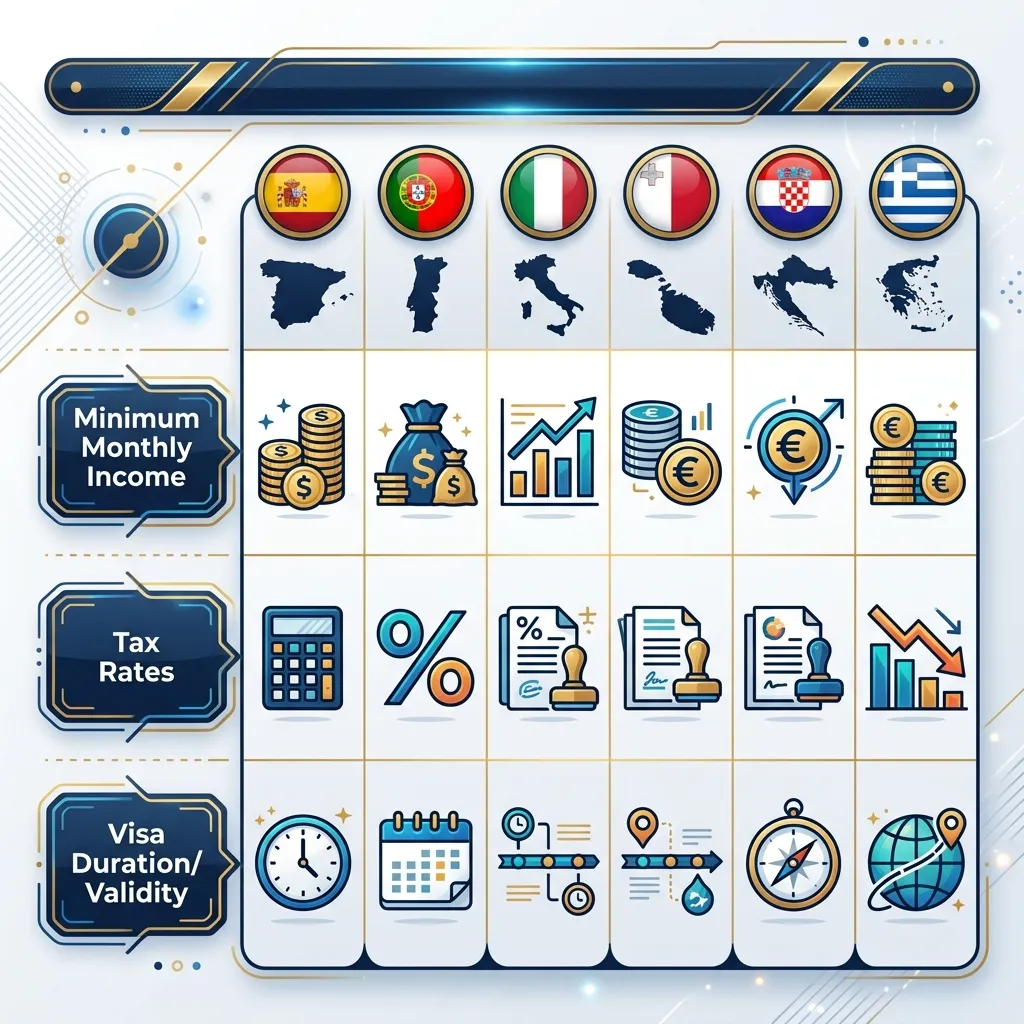
According to Italy’s Agenzia delle Entrate, the Regime Forfettario — originally established under Law 190/2014 — is a simplified tax scheme designed for small businesses and self-employed individuals in Italy. To qualify, your annual gross revenue must not exceed €85,000 (adjusted for 2026).
If you qualify, you enjoy the following benefits:
- 5% Flat Income Tax for the first 5 years (increases to 15% from year 6 onwards). Compare this with Spain’s Beckham Law at 24% or Portugal’s NHR regime at 20%.
- No VAT (IVA) charging required on your invoices, making your rates highly competitive.
- No complex accounting: Instead of tracking every expense, Italy assigns a fixed “profitability coefficient” based on your industry. You are only taxed on that percentage of your income.
How is Taxable Income Calculated?
Unlike other countries where you deduct actual expenses (like laptop purchase, rent, internet), the Regime Forfettario uses a Coefficient of Profitability (coefficiente di redditività) based on your ATECO code (activity classification code).
For digital nomads, the common ATECO categories are:
- Software Developers, IT Consultants, and Web Designers (ATECO 62.01.00 / 62.02.00): Coefficient is 67%. This means Italy assumes 33% of your income goes to business expenses. You are only taxed on 67% of your gross billings.
- Content Creators, Copywriters, and Marketers (ATECO 73.11.02): Coefficient is 78%. You are taxed on 78% of your gross billings.
The Role of Social Security (INPS)
While a 5% income tax sounds incredibly low, per the Agenzia delle Entrate you must also factor in social security contributions (Gestione Separata INPS).
- For freelancers without a dedicated professional order (like IT consultants, copywriters, or virtual assistants), the INPS contribution rate is roughly 26.07% of your taxable base.
- Social security contributions are fully tax-deductible from your taxable base before calculating your 5% income tax.
Step-by-Step Calculation Example
Let’s calculate the exact taxes for a Software Developer earning €60,000 per year under the 5% Regime Forfettario in their first year.
1. Determine Taxable Revenue
With a profitability coefficient of 67%: $$\text{Taxable Base} = \text{€60,000} \times 0.67 = \text{€40,200}$$
2. Calculate Social Security (INPS)
INPS is 26.07% of the taxable base: $$\text{INPS Contribution} = \text{€40,200} \times 0.2607 = \text{€10,480}$$
3. Calculate Income Taxable Base
Social security is deducted from the taxable base before tax: $$\text{Net Taxable Base} = \text{€40,200} - \text{€10,480} = \text{€29,720}$$
4. Calculate 5% Income Tax
$$\text{Income Tax (5%)} = \text{€29,720} \times 0.05 = \text{€1,486}$$
5. Final Net Take-Home Pay
- Gross Revenue: €60,000
- Total Deductions (INPS + Tax): €11,966 (€10,480 + €1,486)
- Net Income: €48,034
- Effective Tax + Social Security Rate: 19.9%
[!NOTE] Even with social security included, an effective rate of under 20% on €60,000 is exceptionally low for Western Europe, where standard tax rates at this bracket typically exceed 35%. For other EU digital nomad visa options, see our guides on Croatia’s DN visa and double taxation treaties to avoid paying tax twice.
How to Apply for the Regime Forfettario
Per guidelines from Italy’s Agenzia delle Entrate, to set up this tax structure you must open a Partita IVA (Italian VAT number).
- Hire a Commercialista: Trying to navigate Italian tax bureaucracy on your own is highly discouraged. Hire an accountant (commercialista) who specializes in expat taxes.
- Open Partita IVA: File the registration form (Modello AA9/12) to open your VAT number. You must specify your ATECO code and declare that you wish to opt into the Regime Forfettario.
- Register for INPS: Enroll in the Gestione Separata division of the Italian social security database.
- Issue Electronic Invoices: Italy mandates electronic invoicing (fatturazione elettronica) for all VAT holders. Your commercialista will set up a software portal (like Aruba or Fatture in Cloud) to issue invoices.