Foreign Tax Credit (FTC) vs FEIE: How to Choose for US Expats
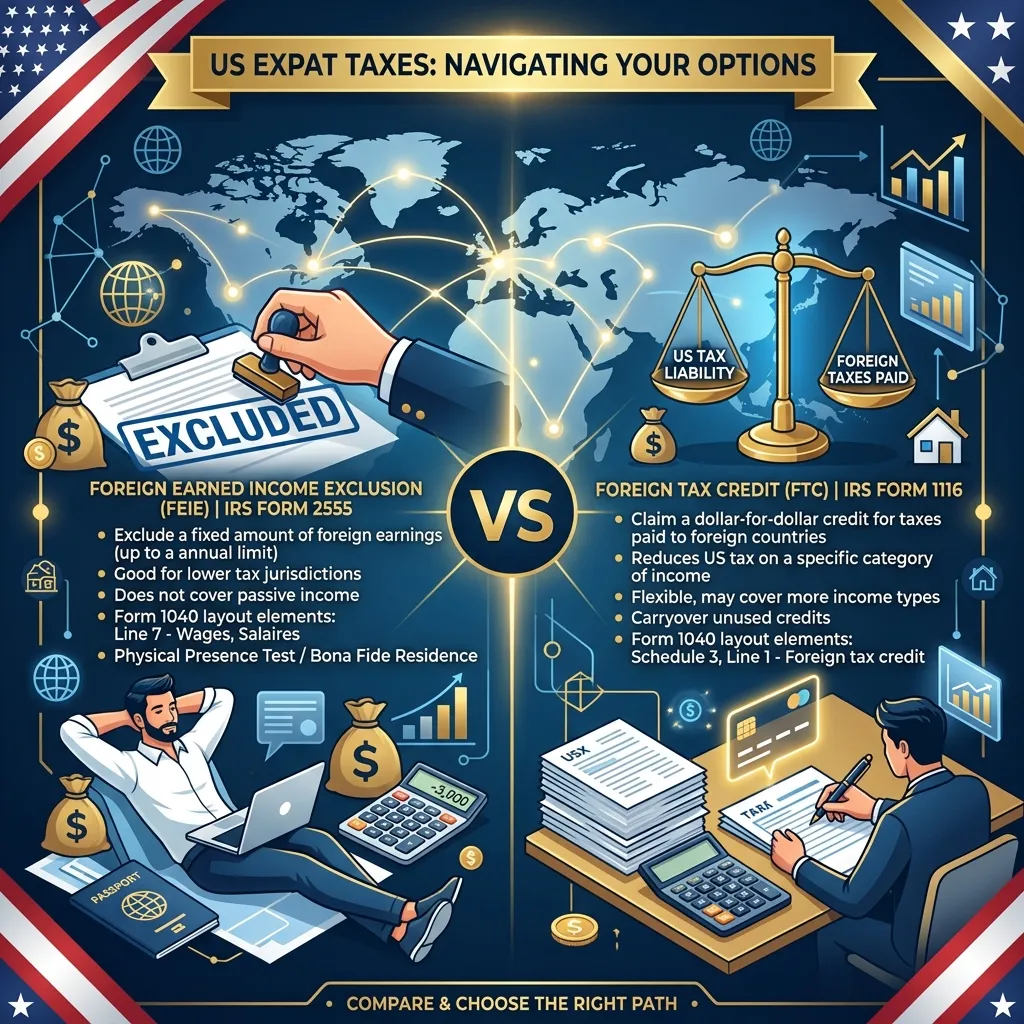
TL;DR: US expat remote workers must choose between two primary mechanisms to prevent double taxation on their global income: the Foreign Earned Income Exclusion (FEIE) via Form 2555 and the Foreign Tax Credit (FTC) via Form 1116. While the FEIE is ideal for expats living in low-tax jurisdictions (like Dubai or Thailand), the FTC is highly superior for those residing in high-tax countries (like Spain or the UK), as it preserves eligibility for the refundable Child Tax Credit, allows retirement contributions to Roth IRAs, and generates carryover credits.
For citizens and permanent residents of the United States, crossing the border does not mean leaving the Internal Revenue Service (IRS) behind. The US is one of only two countries in the world that utilizes citizenship-based taxation, a policy established during the Civil War and codified under Internal Revenue Code (IRC) Section 1.
This means that whether you are a W-2 remote employee or a self-employed freelancer, if you hold a US passport, you must file a federal tax return every year reporting your worldwide income. To prevent you from paying tax twice—once to your host country and once to the US—the tax code offers the Foreign Earned Income Exclusion (FEIE) and the Foreign Tax Credit (FTC).
Choosing the wrong option can cost you thousands of dollars annually in lost credits, restricted retirement savings, and unnecessary tax liabilities. This guide details the legal and financial frameworks of both tools to help you determine the optimal strategy in 2026.
Understanding the Foreign Earned Income Exclusion (FEIE)
The FEIE, governed by IRC Section 911, allows qualifying taxpayers to exclude a specific amount of foreign-source earned income from US federal income tax.
The 2026 FEIE Threshold and Basics
For the 2026 tax year, the maximum exclusion limit is $130,000 per qualifying individual. If you and your spouse are both US citizens living abroad and both earn income, you can potentially exclude up to $260,000 combined.
The exclusion is claimed by filing IRS Form 2555 alongside your Form 1040.
It is important to emphasize that the FEIE only applies to earned income—wages, salaries, professional fees, and self-employment income for services rendered. It does not apply to passive income, such as dividends, interest, rental income, capital gains, or pension distributions.
Passing the Residency Tests
To claim the FEIE, you must establish a “tax home” in a foreign country and pass one of two residency tests outlined in IRS Publication 54:
- The Physical Presence Test: You must be physically present in a foreign country or countries for at least 330 full days (midnight to midnight) during any consecutive 12-month period. This test is popular for digital nomads because it is purely mathematical, allowing no more than 35 days on US soil during that 12-month window.
- The Bona Fide Residence Test: You must be a resident of a foreign country for an uninterrupted period that includes an entire calendar year (January 1 to December 31). This test is subjective and requires proof of integration, such as a long-term lease, a local tax card, local bank accounts, and social ties.
The Stacking Rule and Margins
Under the “stacking rule” of IRC Section 911(d)(6), the IRS calculates tax on your non-excluded income by applying the tax rates that would have applied had you not claimed the exclusion.
For example, if you earn $150,000 in 2026 and exclude $130,000 using the FEIE, the remaining $20,000 is not taxed at the lowest 10% or 12% brackets. Instead, it is taxed at the marginal rates corresponding to the $130,000 to $150,000 income bracket (typically 22% or 24%).
Understanding the Foreign Tax Credit (FTC)
The FTC, governed by IRC Section 901, takes a fundamentally different approach. Instead of hiding your foreign income from the IRS, you report your full global income.
You then claim a dollar-for-dollar tax credit for the income taxes you have already paid (or accrued) to a foreign government.
Form 1116 and the Credit Calculation
The FTC is claimed on IRS Form 1116. The maximum credit you can claim is limited to the portion of your US tax liability that is attributable to your foreign-source income. The general limitation formula is:
$$\text{Maximum Credit} = \text{US Tax Before Credits} \times \left( \frac{\text{Foreign Source Taxable Income}}{\text{Total Taxable Income}} \right)$$
Because you must calculate the credit separately for different categories of income, you may have to file multiple Forms 1116. The two most common categories for remote workers are:
- General Category Income: Wages, salary, and active business profits.
- Passive Category Income: Interest, dividends, royalties, and capital gains.
Carryback and Carryforward Rules
If you live in a country where the local income tax rate is higher than the US federal income tax rate, you will pay more in local taxes than you owe to the US. This creates “excess foreign tax credits.”
Under IRC Section 904(c), you can carry these excess credits back 1 year to offset prior US tax or carry them forward for up to 10 years to offset future US tax on foreign-source income. This is a massive advantage for expats who anticipate their income or tax situations changing.
Key Decision Factors: FEIE vs. FTC (2026)
Choosing between Form 2555 and Form 1116 requires analyzing four critical factors: local tax rates, child tax credits, retirement accounts, and income thresholds.
Factor 1: Local Tax Rates (High-Tax vs. Low-Tax Countries)
The tax rate of the country where you reside is the primary indicator of which tool is best.
- High-Tax Countries (UK, Spain, Germany, France, Japan): The FTC is almost always the superior choice. Because the tax rates in these nations exceed US federal brackets (for example, Spain’s progressive rates reach 47% and the UK’s reach 45%), the foreign taxes you pay will completely wipe out your US tax liability on that income, leaving you with excess credits to carry forward.
- Low-Tax or Zero-Tax Countries (UAE, Georgia, Costa Rica, Bali under a nomad visa): The FEIE is the preferred option. Since you are paying little to no tax locally, you do not have enough foreign taxes paid to generate a meaningful credit on Form 1116. Using the FEIE allows you to exclude the first $130,000 of income entirely.
Factor 2: The Child Tax Credit (CTC) and Refunds
For expats with children, the Child Tax Credit (CTC) under IRC Section 24 is a major differentiator.
- If you claim the FEIE: The IRS rules state that any income excluded on Form 2555 cannot be used to generate the Additional Child Tax Credit (ACTC), which is the refundable portion of the credit. If you exclude all of your income, you receive $0 in tax refunds for your children.
- If you claim the FTC: Your income remains part of your adjusted gross income (AGI)—it is simply offset by tax credits. Because you have taxable earned income, you remain eligible to receive the refundable child credit, which is up to $1,700–$2,000 per qualifying child (depending on 2026 inflation adjustments).
[!TIP] If you have two children and live in a high-tax country, choosing the FTC over the FEIE can result in the IRS mailing you a physical refund check for up to $4,000 every year, even if your net US tax liability is zero.
Factor 3: Retirement Contributions (IRA and Roth IRA)
To make contributions to an Individual Retirement Account (IRA) or a Roth IRA, you must have “taxable compensation” as defined under IRC Section 219.
- If you claim the FEIE: If your total earned income is under the $130,000 limit and you exclude all of it, your taxable compensation is $0. Consequently, you are legally barred from contributing to a traditional or Roth IRA.
- If you claim the FTC: Because your income is not excluded, it counts as taxable compensation. You can fully contribute to a Roth IRA or traditional IRA up to the 2026 limit (typically $7,000 to $8,000 depending on age and final IRS adjustments), provided your income does not exceed the standard Roth IRA phase-out ranges.
Factor 4: Income Level and the Foreign Housing Exclusion
If you earn more than $130,000, you cannot exclude the excess using the FEIE alone. However, you can couple the FEIE with the Foreign Housing Exclusion (Form 2555, Part VI).
This allows you to exclude housing expenses (such as rent, utilities, and household insurance) that exceed a base amount ($18,200 for 2026) up to a maximum limit (generally $39,000 but adjusted upward for high-cost cities like London, Tokyo, or Geneva).
If your income still exceeds the combined FEIE and Housing Exclusion, you can apply the Foreign Tax Credit to the remaining unexcluded income. This is called “stacking” the FTC on top of the FEIE, but you cannot apply the FTC to the portion of income that was already excluded (no double-dipping).
Comparison Table: FEIE (Form 2555) vs. FTC (Form 1116)
| Feature | FEIE (Form 2555) | FTC (Form 1116) |
|---|---|---|
| Primary Mechanism | Excludes income from US tax return | Offsets US tax with foreign tax paid |
| 2026 Limit | Flat $130,000 (plus housing exclusion) | Unlimited (limited only by foreign tax paid) |
| Eligible Income Types | Earned income only (W-2, Schedule C) | All income taxed abroad (Earned & Passive) |
| Physical Location Rule | Strict (Must pass PPT or BFR tests) | None (Only requires taxes paid to foreign gov) |
| Child Tax Credit Impact | Disables refundable portion (ACTC) | Preserves refundable portion (ACTC) |
| Roth/IRA Contribution | Disallowed (if all income is excluded) | Allowed (income remains taxable compensation) |
| Carryover Benefits | None (Use it or lose it each year) | Carry back 1 year, carry forward 10 years |
| Revocation Consequence | Cannot re-elect for 5 years without consent | Can switch back easily (subject to FEIE rules) |
Practical Scenarios (Case Studies)
To see how these rules translate to real-world math, let’s examine three typical remote worker profiles.
Scenario 1: Freelance Copywriter in Spain
- Profile: Single, no children, earns $90,000 as an autonomous freelancer.
- Local Tax: Pays approximately $25,000 in Spanish income and self-employment taxes.
- The Choice: Foreign Tax Credit (FTC).
- Why: Spain’s tax rate is higher than the US federal tax rate for a $90,000 income (which would be around $11,000 in US tax). If the writer claims the FTC, the $25,000 paid to Spain fully covers the $11,000 US tax. The writer owes $0 to the IRS and carries forward $14,000 in excess tax credits. They can also contribute to a Roth IRA.
Scenario 2: Software Engineer in Thailand
- Profile: Single, no children, earns $110,000 working remotely on a Thailand Destination Visa.
- Local Tax: Pays $0 local tax due to visa-specific tax exemptions.
- The Choice: Foreign Earned Income Exclusion (FEIE).
- Why: Because the engineer pays $0 to Thailand, the FTC is useless (there are no foreign taxes to credit). By using the FEIE and passing the Physical Presence Test, they exclude the entire $110,000 from US federal tax, paying $0 to both governments.
Scenario 3: Expat Family in the UK
- Profile: Married couple filing jointly, two children (ages 6 and 8), earns $160,000 W-2 remote salary.
- Local Tax: Pays $42,000 in UK income tax.
- The Choice: Foreign Tax Credit (FTC).
- Why: If they choose the FEIE, they exclude $130,000 of their income but lose their $4,000 refundable Child Tax Credit. By choosing the FTC instead, the UK tax paid completely wipes out their US liability, and because their income is reported rather than excluded, the IRS sends them a refund check for $4,000.
The 5-Year Revocation Trap
A critical trap for expats is the 5-year revocation rule under IRC Section 911(e)(2).
Once you choose to claim the FEIE, it remains in effect for all subsequent tax years until you formally revoke it. If you choose to switch from the FEIE to the FTC to take advantage of the Child Tax Credit or because you moved to a high-tax country, that switch acts as a revocation of the FEIE.
Once revoked, you are legally barred from claiming the FEIE again for the next five tax years unless you obtain formal consent from the IRS Commissioner via a private letter ruling, which is expensive and rarely granted.
[!WARNING] Before switching from the FEIE to the FTC, model your income for the next 3–5 years. If you switch to the FTC while living in the UK, but then move to Dubai two years later, you will not be able to claim the FEIE in Dubai. You will be stuck paying full US taxes on your Dubai income because you have no local taxes to credit under the FTC.
Frequently Asked Questions
Can I use my foreign self-employment taxes as a credit on Form 1116?
No. Foreign taxes that are equivalent to US self-employment taxes (such as foreign social security contributions) generally cannot be claimed as a credit on Form 1116 to offset US self-employment tax. They can only offset federal income tax, unless a specific Social Security Totalization Agreement exists between the US and your host country that exempts you from US self-employment tax entirely.
What happens if I file my taxes late? Can I still claim the FEIE?
Yes, but with restrictions. Under Treasury Regulation Section 1.911-7, you can claim the FEIE on a late-filed return if you file before the IRS discovers your failure to file and sends you a notice. If the IRS contacts you first, you may lose your right to claim the exclusion for that tax year.
How does the IRS verify the 330-day Physical Presence Test?
The IRS coordinates with the Department of Homeland Security (DHS) and tracks your entries and departures using your passport data and Form I-94 records. When you file Form 2555, you must list every travel date, flight connection, and day spent in the US. If you are audited, you will be required to provide flight tickets, boarding passes, and passport stamps.
Can I claim the FTC on passive investment income like stock dividends?
Yes. The FTC is highly flexible and applies to both earned and passive income. However, you must file a separate Form 1116 for Passive Category Income. The tax credit will be limited to the tax rate applied by the foreign country on those investments, and you cannot use excess credits from your job (General Category) to offset taxes on your investments (Passive Category).
If I use the FEIE, do I still need to file state taxes?
The FEIE only applies to federal income taxes. Whether you owe state taxes depends on the state you lived in before moving abroad. “Sticky states” like California, New York, Virginia, and Maryland do not recognize the FEIE and will continue to tax your worldwide income unless you can prove you have permanently severed all ties and established domicile elsewhere.
Final Thoughts
The decision between the FEIE and the FTC is not a one-size-fits-all calculation. It requires looking at your current host country’s tax rate, your family structure, your long-term retirement goals, and your travel habits.
If you are a nomad hopping between low-tax countries, the FEIE is your best shield against US taxes. If you are settling down in a high-tax jurisdiction, the FTC is a far more robust tool that preserves your retirement options and child credits.
Use our Tax Calculator to simulate your tax liabilities under both scenarios. If you are managing self-employment income, or moving between tax regimes, consulting a qualified expat CPA will ensure you remain fully compliant while minimizing what you owe.