Japan Digital Nomad Visa: Requirements, Tax Rules & How to Apply (2026)

Japan has long been a dream destination for remote workers — world-class infrastructure, bullet trains, impeccable internet, and a culture that blends ancient tradition with cutting-edge technology. But until recently, there was no legal pathway for digital nomads to live and work remotely from Japan for more than 90 days. That changed in April 2024 when Japan officially launched its Digital Nomad Visa (officially the “Designated Activities — Digital Nomad” status of residence), giving remote workers from eligible countries the ability to stay for up to six months while working for overseas employers or clients. In 2026, Japan remains one of the most attractive digital nomad destinations in Asia, and this guide covers everything you need to know — from eligibility and income thresholds to tax obligations and cost of living.
TL;DR: Japan’s Digital Nomad Visa allows remote workers earning ¥10 million or more annually (~$68,000 USD) to live in Japan for up to six months. Foreign-sourced income is exempt from Japanese income tax during that period, but residency-based taxation kicks in if you stay beyond one year. You must hold a passport from one of Japan’s 49 eligible tax-treaty countries and carry private health insurance for the duration of your stay.
What Is the Japan Digital Nomad Visa?
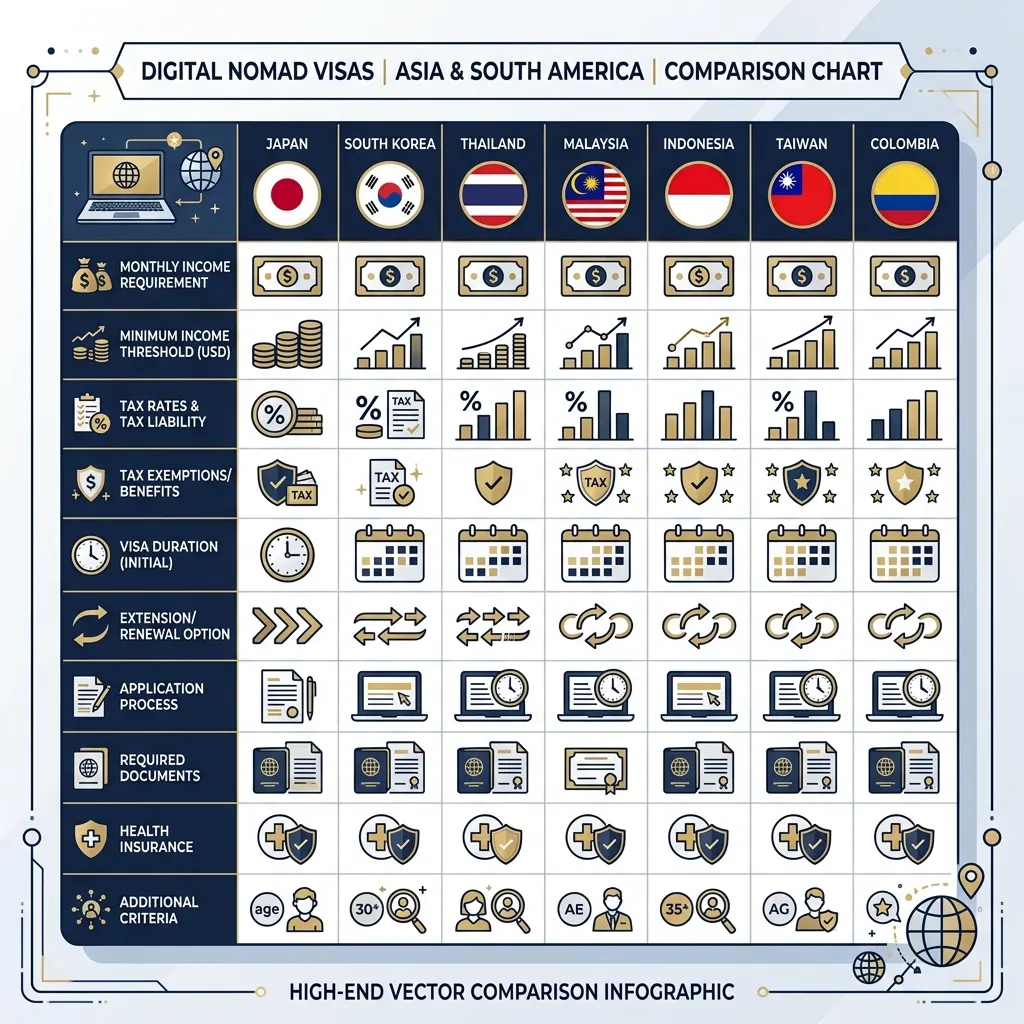
A digital nomad visa is a residence permit that allows foreign nationals to live in a country while working remotely for employers or clients based outside that country. Japan’s version — formally classified under the “Designated Activities” (特定活動) status of residence — was introduced on April 1, 2024 by the Immigration Services Agency of Japan (ISA).
According to the Immigration Services Agency of Japan, the visa was created to “attract highly skilled foreign nationals who engage in work remotely using information and communication technology while staying in Japan,” recognizing the global shift toward location-independent work accelerated by the COVID-19 pandemic.
Unlike traditional work visas, the Japan Digital Nomad Visa does not permit you to work for a Japanese company, take on Japanese clients, or engage in any business activities within Japan’s domestic economy. Your income must be sourced entirely from outside Japan.
Eligibility Requirements
To qualify for Japan’s Digital Nomad Visa in 2026, you must meet all of the following criteria:
1. Nationality Requirement
You must hold a passport from one of the 49 countries and regions that have an income tax treaty or agreement with Japan. According to the Ministry of Justice, eligible countries include:
- North America: United States, Canada, Mexico
- Europe: United Kingdom, Germany, France, Netherlands, Spain, Italy, Sweden, Switzerland, Portugal, and most EU member states
- Asia-Pacific: Australia, New Zealand, South Korea, Singapore, India, Thailand, Indonesia, Malaysia
- Others: Brazil, South Africa, Israel, UAE
If your country does not have a tax treaty with Japan, you are currently ineligible — though the list has expanded since the visa’s initial launch and may continue to grow.
2. Income Requirement
You must demonstrate an annual income of ¥10 million or more (approximately $68,000 USD at current exchange rates). This is one of the higher income thresholds among global digital nomad visa programs.
Acceptable proof includes:
- Tax returns from your home country (most recent tax year)
- Employment contracts showing annual salary
- Bank statements demonstrating consistent income
- Freelancer invoices and financial statements
3. Remote Work for Overseas Entities
Your work must be performed remotely for an employer, client, or business that is based outside Japan. You cannot:
- Work for a Japanese company
- Solicit or serve Japanese clients
- Operate a business that generates revenue from Japanese sources
4. Health Insurance
You must carry private health insurance that covers medical expenses in Japan for your entire period of stay. Japan’s National Health Insurance (NHI) system is not available to digital nomad visa holders. Per the Immigration Services Agency of Japan, the insurance policy must cover illness, injury, and emergency medical evacuation.
5. No Dependents on the Same Visa
As of 2026, the Japan Digital Nomad Visa does not allow accompanying family members on a dependent visa linked to your DN status. Spouses and children would need their own visa status — though a spouse who also qualifies independently could apply for their own Digital Nomad Visa.
How to Apply: Step-by-Step
The application process for Japan’s Digital Nomad Visa involves several steps. Here is the complete process:
Step 1: Confirm Eligibility
Verify that your nationality, income level, and work arrangement meet all the requirements listed above. Use the NomadTaxGuide calculator to estimate your tax obligations.
Step 2: Gather Required Documents
Prepare the following documents:
| Document | Details |
|---|---|
| Valid passport | From an eligible tax-treaty country, valid for 6+ months |
| Visa application form | Standard Japanese visa application (available at consulate) |
| Passport-size photo | 4.5 cm × 3.5 cm, taken within last 6 months |
| Proof of income | Tax returns, contracts, or bank statements showing ¥10M+ annual income |
| Proof of remote work | Employment contract or client agreements confirming foreign-based work |
| Health insurance certificate | Coverage valid in Japan for the full duration of stay |
| Itinerary or accommodation plan | Evidence of where you intend to stay in Japan |
| Resume / CV | Outlining your professional background |
Step 3: Submit Application at a Japanese Embassy or Consulate
Unlike some countries that offer online visa applications, Japan requires you to apply in person at a Japanese Embassy or Consulate in your country of residence or nationality. Processing times typically range from 5 to 10 business days, though this varies by location.
Step 4: Receive Your Visa and Enter Japan
Once approved, you will receive a visa sticker in your passport. Upon arrival in Japan, you will go through immigration and receive your residence card (在留カード / zairyū kādo) with the “Designated Activities” status.
Step 5: Register Your Address
Within 14 days of moving into your accommodation, you must register your address at the local ward office (区役所) or city hall (市役所). This is a legal requirement for all foreign residents in Japan.
Tax Rules for Digital Nomads in Japan
Understanding Japan’s tax system is critical for digital nomads. The rules hinge on your tax residency status, which is determined by the length of your stay.
The 1-Year Rule
According to the Japanese National Tax Agency (NTA), individuals are classified into three categories for tax purposes:
| Tax Status | Duration in Japan | What’s Taxed |
|---|---|---|
| Non-Resident | Less than 1 year | Only Japan-sourced income |
| Non-Permanent Resident | 1–5 years with no intention to reside permanently | Japan-sourced income + foreign income remitted to Japan |
| Permanent Resident | 5+ years or intent to reside permanently | Worldwide income |
As a Digital Nomad Visa holder staying for six months or less, you are classified as a non-resident for Japanese tax purposes. This means:
- Foreign-sourced income is not taxed in Japan. Since your employer and clients are outside Japan, your income is considered foreign-sourced.
- You do not need to file a Japanese tax return for foreign-sourced employment or freelance income.
- Consumption tax (消費税) at 10% still applies to goods and services you purchase in Japan, but this is standard sales tax, not income tax.
What Happens if You Stay Longer Than Six Months?
If you leave and re-enter Japan or extend your stay through other visa arrangements, be aware that spending more than one cumulative year in Japan can trigger non-permanent resident status. At that point, any foreign income remitted to Japan — such as transferring your salary to a Japanese bank account — becomes taxable.
Per the Japanese National Tax Agency, the standard income tax rates for residents are progressive:
| Taxable Income (¥) | Tax Rate |
|---|---|
| Up to ¥1,950,000 | 5% |
| ¥1,950,001 – ¥3,300,000 | 10% |
| ¥3,300,001 – ¥6,950,000 | 20% |
| ¥6,950,001 – ¥9,000,000 | 23% |
| ¥9,000,001 – ¥18,000,000 | 33% |
| ¥18,000,001 – ¥40,000,000 | 40% |
| Over ¥40,000,000 | 45% |
Additionally, a 10% local inhabitant tax (住民税) applies to residents, making the effective top marginal rate approximately 55%.
Interaction with Your Home Country’s Taxes
Holding a Japan Digital Nomad Visa does not automatically change your tax residency in your home country. If you are a U.S. citizen or green card holder, you remain subject to U.S. taxation on worldwide income regardless of where you live. You may be able to use the Foreign Earned Income Exclusion (FEIE) or foreign tax credits to offset double taxation.
For citizens of other countries, your home-country obligations depend on whether you’ve formally severed tax residency. Understanding double taxation treaties is essential — Japan’s network of 49 tax treaties is specifically what makes this visa program possible.
Consider obtaining a tax residency certificate from your home country before departing, as this can simplify any treaty-based claims.
Cost of Living: Tokyo vs. Osaka vs. Fukuoka
Japan offers a surprisingly wide range of cost-of-living options. While Tokyo is famously expensive, secondary cities like Osaka and Fukuoka offer excellent quality of life at significantly lower prices. Here’s a detailed breakdown for a single digital nomad in 2026:
| Expense Category | Tokyo | Osaka | Fukuoka |
|---|---|---|---|
| Studio apartment (city center) | ¥130,000–¥180,000/mo ($885–$1,225) | ¥80,000–¥120,000/mo ($545–$815) | ¥55,000–¥85,000/mo ($375–$580) |
| Coworking space | ¥30,000–¥50,000/mo ($205–$340) | ¥20,000–¥35,000/mo ($135–$240) | ¥15,000–¥25,000/mo ($100–$170) |
| Groceries | ¥40,000–¥60,000/mo ($270–$410) | ¥35,000–¥50,000/mo ($240–$340) | ¥30,000–¥45,000/mo ($205–$305) |
| Dining out (per meal) | ¥800–¥1,500 ($5.45–$10.20) | ¥700–¥1,200 ($4.75–$8.15) | ¥600–¥1,000 ($4.10–$6.80) |
| Transportation (monthly pass) | ¥10,000–¥15,000 ($68–$102) | ¥8,000–¥12,000 ($54–$82) | ¥6,000–¥10,000 ($41–$68) |
| Total monthly estimate | ¥250,000–¥350,000 ($1,700–$2,380) | ¥180,000–¥260,000 ($1,225–$1,770) | ¥140,000–¥200,000 ($950–$1,360) |
Fukuoka has become especially popular among digital nomads due to its affordable cost of living, proximity to the airport, thriving startup ecosystem, and the local government’s active promotion of the city as a “Startup City.” Nomad List consistently ranks it among the top cities in Asia for remote workers.
Internet and Coworking Infrastructure
Japan boasts some of the fastest and most reliable internet infrastructure in the world. According to Speedtest Global Index data, Japan’s average fixed broadband speed exceeds 200 Mbps download, placing it among the top 10 countries globally.
Internet Speeds by City
| City | Avg. Download Speed | Avg. Upload Speed | Reliability |
|---|---|---|---|
| Tokyo | 250+ Mbps | 180+ Mbps | 99.9% uptime |
| Osaka | 230+ Mbps | 160+ Mbps | 99.9% uptime |
| Fukuoka | 210+ Mbps | 150+ Mbps | 99.8% uptime |
Coworking Spaces
Japan has a mature coworking ecosystem, particularly in major cities:
- Tokyo: WeWork (multiple locations), Fabbit, The Hub, CASE Shinjuku, Andwork — hundreds of options across 23 wards
- Osaka: The Deck, Osaka Innovation Hub, GVH Osaka, WeWork Namba
- Fukuoka: Fukuoka Growth Next (government-backed startup hub), The Company, Salt, Engineers Cafe
Most coworking spaces offer day passes (¥1,500–¥3,000), weekly rates, and monthly memberships. Many cafes also offer strong Wi-Fi and are culturally acceptable places to work during off-peak hours.
How Japan Compares to Other Asian Digital Nomad Visas
Japan is not the only Asian country courting remote workers. Here’s how the Japan Digital Nomad Visa stacks up against the major alternatives in the region:
| Feature | 🇯🇵 Japan DN Visa | 🇹🇭 Thailand DTV | 🇮🇩 Indonesia DN Visa | 🇲🇾 Malaysia DE Rantau | 🇰🇷 South Korea Workcation |
|---|---|---|---|---|---|
| Launch Date | April 2024 | June 2024 | Late 2024 | October 2022 | January 2024 |
| Duration | 6 months | 5 years (180-day stays) | 1 year (renewable) | 12 months (renewable) | Up to 2 years |
| Income Requirement | ¥10M (~$68,000) | THB 500K (~$14,000) | $60,000/year | $24,000/year | $85,000 (or $65K w/ degree) |
| Tax on Foreign Income | Exempt (under 1 year) | Exempt (if not remitted) | Exempt | Exempt | Exempt |
| Health Insurance Required | Yes | Yes | Yes | Yes | Yes |
| Dependents Allowed | No | Yes | Yes (separate visa) | Yes | Yes |
| Cost of Living (monthly) | $1,200–$2,400 | $800–$1,600 | $700–$1,400 | $800–$1,500 | $1,200–$2,200 |
| Internet Speed (avg.) | 200+ Mbps | 100+ Mbps | 30–80 Mbps | 100+ Mbps | 200+ Mbps |
| Safety Ranking | Top 10 globally | Moderate | Moderate | Good | Top 15 globally |
Japan’s income requirement is among the highest, but the trade-off is exceptional infrastructure, safety, and quality of life. For a deeper comparison of all top destinations, see our best digital nomad countries for 2026 guide.
If you’re considering the South Korean option, check out our dedicated guide to the South Korea Workcation Visa.
Practical Tips for Living in Japan as a Digital Nomad
Banking and Money
Opening a Japanese bank account as a short-term resident is difficult. Most digital nomads rely on:
- Wise (TransferWise): Multi-currency account with competitive exchange rates
- Revolut: Fee-free spending in Japan with good JPY rates
- 7-Eleven ATMs: Accept most international debit cards with reasonable fees
- Cash: Japan is still more cash-dependent than most developed countries, especially outside major cities
SIM Cards and Connectivity
- Prepaid SIM cards are available at airports (Narita, Haneda, Kansai) from providers like IIJmio, Mobal, and Sakura Mobile
- Pocket Wi-Fi rentals are popular for short-term visitors — pick up and return at the airport
- eSIMs from providers like Ubigi, Airalo, or Holafly work on most modern phones
Healthcare
Remember that as a Digital Nomad Visa holder, you are not enrolled in Japan’s National Health Insurance system. Your private health insurance is your primary coverage. See our digital nomad insurance guide for recommended international health insurance providers.
Japan’s healthcare quality is excellent, with many hospitals in major cities having English-speaking staff. A typical doctor’s visit without insurance costs ¥5,000–¥10,000 ($34–$68).
Language Considerations
While Japan’s major cities are increasingly English-friendly, Japanese language ability significantly improves your experience. Key resources:
- Google Translate’s camera feature for reading menus and signs
- Apps like Tabelog (restaurant reviews) and Navitime (transit directions)
- Basic phrases: すみません (sumimasen — excuse me), ありがとうございます (arigatou gozaimasu — thank you)
Common Mistakes to Avoid
Digital nomads in Japan frequently make these errors — many of which can have serious financial or legal consequences:
-
Overstaying the 6-month limit — Unlike Schengen zone tracking (see our Schengen 90-day calculator guide), Japan’s system is straightforward, but overstaying can result in deportation and a 5-year entry ban.
-
Working for Japanese clients — Even one Japanese client technically violates your visa conditions. Keep all contracts with foreign entities.
-
Ignoring home-country tax obligations — Your Japan DN visa does not exempt you from taxes in your home country. Review common nomad tax mistakes before you go.
-
Assuming you can extend indefinitely — The 6-month visa is not designed for back-to-back renewals. Immigration may deny re-entry if you appear to be using the DN visa as a long-term residence workaround.
-
Not carrying health insurance documentation — Immigration can request proof of insurance at any time. Keep digital and physical copies accessible.
Frequently Asked Questions
Can I apply for the Japan Digital Nomad Visa online?
No. As of 2026, Japan requires in-person visa applications at a Japanese Embassy or Consulate in your country of residence or nationality. There is no online application portal for this visa category. Processing typically takes 5–10 business days, according to the Ministry of Foreign Affairs of Japan.
Can I bring my family on the Japan Digital Nomad Visa?
Currently, the Japan Digital Nomad Visa does not include provisions for dependent family members. Your spouse or children would need to qualify for their own visa category — either an independent Digital Nomad Visa (if they meet the income requirement) or another status of residence such as a tourist visa (limited to 90 days with no work permitted).
What happens if my income drops below ¥10 million during my stay?
The income requirement is assessed at the time of application, not during your stay. However, if you apply for a new Digital Nomad Visa in the future, you will need to demonstrate that you still meet the ¥10 million threshold based on your most recent financial documentation.
Do I need to pay Japanese pension or social insurance contributions?
No. According to the Japanese National Tax Agency, Digital Nomad Visa holders classified as non-residents are not enrolled in Japan’s social insurance system (shakai hoken) and are not required to make pension (nenkin) or health insurance contributions through the national system.
Can I work from anywhere in Japan, or only in specific cities?
The Digital Nomad Visa does not restrict you to any particular city or region. You are free to live and work remotely from anywhere in Japan — Tokyo, Osaka, Fukuoka, Okinawa, rural areas, or even while traveling between cities.
Is the Japan Digital Nomad Visa renewable?
The visa is valid for six months, and you cannot extend it while in Japan. However, you can leave Japan and apply for a new Digital Nomad Visa at a Japanese consulate abroad. Be aware that immigration authorities may scrutinize repeat applications, particularly if they suggest you are attempting to use the DN visa as a de facto long-term residence visa.
How is the ¥10 million income requirement calculated?
Per the Immigration Services Agency of Japan, the ¥10 million threshold is based on your gross annual income from the most recent tax year or a 12-month period. This can include salary, freelance income, business profits, and investment income — as long as the sources are outside Japan. Income is typically verified through tax returns, employment contracts, or certified financial statements.
Final Thoughts
Japan’s Digital Nomad Visa represents a significant shift in the country’s traditionally conservative immigration policy. While the ¥10 million income requirement makes it one of the more exclusive programs globally, the trade-off is access to one of the world’s safest, best-connected, and most culturally rich countries for remote work.
The key advantage from a tax perspective is clear: stay under one year, keep your income foreign-sourced, and you owe zero Japanese income tax. Combine that with Japan’s reliable 200+ Mbps internet, world-class public transportation, and an increasingly nomad-friendly infrastructure, and it’s easy to see why Japan consistently ranks among the best digital nomad countries in 2026.
Just make sure you understand the interaction between Japan’s tax rules and your home-country obligations. Use the NomadTaxGuide calculator to model your specific situation, and consult a cross-border tax professional if your circumstances are complex — especially if you’re a U.S. citizen leveraging the FEIE or claiming treaty benefits under a double taxation agreement.