The Roth IRA Trap for US Digital Nomads: How the FEIE Can Ruin Your Retirement Contributions
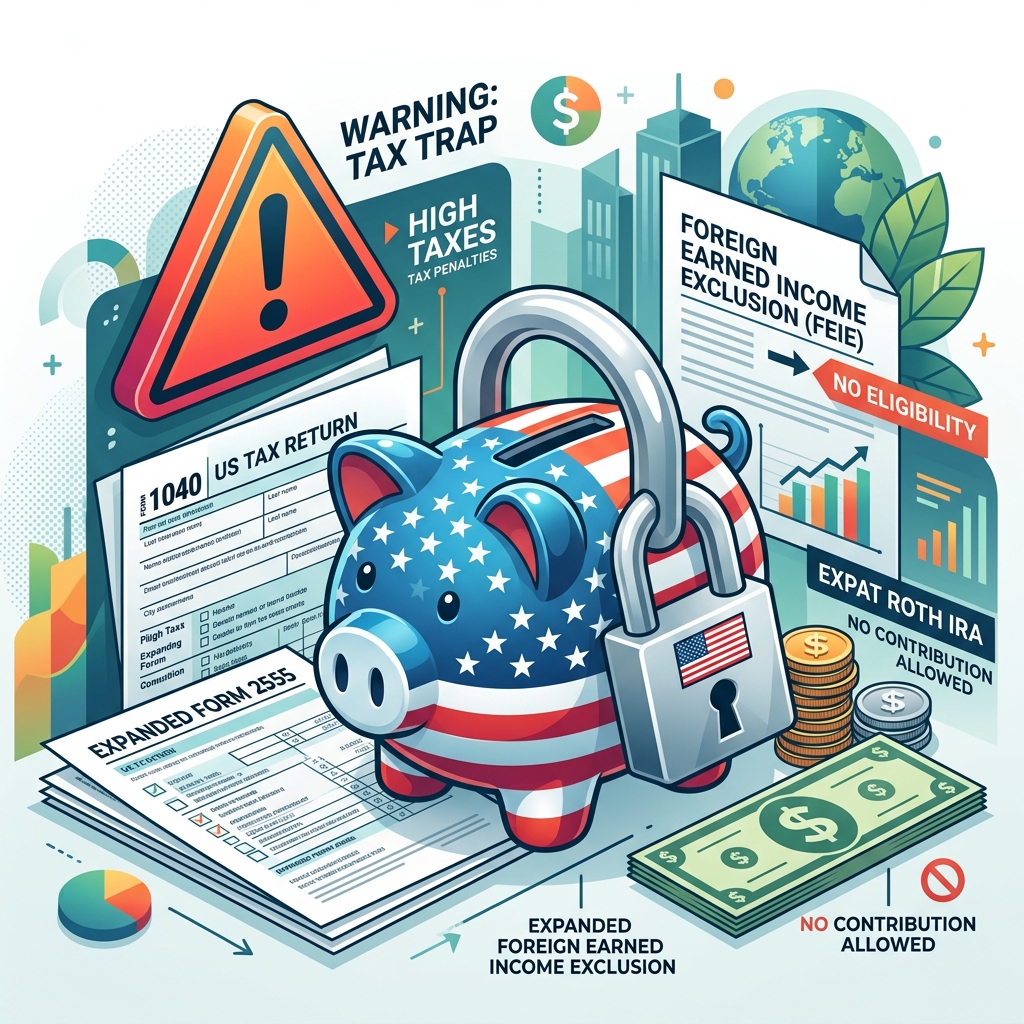
For U.S. expats and digital nomads, tax planning is a double-edged sword. On one hand, the Foreign Earned Income Exclusion (FEIE) allows you to exclude a significant portion of your foreign-earned salary from U.S. federal income tax. On the other hand, many expats unknowingly fall into the Roth IRA Expat Tax Trap by continuing to fund their retirement accounts while claiming this exclusion. According to IRS guidelines, you cannot contribute to an Individual Retirement Account (IRA) unless you have qualifying “earned income” that is not excluded from U.S. taxation.
TL;DR: To contribute to a Roth IRA, you must have taxable earned income. If you use the FEIE (Form 2555) to exclude 100% of your earnings, your U.S. taxable earned income becomes $0. Consequently, your Roth IRA contribution limit is also $0. If you contribute anyway, the IRS imposes a strict 6% annual excise tax penalty on the excess contribution for every year the money remains in the account. To avoid this trap, expats can either utilize the Foreign Tax Credit (FTC) instead of the FEIE, leave a portion of their income unexcluded, or reverse incorrect contributions before the tax filing deadline.
This guide details how the trap works, the calculation of penalties, and the three legal workarounds you can use to fund your Roth IRA as an expat.
How the Trap Works: A Mathematical Example
Under IRS rules, your maximum contribution to a traditional or Roth IRA is the lesser of:
- The annual contribution limit (which is $7,000 for individuals under 50 in 2026, or $8,000 if 50 or older).
- Your taxable earned income for the year.
If you are a remote freelancer or employee earning a salary abroad, your income is classified as foreign earned income.
Let’s look at a common expat scenario:
| Step | Scenario A: 100% FEIE | Scenario B: FTC or Partial Exclusion |
|---|---|---|
| 1. Gross Earned Income | $100,000 | $100,000 |
| 2. FEIE Claimed (Form 2555) | -$100,000 | -$93,000 (Partial) |
| 3. Taxable Earned Income | $0 | $7,000 |
| 4. Roth IRA Contribution Limit | $0 | $7,000 |
| 5. Potential IRS Penalty | 6% on any contribution | $0 (Fully legal) |
In Scenario A, because your taxable earned income is reduced to $0 by the FEIE, you are legally prohibited from contributing to any IRA.

The Consequences: The 6% Excess Contribution Penalty
If you make an excess contribution to a Roth IRA, the IRS levies a 6% excise tax on the excess amount under Internal Revenue Code Section 4973.
This penalty:
- Is applied annually for every year the excess amount remains in your account.
- Accumulates compound penalties if you make contributions over multiple tax years without realizing the mistake.
- Requires you to file IRS Form 5329 to report and pay the excise tax.
Example Penalty Calculation:
If you contributed $6,500 in 2024, $7,000 in 2025, and $7,000 in 2026 while excluding 100% of your income:
- Total Excess Contribution: $20,500.
- Annual Penalty Rate: 6%.
- 2026 Excise Tax Liability: $1,230 for 2026 alone, plus cumulative penalties from prior years.

3 Workarounds to Fund Your Roth IRA Legally
Expats have three main strategies to build retirement wealth without triggering IRS audits or penalties.
Strategy 1: Use the Foreign Tax Credit (FTC) Instead of the FEIE
If you reside in a foreign country with income tax rates that are higher than or equal to U.S. federal rates (e.g., Spain, Germany, UK, Australia, Portugal under standard tiers), you should claim the Foreign Tax Credit (Form 1116) instead of the FEIE.
- How it works: Instead of excluding your income, you report it to the U.S. and claim tax credits for the foreign taxes you paid. Because foreign tax rates are typically higher, your U.S. tax liability is wiped out to $0.
- The benefit: Your gross income remains on your tax return as “taxable earned income” (not excluded). This means your Roth IRA contribution limit remains the full $7,000, and you pay 0% U.S. tax.
Strategy 2: Leave a Portion of Income Unexcluded (Partial FEIE)
If your income exceeds the FEIE maximum limit (which is $126,500 in 2026), you are in a highly advantageous position.
- Example: You earn $135,000. You exclude the maximum allowed $126,500.
- The benefit: The remaining $8,500 is unexcluded earned income. Since this exceeds the $7,000 IRA limit, you can legally fund your Roth IRA to the maximum, even though you used the FEIE to cover the bulk of your income.
Strategy 3: The Backdoor Roth IRA (For High Earners)
If your Modified Adjusted Gross Income (MAGI) is too high to contribute to a Roth IRA directly (e.g., above $161,000 for singles in 2026), you can use the Backdoor Roth IRA method.
- How it works: You make a non-deductible contribution to a Traditional IRA, then immediately convert it to a Roth IRA.
- Note: This only bypasses the upper income limits for Roth IRAs. It does not bypass the requirement to have earned income. You must still have at least $7,000 in unexcluded earned income (using the FTC or the Partial FEIE strategy) to fund the Traditional IRA in the first place.
Expat Action Plan: What to Do If You Already Contributed
If you realize you have made illegal contributions while using the FEIE, take these steps immediately:
- Correct Before the Filing Deadline: If you correct the mistake before the tax filing deadline (plus extensions, typically October 15th), you can contact your brokerage to execute a “Removal of Excess Contributions.” You must withdraw the excess contribution plus any earnings (net income attributable). The earnings will be subject to standard income tax, but you avoid the 6% penalty.
- Recharacterize the Contribution: If you had some unexcluded income or want to change your filing status, you can recharacterize the contribution to a traditional IRA, although the same earned-income rules apply.
- File Form 5329: If the deadline has passed, you must file Form 5329 for each year the excess remains, pay the 6% penalty, and plan a withdrawal to stop the penalty from compounding.
Authoritative Reference Sources
- IRS Publication 590-A (Contributions to IRAs): IRS Publication 590-A
- IRS Form 2555 (Foreign Earned Income): IRS Form 2555 Instructions
- IRS Form 5329 (Additional Taxes on Qualified Plans): IRS Form 5329 Guidelines
- Internal Revenue Code Section 911 (FEIE rules): IRC Section 911
- Internal Revenue Code Section 4973 (Tax on Excess Contributions): IRC Section 4973