South Korea Workcation Visa: The Complete Digital Nomad Guide (2026)
South Korea has rapidly emerged as one of Asia’s most compelling destinations for digital nomads. With blazing-fast internet (consistently ranked #1 or #2 globally for broadband speed), a thriving café culture built for remote work, excellent public healthcare, and a dynamic blend of ultra-modern cities and stunning natural landscapes, it checks nearly every box for location-independent professionals. In January 2024, South Korea officially launched the Workcation Visa (F-1-D) — a dedicated residence permit that allows foreign remote workers to live in the country for up to two years while working for overseas employers or clients. By 2026, the program has matured into one of the most generous digital nomad visa offerings in Asia, and this guide walks you through everything you need to know to take advantage of it.
TL;DR: South Korea’s Workcation Visa (F-1-D) lets digital nomads live and work remotely in South Korea for up to 2 years. You need at least $85,000 in annual income ($65,000 if you hold a bachelor’s degree or higher), and foreign-sourced income is exempt from Korean income tax. The visa allows dependents, offers access to Korea’s world-class infrastructure, and is renewable — making it one of the longest and most flexible digital nomad visas available.
What Is the South Korea Workcation Visa?
A workcation visa — South Korea’s term for its digital nomad visa — is a residence permit under the F-1-D visa category that allows foreign nationals to reside in South Korea while performing remote work exclusively for employers or clients based outside the country. The term “workcation” reflects the Korean government’s intent to position the country as a place where professionals can combine productive remote work with the experience of living in Korea.
According to the Korea Immigration Service (KIS), the Workcation Visa was introduced as part of a broader government initiative to attract high-skilled foreign talent, boost local economies through long-term visitor spending, and enhance Korea’s global reputation as a tech-forward, livable country.
The visa is classified under the F-1 (Visiting/Joining Family) status of residence, specifically sub-category D, which was newly created for this purpose. Despite the F-1 classification, it is a standalone visa category — you do not need family ties in Korea to apply.
Eligibility Requirements
The Workcation Visa has specific eligibility criteria. Here’s what you need to qualify:
1. Nationality
The Workcation Visa is open to citizens of countries that have diplomatic relations with South Korea and are not subject to visa restrictions. As of 2026, this includes citizens of most countries in North America, Europe, Oceania, and large parts of Asia and Latin America. According to the Korea Immigration Service, citizens from countries under sanctions or with restricted diplomatic relations are not eligible.
2. Income Requirement
This is the most significant hurdle. According to the Ministry of Justice of South Korea, you must demonstrate:
- $85,000 USD or more in annual income from foreign sources, OR
- $65,000 USD or more if you hold a bachelor’s degree or higher from a recognized institution
This two-tier structure is designed to attract both high earners and educated professionals. The income threshold is measured based on your most recent tax year or trailing 12-month period.
Acceptable documentation includes:
- National tax returns (e.g., IRS Form 1040 for U.S. citizens)
- Employer-issued income verification letters
- Freelance contracts with corresponding bank statements
- Corporate financial statements (for business owners)
3. Remote Work for Foreign Entities
You must be employed by, contracting for, or operating a business that is based entirely outside South Korea. You cannot:
- Take on Korean clients or customers
- Work for a Korean-registered company
- Generate any revenue from Korean-sourced business activities
4. Health Insurance
You must hold health insurance valid in South Korea for the duration of your stay. While the Workcation Visa does make you eligible to enroll in Korea’s National Health Insurance Service (NHIS) after six months of residence (as required by Korean law for all registered foreigners), you need private coverage for the initial period.
Per the Korea Immigration Service, your insurance must cover:
- Medical treatment and hospitalization
- Emergency medical evacuation
- A minimum coverage amount of approximately $100,000 USD
5. Clean Criminal Record
You must provide a criminal background check from your home country, issued within the last six months. This must be apostilled or authenticated through your country’s designated process.
6. Dependents
Unlike Japan’s Digital Nomad Visa, South Korea’s Workcation Visa allows accompanying dependents. Your spouse and minor children can apply for dependent status (F-3 visa), allowing them to reside in Korea for the same duration as your Workcation Visa. Dependents are not permitted to work in Korea.
How to Apply: Step-by-Step
Step 1: Verify Your Eligibility
Confirm that you meet the income threshold, nationality requirements, and remote work conditions. Use the NomadTaxGuide calculator to estimate how your move to South Korea might affect your overall tax obligations.
Step 2: Prepare Your Documents
Gather the following required documents:
| Document | Details |
|---|---|
| Valid passport | Minimum 6 months validity beyond intended stay |
| Visa application form (Form 34) | Available from Korean consulate or HiKorea portal |
| Passport photo | 3.5 cm × 4.5 cm, white background, taken within 6 months |
| Proof of income | Tax returns or financial statements showing $85K+ (or $65K+ with degree) |
| Degree certificate | Required if applying under the $65K threshold (must be apostilled) |
| Employment/contract proof | Documents confirming foreign-based remote work |
| Health insurance certificate | Valid in South Korea, $100K+ coverage |
| Criminal background check | Issued within 6 months, apostilled |
| Accommodation plan | Proof of housing or a detailed plan for accommodation |
| Application fee | Approximately $60–$90 USD (varies by consulate) |
Step 3: Submit Your Application
You can apply at a Korean Embassy or Consulate in your country of residence. Some consulates accept applications by mail, and Korea’s HiKorea (hikorea.go.kr) online platform supports parts of the application process for certain nationalities, though an in-person visit is typically required for biometrics.
Processing time ranges from 10 to 20 business days, depending on the consulate and completeness of your application.
Step 4: Enter South Korea and Register
Upon arrival, you must:
- Register as a foreign resident at your local Immigration Office within 90 days
- Receive your Alien Registration Card (ARC) — this serves as your ID in Korea
- Register your address at the local community service center (주민센터)
- After 6 months, you will be automatically enrolled in NHIS (National Health Insurance Service)
Step 5: Enjoy Up to 2 Years
The initial Workcation Visa is issued for 1 year and is renewable for an additional year, giving you a maximum stay of 2 years — one of the longest digital nomad visa durations in Asia.
Tax Rules for Digital Nomads in South Korea
South Korea’s tax treatment of Workcation Visa holders is one of the visa’s most attractive features. Here’s how it works:
Foreign Income Exemption
According to the National Tax Service of Korea (NTS), individuals on the Workcation Visa who earn income exclusively from foreign sources are exempt from Korean income tax on that income. This exemption applies as long as:
- Your employer/clients are based outside South Korea
- The work does not involve Korean clients or the Korean market
- You are on the F-1-D visa status
This is a significant benefit. South Korea’s standard income tax rates for residents are steep:
| Taxable Income (KRW) | Tax Rate |
|---|---|
| Up to ₩14,000,000 | 6% |
| ₩14,000,001 – ₩50,000,000 | 15% |
| ₩50,000,001 – ₩88,000,000 | 24% |
| ₩88,000,001 – ₩150,000,000 | 35% |
| ₩150,000,001 – ₩300,000,000 | 38% |
| ₩300,000,001 – ₩500,000,000 | 40% |
| ₩500,000,001 – ₩1,000,000,000 | 42% |
| Over ₩1,000,000,000 | 45% |
Additionally, a local income tax of 10% of the national tax amount applies, pushing the effective top rate to approximately 49.5%. The foreign income exemption under the Workcation Visa means you avoid all of this on your qualifying income.
When Does Korean Tax Apply?
Korean taxation on your income could be triggered if:
- You take on Korean clients — even informally, this creates Korean-sourced income subject to full taxation
- You overstay your visa and become a tax resident through other means — spending more than 183 days in Korea generally triggers resident status, but the Workcation Visa provides the exemption regardless of days
- You generate Korean-sourced investment income — dividends from Korean stocks or rental income from Korean property would be taxable
Home Country Tax Obligations
Your Workcation Visa does not affect your tax obligations in your home country. Key considerations:
- U.S. citizens and green card holders: You are taxed on worldwide income by the IRS regardless of where you live. However, you may qualify for the Foreign Earned Income Exclusion (FEIE) if you meet the physical presence or bona fide residence test. South Korea has a comprehensive tax treaty with the United States.
- EU/UK citizens: Your home-country tax obligations depend on whether you’ve severed tax residency. Living in South Korea for up to 2 years may or may not break your home-country tax residency — check your national rules.
- Everyone: Understanding double taxation treaties between South Korea and your home country is essential. Korea has treaties with over 90 countries.
For a deeper understanding of how tax residency certificates can protect you, read our tax residency certificate guide.
Cost of Living: Seoul vs. Busan vs. Jeju
South Korea offers diverse living environments, from the hyperconnected metropolis of Seoul to the coastal city of Busan and the subtropical island of Jeju. Here’s a detailed monthly cost breakdown for a single digital nomad in 2026:
| Expense Category | Seoul | Busan | Jeju |
|---|---|---|---|
| Studio apartment (city center) | ₩1,200,000–₩1,800,000/mo ($870–$1,305) | ₩600,000–₩1,000,000/mo ($435–$725) | ₩500,000–₩900,000/mo ($360–$650) |
| Coworking space | ₩250,000–₩400,000/mo ($180–$290) | ₩150,000–₩300,000/mo ($110–$220) | ₩100,000–₩250,000/mo ($73–$180) |
| Groceries | ₩400,000–₩600,000/mo ($290–$435) | ₩350,000–₩500,000/mo ($255–$360) | ₩300,000–₩450,000/mo ($220–$325) |
| Dining out (per meal) | ₩8,000–₩15,000 ($5.80–$10.90) | ₩7,000–₩12,000 ($5.10–$8.70) | ₩7,000–₩13,000 ($5.10–$9.40) |
| Transportation (monthly) | ₩65,000–₩100,000 ($47–$73) | ₩50,000–₩80,000 ($36–$58) | ₩100,000–₩200,000 ($73–$145)* |
| Total monthly estimate | ₩2,100,000–₩3,200,000 ($1,525–$2,320) | ₩1,400,000–₩2,100,000 ($1,015–$1,525) | ₩1,200,000–₩2,000,000 ($870–$1,450) |
*Jeju has limited public transportation; many nomads rent a car (₩500,000–₩700,000/month).
A note on Korean housing: Korea has a unique rental system called jeonse (전세), where you deposit a large lump sum (often $50,000–$200,000+) and pay no monthly rent. For digital nomads, the more practical option is wolse (월세) — a smaller deposit (typically 2–10 months’ rent) with regular monthly payments. Furnished short-term rentals on platforms like Zigbang, Dabang, and Airbnb are also widely available.
Why Each City Appeals to Nomads
-
Seoul: World-class infrastructure, massive expat community, excellent coworking scene (WeWork, FastFive, SparkPlus), and direct flights across Asia. Gangnam, Hongdae, and Itaewon are popular nomad neighborhoods.
-
Busan: Korea’s second-largest city with a relaxed coastal vibe, beautiful beaches (Haeundae, Gwangalli), lower cost of living, and a 2.5-hour KTX connection to Seoul.
-
Jeju Island: A subtropical volcanic island with unique culture and special economic zone status. Growing coworking scene in Jeju City and Seogwipo, though a rental car is recommended.
Internet and Digital Infrastructure
South Korea is synonymous with high-speed internet. According to Speedtest Global Index, South Korea consistently ranks among the top 3 countries globally for both fixed broadband and mobile internet speeds.
| Metric | South Korea Average | Global Average |
|---|---|---|
| Fixed broadband download | 280+ Mbps | ~90 Mbps |
| Fixed broadband upload | 220+ Mbps | ~50 Mbps |
| Mobile download (5G) | 400+ Mbps | ~60 Mbps |
| 5G coverage (urban areas) | 95%+ | Varies widely |
| Free public Wi-Fi | Ubiquitous (subway, buses, parks) | Limited |
Coworking Spaces
South Korea has a thriving coworking ecosystem:
- Seoul: WeWork (10+ locations), FastFive, SparkPlus, MYWORKSPACE, Center of Gravity, Hive Arena — options in virtually every major neighborhood
- Busan: Busan Startup Center, B.Hive, WorkFlex, and several government-supported shared offices
- Jeju: JSpace, Jeju Startup Center, Workation Jeju, and numerous nomad-friendly cafés with dedicated work areas
Monthly coworking memberships range from ₩100,000–₩400,000 ($73–$290), with hot desk day passes available for ₩10,000–₩25,000 ($7–$18).
SIM Cards and Connectivity
Prepaid SIM cards are available at Incheon International Airport from KT, SK Telecom, and LG U+, and eSIMs from Airalo and Holafly work seamlessly. With your ARC, you can sign up for a regular Korean phone plan — typically ₩30,000–₩60,000/month ($22–$44) for unlimited 5G data.
Healthcare in South Korea
Healthcare is one of South Korea’s strongest selling points for digital nomads. The country has a universal healthcare system administered through the National Health Insurance Service (NHIS), and it’s remarkably affordable compared to countries like the United States.
Healthcare Timeline for Workcation Visa Holders
| Period | Coverage |
|---|---|
| Months 1–6 | Private health insurance (required at application) |
| Month 7 onward | Automatic NHIS enrollment (mandatory for all foreign residents after 6 months) |
NHIS Costs and Coverage
According to the National Health Insurance Service, foreign residents enrolled in NHIS pay a monthly premium based on income — typically ₩130,000–₩200,000/month ($95–$145) for a single individual. This covers:
- 70–80% of most medical costs (you pay 20–30% co-pay)
- Prescription medications
- Dental and vision care (partial coverage)
- Mental health services
- Maternity care
Out-of-pocket costs are remarkably low. A typical doctor’s visit costs ₩5,000–₩15,000 ($3.60–$10.90) with NHIS coverage. A specialist consultation runs ₩15,000–₩30,000 ($10.90–$21.80). Even without insurance, Korean healthcare is substantially cheaper than the U.S. — a general hospital visit without NHIS typically costs ₩30,000–₩80,000 ($22–$58).
For comprehensive coverage recommendations, see our digital nomad insurance guide.
South Korea Workcation Visa vs. Japan Digital Nomad Visa
Since both programs launched in 2024 and target a similar demographic, here’s a direct comparison:
| Feature | 🇰🇷 South Korea Workcation | 🇯🇵 Japan DN Visa |
|---|---|---|
| Maximum Duration | 2 years (1+1 renewal) | 6 months (no in-country extension) |
| Income Requirement | $85,000 (or $65K w/ degree) | ~$68,000 (¥10M) |
| Tax on Foreign Income | Exempt | Exempt (under 1 year) |
| Dependents | ✅ Yes (F-3 visa) | ❌ No |
| Public Healthcare Access | ✅ After 6 months (NHIS) | ❌ Private only |
| Internet Speed | 280+ Mbps (top 3 globally) | 200+ Mbps (top 10 globally) |
| Cost of Living (monthly) | $1,000–$2,300 | $1,200–$2,400 |
| Application Method | Embassy + partial online | Embassy only (in-person) |
| Criminal Background Check | Required | Not required |
| Renewable | ✅ Yes (1 additional year) | ❌ Must reapply from abroad |
| 5G Coverage | 95%+ urban | 90%+ urban |
Bottom line: South Korea offers the longer stay, healthcare access, and dependent provisions, while Japan offers a lower income threshold and arguably richer cultural immersion for shorter stays. Many nomads alternate between both — spending six months in Japan and the remainder of the year in South Korea.
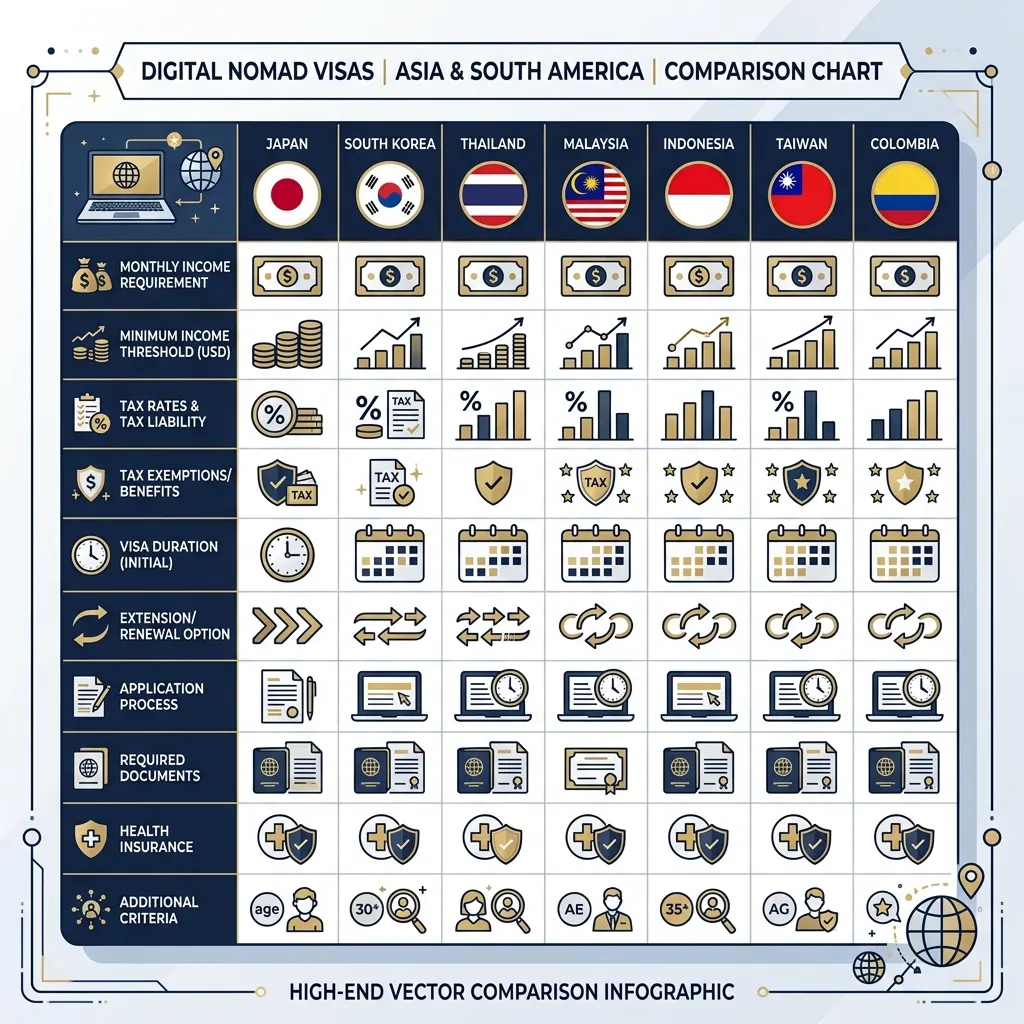
For a broader comparison including Thailand, Indonesia, and Malaysia, see our best digital nomad countries for 2026.
Common Mistakes to Avoid
Based on common pitfalls reported by digital nomads in South Korea:
-
Underestimating the income documentation requirements — Korean immigration is thorough. Provide clear, translated, and apostilled documents. Vague bank statements without context may lead to rejection.
-
Not understanding the jeonse vs. wolse rental system — Many nomads sign jeonse contracts without realizing they need a massive upfront deposit. Stick to wolse or short-term furnished rentals.
-
Ignoring NHIS enrollment — After 6 months, NHIS enrollment is mandatory, not optional. Failing to enroll can result in backdated premiums and penalties.
-
Assuming the visa replaces home-country tax filing — Your Workcation Visa does not exempt you from taxes in your country of citizenship or prior tax residency. See our guide on common nomad tax mistakes.
-
Working for Korean clients — Even small freelance projects for Korean companies violate your visa terms and could create Korean-sourced taxable income.
-
Not getting your ARC promptly — Your Alien Registration Card is essential for banking, phone contracts, and many everyday transactions in Korea. Register within 90 days.
Frequently Asked Questions
Can I apply for the South Korea Workcation Visa online?
Partially. According to the Korea Immigration Service, you can begin the process through the HiKorea (hikorea.go.kr) portal, but most applicants will still need to visit a Korean Embassy or Consulate in person for biometric collection and document verification. Some consulates accept mailed applications — check with your local consulate for their specific procedures.
Do I need to speak Korean to get the Workcation Visa?
No. There is no language requirement for the Workcation Visa. That said, while Seoul is relatively English-friendly, Korean language ability significantly improves daily life in Korea, especially in smaller cities and when dealing with government services. Apps like Papago (Korea’s leading translation app, developed by Naver) and KakaoMap are indispensable.
What if I’m a freelancer — can I still qualify?
Yes. Freelancers are eligible as long as they can document $85,000+ in annual income (or $65,000+ with a degree) from foreign clients. You’ll need to provide client contracts, invoices, and bank statements or tax returns demonstrating your income. Having a structured paper trail is essential — the Korea Immigration Service scrutinizes freelance applications more closely than salaried applicants.
Can I open a Korean bank account on the Workcation Visa?
Yes, once you have your Alien Registration Card (ARC), you can open a bank account at major Korean banks including Hana Bank, KEB Hana, Shinhan Bank, and Woori Bank. Some banks have English-speaking staff, particularly in Seoul. You’ll typically need your passport, ARC, and proof of address. Note that some financial services may have restrictions for non-permanent residents.
Is the Workcation Visa the same as the H-1 Working Holiday Visa?
No. The H-1 Working Holiday Visa is a separate program for young adults (typically 18–30) from countries with bilateral working holiday agreements with Korea. It allows part-time work for Korean employers. The Workcation Visa (F-1-D) is specifically for remote workers employed by foreign entities, has no age limit, and requires significantly higher income. They are completely different visa categories with different rules and restrictions.
What happens after my 2-year Workcation Visa expires?
After the maximum 2-year period, you must leave South Korea. You can apply for a new Workcation Visa from abroad, though the Ministry of Justice may require a gap between stays (current guidance suggests at least 3–6 months). If you wish to stay in Korea long-term, you would need to transition to a different visa category — such as an E-7 (Professional Employment) visa with a Korean employer, or an F-2 (Long-Term Residence) visa if you qualify through Korea’s points-based immigration system.
Do I need to pay into Korea’s National Pension while on the Workcation Visa?
According to the National Tax Service of Korea, Workcation Visa holders whose income is entirely foreign-sourced are generally exempt from National Pension contributions. However, once you are enrolled in NHIS (after 6 months), you are required to pay NHIS premiums. Check whether your home country has a social security totalization agreement with South Korea — countries like the U.S., Australia, and several EU nations do, which can affect pension obligations.
Final Thoughts
South Korea’s Workcation Visa stands out as one of the most thoughtfully designed digital nomad visa programs in the world. The combination of a 2-year maximum stay, dependent provisions, NHIS healthcare access, world-leading internet speeds, and a clear foreign-income tax exemption makes it exceptionally competitive.
The $85,000 income requirement (or $65,000 with a degree) is on the higher end globally, but it reflects the caliber of experience Korea offers — a country where your video calls never buffer and your healthcare costs are a fraction of what they’d be in the U.S.
From a tax planning perspective, the Workcation Visa is remarkably clean — foreign income stays exempt, and you avoid Korea’s steep progressive rates (up to 49.5%). The main risk lies in misunderstanding your home-country obligations. Use the NomadTaxGuide calculator to model your scenario, stay aware of common tax mistakes, and ensure your double taxation treaty protections are in order.
Whether you’re choosing between South Korea and Japan’s Digital Nomad Visa, or evaluating the full slate of 2026’s best digital nomad destinations, the Workcation Visa deserves serious consideration.