South Korea Workcation Visa Tax Guide: 183-Day Residency & 19% Flat Tax (2026)
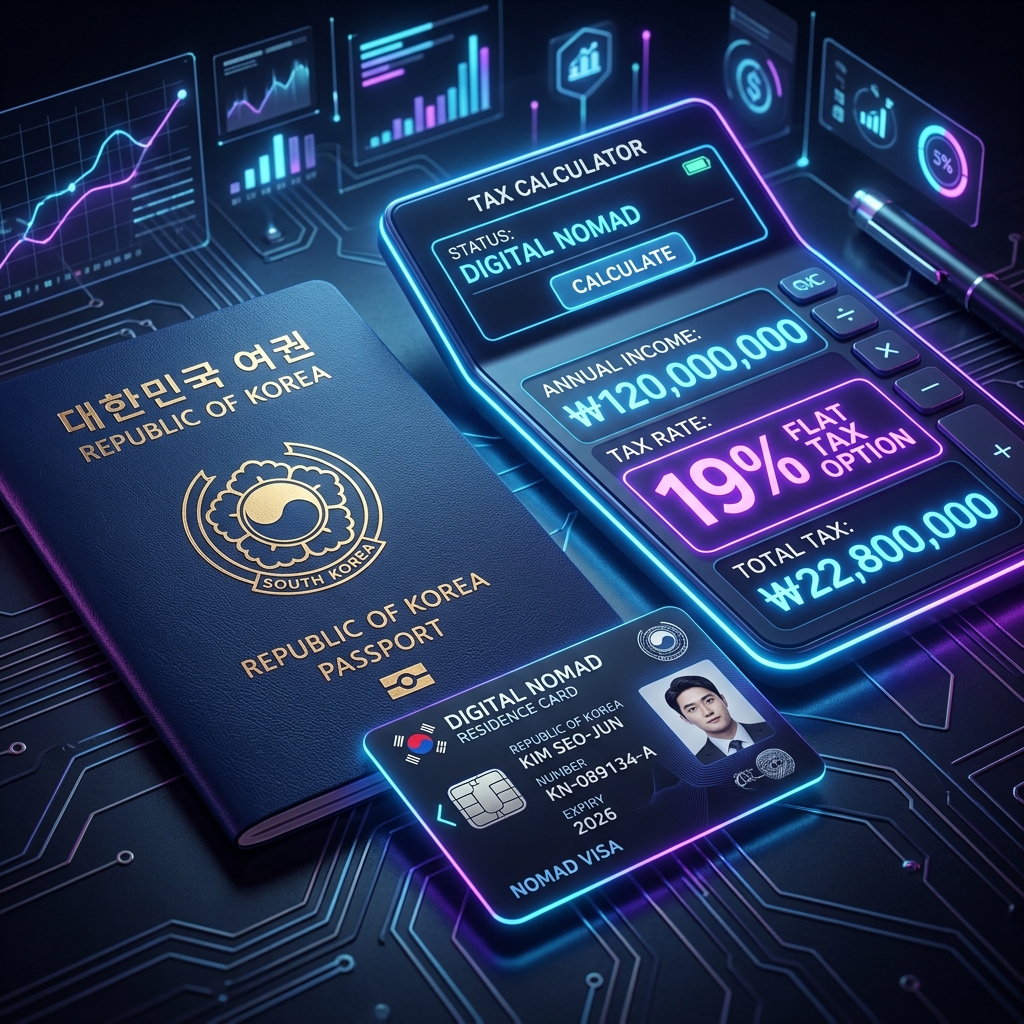
South Korea launched its F-1-D Workcation Visa (commonly known as the Digital Nomad Visa) to attract high-earning remote workers. Valid for one year and renewable for an additional year, this visa allows you to stay in South Korea for up to 24 months while working for a foreign employer or running a foreign business.
One of the strict entry requirements is demonstrating a high income—specifically, at least double South Korea’s GNI per capita from the previous year. As of 2026, this threshold is approximately KRW 104.8 million per year (around $75,000 to $80,000 USD).
Since South Korea has a high income tax rate that climbs progressively from 6% to 45% (plus a 10% local tax surcharge, making the maximum rate 49.5%), understanding your tax exposure is crucial.
TL;DR: Under South Korean tax law, tax liability depends on your physical presence:
- If you stay in Korea for less than 183 days in a calendar year, you are a tax non-resident and pay 0% tax to South Korea on your remote work income.
- If you stay for 183 days or more, you become a tax resident and are technically subject to Korean progressive tax on your worldwide income. However, foreign residents can claim the 5-year foreigner exemption (which excludes foreign-sourced income from tax unless it is remitted to Korea) or elect a 19% flat tax rate (20.9% effective with local tax) that simplifies filings.
Here is a detailed breakdown of how to navigate South Korea’s tax system as a digital nomad.
1. Determining South Korean Tax Residency (The 183-Day Rule)
Under Article 1-2 of the Korean Income Tax Act (ITA), your tax status is defined as follows:
- Non-Resident: An individual who does not have a domicile in Korea and has resided in Korea for less than 183 days in a calendar year. Non-residents are only taxed on Korean-sourced income. Because the F-1-D visa strictly prohibits working for Korean companies, your remote work income is classified as foreign-sourced and is not taxed by South Korea.
- Resident: An individual who has a domicile in Korea or resides in Korea for 183 days or more in a calendar year. Korea uses a physical presence test: if your cumulative stay (not necessarily consecutive) crosses 183 days in a single tax year, you are classified as a tax resident.
If you utilize the F-1-D visa for its full 1-year duration, you will cross the 183-day mark and become a South Korean tax resident.
2. Tax Relief: The 5-Year Remittance Rule for Foreign Residents
If you become a Korean tax resident, you are theoretically taxed on your worldwide income. However, the ITA provides a significant tax shield for short-term foreign residents.
Under Article 3 of the ITA (often called the 5-Year Rule):
- Foreign residents who have resided in Korea for 5 years or less out of the preceding 10 years are only subject to Korean income tax on foreign-sourced income if that income is paid in or remitted (transferred) to South Korea.
- If you keep your remote earnings in a foreign bank account outside of South Korea (e.g., in a U.S., UK, or offshore business account) and do not transfer it to a Korean bank account, it is exempt from Korean taxation.
- Only the portion of your income that you physically transfer to Korea to cover your living expenses is subject to taxation.
3. The Flat Tax Election: 19% Flat Rate (20.9% Effective)
If you are a salaried employee of a foreign company and choose to remit your income or are otherwise subject to Korean tax, you can elect a special tax benefit designed for foreign workers: the 19% Foreigner Flat Tax.
- Instead of being taxed under Korea’s progressive brackets (6% to 45%), foreign employees can choose to pay a flat 19% tax rate on their gross earned income.
- When including the mandatory local income tax surcharge (which is 10% of the calculated income tax), the total effective flat tax rate is 20.9%.
- The Catch: If you choose the flat tax, you cannot claim any tax deductions, exemptions, or foreign tax credits. This is a pure flat tax on gross income.
- For high earners (above the KRW 104.8M GNI threshold), electing the 19% flat rate is highly advantageous because it caps your tax liability, shielding you from Korea’s higher progressive tax brackets (which hit 24% at ~KRW 88M and 35% at ~KRW 150M).
[!IMPORTANT] To qualify for the 19% flat tax, you must be classified as an employee. If you are a freelancer, independent contractor, or operate as a sole proprietorship, you are not eligible for this flat rate and will be taxed under standard progressive rates.
4. Standard Progressive Tax Brackets (2026)
If you do not elect the flat tax (or are a freelancer ineligible for it), your taxable income in South Korea will be subject to progressive rates. Below are the national tax brackets (to which you must add a 10% local tax surcharge):
| Taxable Income (KRW) | Taxable Income (EUR Approx.) | Tax Rate | Cumulative Surcharge |
|---|---|---|---|
| Up to 14 Million | Up to €8,500 | 6% | 6.6% |
| 14 Million to 50 Million | €8,500 to €30,300 | 15% | 16.5% |
| 50 Million to 88 Million | €30,300 to €53,300 | 24% | 26.4% |
| 88 Million to 150 Million | €53,300 to €90,900 | 35% | 38.5% |
| 150 Million to 300 Million | €90,900 to €181,800 | 38% | 41.8% |
| 300 Million to 500 Million | €181,800 to €303,000 | 40% | 44.0% |
| Above 500 Million | Above €303,000 | 42% - 45% | 46.2% - 49.5% |
You can use the Nomad Tax Calculator to compare these progressive brackets against the 19% flat tax option to determine which method minimizes your tax burden.
5. Double Taxation Treaties & Compliance
South Korea has a vast network of double taxation treaties. Under these treaties, if you are taxed in South Korea on remitted income, you can claim a Foreign Tax Credit (FTC) in your home country (e.g. on IRS Form 1116 for US expats) to prevent paying tax twice on the same income.
Compliance Checklist:
- Track Days: If you want to remain a non-resident and pay 0% tax in Korea, leave the country before your cumulative stay reaches 183 days in the calendar year.
- Structure Bank Accounts: Keep your business and salary accounts outside of South Korea. Transfer only what you need for daily expenses via cards or international transfers.
- Register Address: F-1-D visa holders staying over 90 days must obtain a domestic residence card and report address changes. This registers your presence for tax residency tracking.
Disclaimer: International tax is complex. South Korean tax residency can depend on family ties and economic interests in addition to the 183-day rule. Always use our Nomad Tax Calculator as a starting point and consult a certified Korean tax accountant (semusa).