Spain’s Beckham Law vs. Portugal’s NHR 2.0: Expat Tax Comparison (2026)

Europe has become a hotbed for digital nomads and high-net-worth expats looking to optimize their tax burdens. Two of the most famous tax incentives on the continent sit side-by-side on the Iberian Peninsula: Spain’s Beckham Law and Portugal’s Non-Habitual Resident (NHR) regime.
TL;DR: Spain’s Beckham Law offers a flat 24% tax rate on active income for up to 6 years and is exceptionally easy to qualify for under the Spain Digital Nomad Visa. Portugal’s original NHR (which offered a 20% flat rate) was replaced by NHR 2.0 (Scientific Research and Innovation) in 2024, which also offers a 20% rate for 10 years, but is highly restricted to specific academic, startup, and scientific research roles, making it much harder for standard digital nomads to qualify.
This article provides a head-to-head expat tax comparison between Spain’s Beckham Law and Portugal’s NHR 2.0 to help you determine the best tax regime for expats in Europe in 2026.
The Core Shifts: Spain vs. Portugal
Both Spain and Portugal updated their expat tax incentives recently, completely shifting the optimization landscape.
Spain: The Beckham Law Expansion
Officially known as the Régimen Especial para Trabajadores Desplazados, Spain’s Beckham Law was expanded under the Ley de Startups (Startup Law 28/2022). It now includes remote employees, digital nomads, and startup directors, making it one of the most accessible regimes in Europe.
Portugal: The NHR 2.0 Transition
Portugal closed its original, highly popular NHR regime to new applicants on December 31, 2023. It was replaced in the 2024 State Budget by the Incentive for Scientific Research and Innovation (commonly called NHR 2.0). While it still offers a 20% flat tax rate, it restricts eligibility to specific roles in research, higher education, technology development, and certified startups.
Head-to-Head Comparison: Beckham Law vs. NHR 2.0
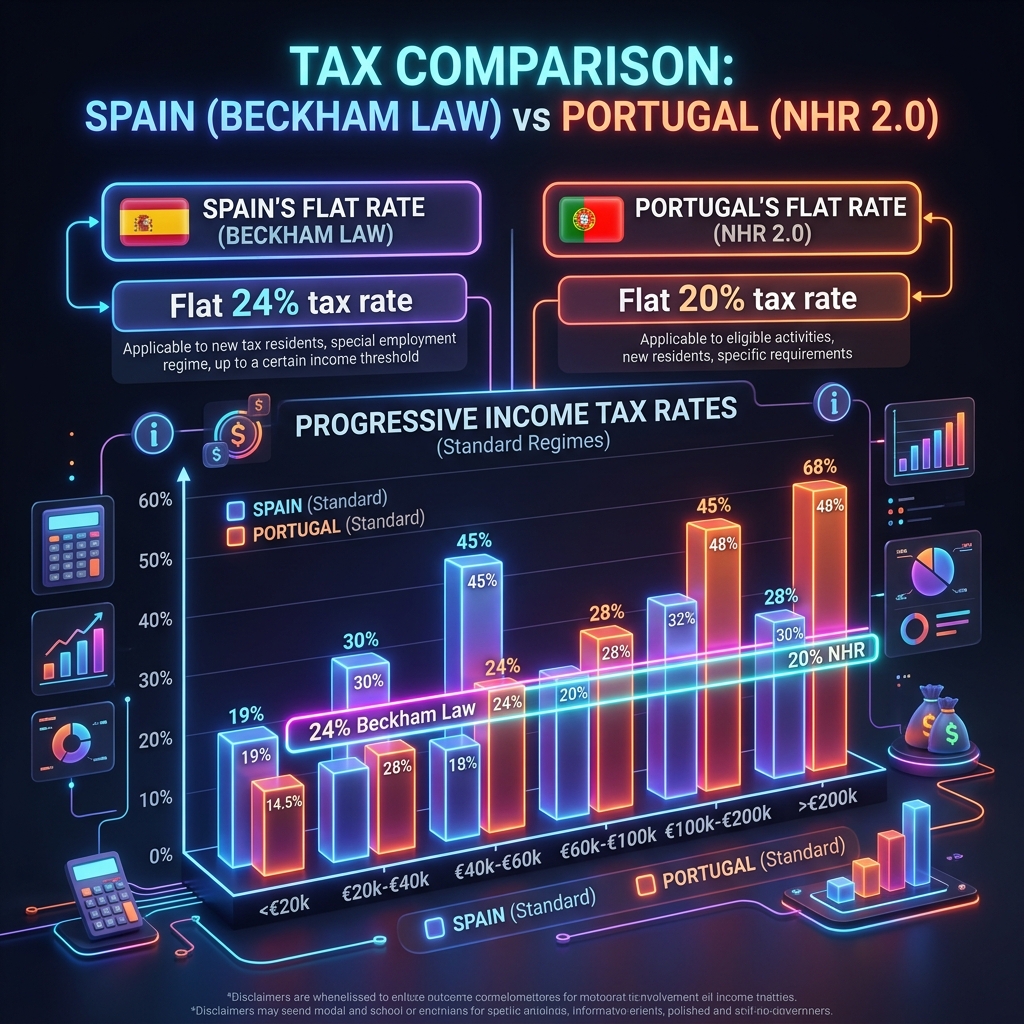
1. Tax Rates and Income Categories
- Spain (Beckham Law): You pay a flat 24% income tax on all Spanish-source employment and active business income up to €600,000 per year. Income exceeding this threshold is taxed at a flat 47%.
- Portugal (NHR 2.0): If you qualify, you pay a flat 20% income tax on employment and self-employment income derived from “eligible activities” (high-value startup, research, and scientific roles). Standard progressive rates up to 48% apply to non-eligible income.
2. Foreign-Source Passive Income
- Spain: 100% tax-free. You pay 0% Spanish tax on foreign dividends, interest, rental income, and capital gains (such as gains from stock sales outside Spain).
- Portugal: Most foreign-source income (dividends, interest, rental income) remains tax-exempt under Portugal’s double taxation treaties (DTAs). However, foreign pensions are now subject to standard progressive tax rates (under the old NHR, they were taxed at 10%).
3. Wealth Tax and Asset Reporting
- Spain: Under the Beckham Law, you are treated as a non-resident for tax purposes. You are exempt from the Spanish Wealth Tax (Impuesto sobre el Patrimonio) on foreign assets, and you do not need to file the complex asset disclosure form (Modelo 720) for assets outside Spain.
- Portugal: Portugal does not have a traditional wealth tax, but it does have local municipal property taxes (IMI/AIMI) on Portuguese real estate. There are no foreign asset reporting forms equivalent to Modelo 720, but worldwide assets must be declared if they generate taxable income.
Eligibility and Visa Integration
The ease of qualifying is where Spain currently holds a major advantage.
| Feature | Spain’s Beckham Law | Portugal’s NHR 2.0 |
|---|---|---|
| Expat Tax Rate | 24% flat rate | 20% flat rate |
| Duration | 6 years (Year of arrival + 5 years) | 10 consecutive years |
| Prior Non-Residency | Must not have been resident for 5 years | Must not have been resident for 10 years |
| Nomad Visa Access | Yes — Native integration with the Spanish Digital Nomad Visa | No — Standard D8 Visa holders do not qualify unless in specific research/startup roles |
| Highly Skilled Requirement | Not required for remote employees | Yes — Must work in higher education, scientific research, or certified startups |
| Application Deadline | Within 6 months of arrival / work start | By March 31 of the year following arrival |
[!WARNING] Digital nomads applying for the Portugal D8 visa often assume they will automatically get NHR tax benefits. This is a critical mistake in 2026. Standard remote copywriting, general digital marketing, and virtual assistant roles do not qualify for NHR 2.0. Unless your employer is a certified Portuguese startup or you work in an official research/scientific role, you will be subject to Portugal’s progressive tax rates, which quickly rise to 48%.
Detailed Cost/Benefit Scenario (€100,000 Income)
Let’s calculate the net tax savings for an IT consultant earning €100,000 per year.
Scenario A: Spain (Beckham Law)
- Gross Income: €100,000
- Tax Base: €100,000 (no deductions allowed under the Beckham Law)
- Tax Owed (24%): €24,000
- Social Security: Capped at approximately €5,000/year (for employees)
- Net Income: ~€71,000
Scenario B: Portugal (NHR 2.0 - Assuming Qualification)
- Gross Income: €100,000
- Tax Owed (20%): €20,000
- Social Security: Approximately 11% (employee) or 21.4% (self-employed, waivable for first year)
- Net Income: ~€69,000 – €80,000 (depending on self-employment structure)
Scenario C: Standard Progressive Tax (No Incentives)
- Spain Standard Tax: ~€34,500 (Effective rate: 34.5%)
- Portugal Standard Tax: ~€38,000 (Effective rate: 38.0%)
Pros and Cons: Expat Tax Comparison Spain Portugal
Spain (Beckham Law)
- Pros: 0% tax on foreign investments; no wealth tax on foreign assets; incredibly easy to qualify for remote workers under the Digital Nomad Visa.
- Cons: Capped at 6 years; flat 24% rate is higher than Portugal’s 20%; tipping point is high (only saves money if earning €55,000+).
Portugal (NHR 2.0)
- Pros: Capped at 20% (lower than Spain’s 24%); lasts for 10 years (longer than Spain’s 6); no wealth tax.
- Cons: Extremely restricted eligibility criteria; requires 10 years of prior non-residency (vs. Spain’s 5); foreign pensions are no longer exempt.
The Verdict: Which is Best for You in 2026?
Choose Spain (Beckham Law) if:
- You are a standard digital nomad, remote freelancer, or IT contractor. The application process is straightforward, and the Spanish Digital Nomad Visa natively supports the Beckham Law opt-in.
- You have substantial foreign passive income (dividends, interest, stock capital gains) that you want to keep completely tax-free.
- You only plan to live in Europe for 3 to 5 years.
Choose Portugal (NHR 2.0) if:
- You work in scientific research, academic education, or are employed by a certified Portuguese startup.
- You plan to settle long-term (the 10-year duration offers €100k+ in cumulative tax savings over Spain’s 6-year cap).
- You are willing to navigate Portugal’s strict eligibility checks and hire a local tax representative to secure approval.
Authoritative Reference Sources
- Spanish Tax Agency (Agencia Tributaria): Agencia Tributaria Beckham Law Guidelines
- Spain Law 28/2022 (Startup Law): BOE Official Startup Legislation
- Portuguese Tax and Customs Authority (AT): Autoridade Tributária NHR Portal
- Portugal State Budget 2024 (Law 82/2023): Diário da República Legislation