UK Non-Dom Abolition: The New 4-Year FIG Tax Regime Guide for Expats & Nomads (2026)
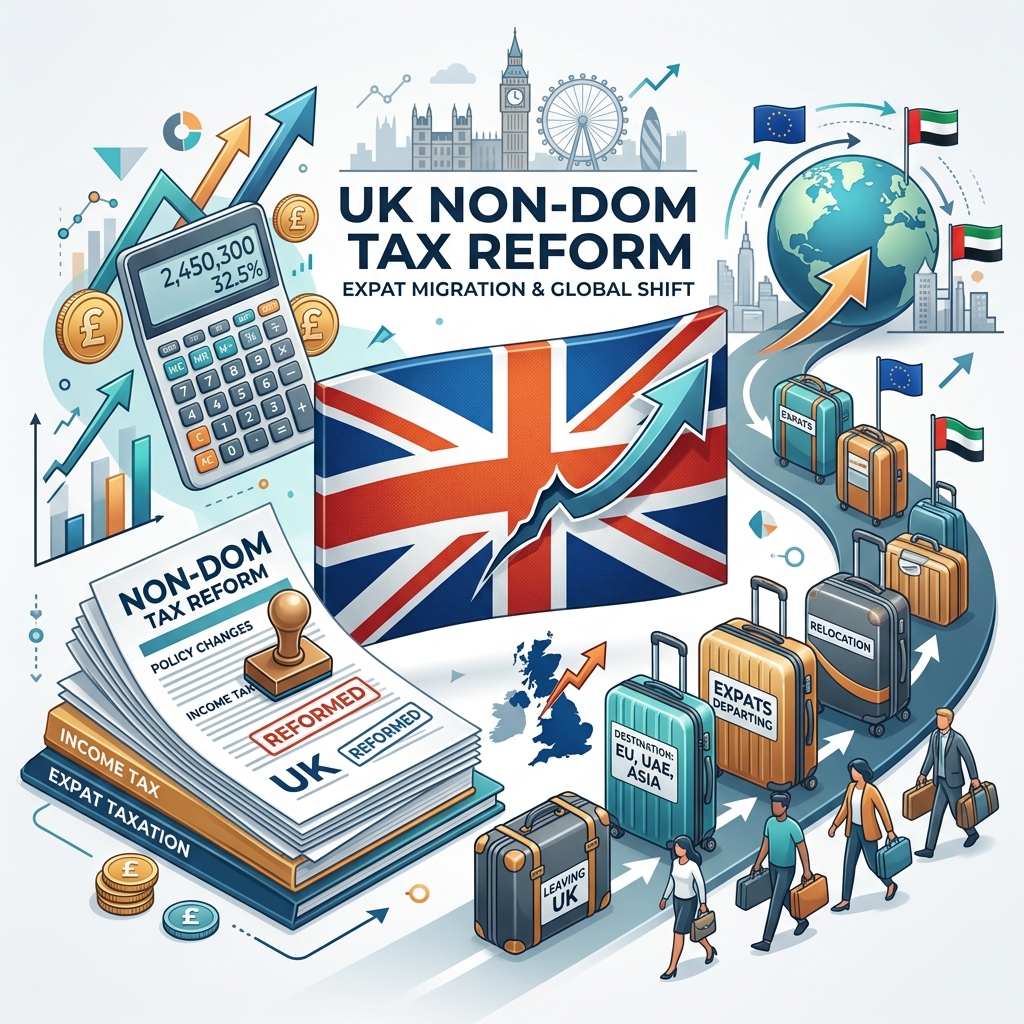
As of April 6, 2025, the United Kingdom has officially abolished its centuries-old non-domiciled (“non-dom”) tax regime and the associated remittance basis of taxation. It has been replaced by a modern, residence-based tax model centered on the new Foreign Income and Gains (FIG) regime. According to the UK Treasury and HM Revenue & Customs (HMRC), this reform marks a fundamental shift, bringing the UK in line with international standards by taxing individuals based on how long they reside in the country, rather than where their permanent ancestral home is located.
TL;DR: Domicile is no longer a factor in UK taxation. New residents who have not been UK tax residents for the previous 10 consecutive years can claim 100% tax relief on their foreign income and gains (FIG) for their first 4 years of UK residence. Unlike the old system, they can bring these funds into the UK tax-free at any time. However, after Year 4, or for existing residents who do not qualify, worldwide income is fully subject to UK tax, and digital nomads must carefully manage their presence days under the Statutory Residence Test (SRT) to avoid accidental worldwide UK tax exposure.
This guide provides a comprehensive technical breakdown of the new rules, the Statutory Residence Test, and transition planning for expats in 2026.
Domicile vs. Residence: The Core Shift
Historically, a “non-dom” was a UK tax resident whose permanent home (domicile) was outside the UK. They could choose the “remittance basis,” meaning they only paid UK tax on foreign income if they brought (remitted) that money into the UK.
Under the new 2026 rules:
- **Domicile is abolished:**Domicile has been completely removed from the tax legislation.
- Residence-based model: Worldwide tax liability is now determined entirely by your physical presence in the UK, assessed annually using the Statutory Residence Test (SRT).
- The 4-Year FIG Regime: New arrivals receive a 4-year window of tax exemption on foreign income, after which they are taxed on all global income, regardless of where it is kept or remitted.

How the 4-Year FIG Regime Works
The Foreign Income and Gains (FIG) regime is a specialized, optional tax relief designed to attract foreign talent, remote executives, and digital nomads to the UK for a short-term period.
Eligibility Criteria
To claim 100% tax relief under the FIG regime, you must meet the following criteria:
- You must be a UK tax resident for the current tax year.
- You must have been a non-UK tax resident for at least 10 consecutive tax years immediately preceding your arrival in the UK.
Key Benefits
- 100% Tax Relief: You pay 0% UK income tax and capital gains tax on your foreign income and gains (such as dividends from foreign corporations, rental income from foreign properties, and gains from foreign investments).
- Tax-Free Remittance: You can bring (remit) this foreign income into the UK at any time, use it to buy property, pay for living expenses, or invest in the UK without triggering any tax charges. (This was highly restricted under the old non-dom system).
- Simple Claims: You must make an active claim on your annual UK Self Assessment tax return for each of the 4 years you wish to utilize the relief.
[!WARNING] If you choose to claim the FIG relief for a tax year, you will forfeit your UK Personal Allowance (tax-free allowance, which is £12,570 in 2026) and your Capital Gains Tax annual exempt amount. For high-earning individuals, this is a negligible trade-off, but it must be factored into your computations.
The Statutory Residence Test (SRT) for Digital Nomads
If you are a digital nomad, remote freelancer, or location-independent entrepreneur traveling in and out of the UK, the Statutory Residence Test (SRT) is the most critical compliance framework you must master. It determines whether you have crossed the threshold into UK tax residency.
The SRT is divided into three parts, applied in order:
1. The Automatic Overseas Tests
You are automatically a non-resident if you meet any of these tests:
- You spend fewer than 16 days in the UK during the tax year (or fewer than 46 days if you have not been a UK resident in the preceding 3 tax years).
- You work full-time abroad (averaging at least 35 hours per week) and spend fewer than 91 days in the UK, with no more than 30 days spent working in the UK.
2. The Automatic UK Tests
You are automatically a UK resident if you meet any of these tests:
- You spend 183 days or more in the UK during the tax year.
- Your only home is in the UK (you have it for at least 91 days and spend at least 30 days there).
- You work full-time in the UK (averaging at least 35 hours per week over a 365-day period).
3. The Sufficient Ties Test
If you do not meet any of the automatic tests, your residency depends on how many “ties” you have to the UK combined with the number of days you spend in the country. The ties are:
- Family Tie: Spouse, civil partner, or minor children resident in the UK.
- Accommodation Tie: Available accommodation in the UK for at least 91 days where you spend at least 1 night.
- Work Tie: Working in the UK for 40 days or more in the tax year (at least 3 hours per day).
- 90-Day Tie: Spending more than 90 days in the UK in either of the previous 2 tax years.
- Country Tie: Spending more days in the UK than in any other single country (only applies if you were resident in the UK in one of the previous 3 tax years).
Sufficient Ties Day Count Matrix (For Non-Residents in Previous 3 Years)
| UK Days Spent | 1 Tie | 2 Ties | 3 Ties | 4 Ties |
|---|---|---|---|---|
| 46 to 90 days | Non-Resident | Non-Resident | Non-Resident | Resident |
| 91 to 120 days | Non-Resident | Non-Resident | Resident | Resident |
| 121 to 182 days | Non-Resident | Resident | Resident | Resident |

Transitional Rules: The Temporary Repatriation Facility (TRF)
For existing UK tax residents who previously utilized the remittance basis and have accumulated untaxed foreign income and gains (pre-April 6, 2025), the UK government has introduced transitional arrangements:
- The Temporary Repatriation Facility (TRF): A special incentive allowing individuals to bring their accumulated pre-2025 foreign income into the UK at a significantly reduced flat tax rate of 12% for the 2025/26 and 2026/27 tax years.
- Re-basing of Assets: For capital gains tax purposes, individuals who have been remittance basis taxpayers can re-base foreign capital assets to their market value as of a specific historical date (typically April 5, 2019), reducing the taxable gain when those assets are sold in 2026 or later.
Actionable Expat Checklist for 2026
If you are moving to the UK or have assets there, follow this compliance checklist:
- Log Your Presence Days Daily: Keep clear records of UK arrival and departure days. Under HMRC rules, a day is counted as a UK day if you are in the UK at midnight (subject to transit exceptions).
- Determine Your 10-Year History: Ensure you have tax returns or utility bills proving 10 years of continuous foreign tax residency to secure your 4-year FIG status.
- Optimize the 4-Year Window: Bring in foreign funds tax-free to buy property or invest while your FIG status is active.
- Evaluate Inheritance Tax (IHT): Under the new rules, once you are a UK tax resident for 10 out of 20 years, your worldwide estate becomes subject to UK IHT (40% rate). Plan to exit before Year 10 if you have high worldwide net worth.
- Set Up the Right Banking Infrastructure: Ensure your international accounts are structured cleanly. See our digital nomad banking setup guide to optimize receiving and transferring global income.
Authoritative Reference Sources
- HMRC Residence, Domicile and Remittance Basis: HMRC Official Guidance
- UK Government Statutory Residence Test Legislation: Statutory Residence Test (SRT) Data
- UK Parliament Autumn Statement Reforms: UK Autumn Budget Tax Policy
- HMRC Temporary Repatriation Facility Guidelines: HMRC TRF Manual