Germany Freiberufler (Freelance) Visa: Taxes, Rules & Application
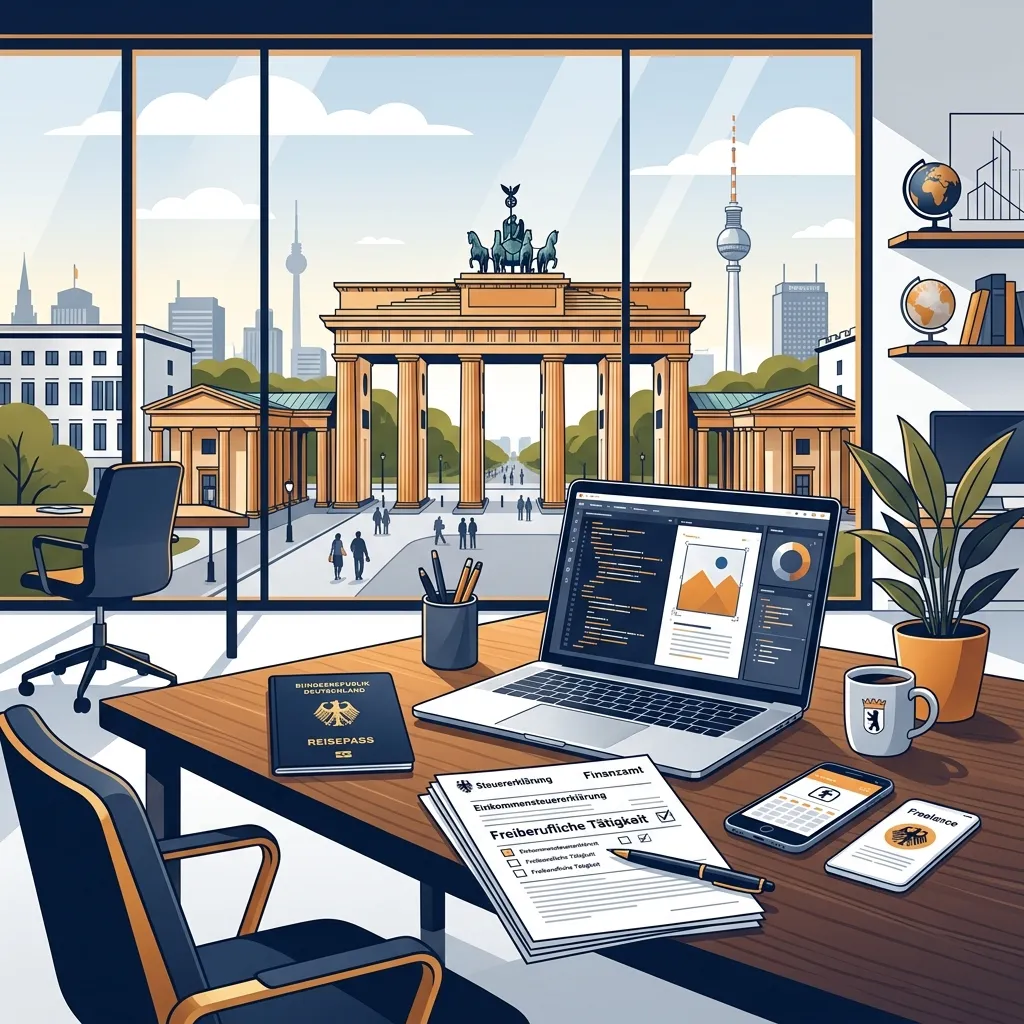
Germany, the economic powerhouse of Europe, offers a high quality of life, robust public services, and a thriving entrepreneurial environment. While it does not offer a traditional “digital nomad visa” designed for short-term remote work, it provides a unique pathway for self-employed individuals to live and work in the country: the Freiberufler (Freelance) Visa. Navigating German bureaucracy is notoriously complex, and understanding your local compliance and tax obligations is essential.
TL;DR: Germany’s Freiberufler Visa allows non-EU freelancers to reside in Germany while operating a “liberal profession” (such as IT, writing, engineering, or design). To qualify, you must register your address in Germany (Anmeldung), secure a German tax number (Steuernummer), show local economic interest (German clients), and hold comprehensive health insurance that complies with German law. Germany operates a progressive income tax system with brackets scaling from 14% to 45%.
In this detailed 2026 guide, we’ll explain the difference between a freelance and trade business, how to complete address and tax registration, Germany’s tax brackets, health insurance rules, and step-by-step application guidelines.
What is the Germany Freiberufler Visa?
Under Section 21(5) of the German Residence Act (Aufenthaltsgesetz), self-employed individuals can apply for a residence permit to carry out a freelance activity. However, German law makes a strict legal distinction between a freelancer (Freiberufler) and a commercial business owner (Gewerbetreibender).
Freiberufler (Liberal Profession) vs. Gewerbe (Trade)
According to the German Federal Ministry of Justice, a liberal profession (Freiberuf) involves providing professional services of an intellectual, scientific, artistic, or educational nature.
- Freiberuf Categories: Include software developers, IT consultants, writers, copywriters, language teachers, graphic designers, photographers, journalists, doctors, and engineers.
- Gewerbe Categories: Include commercial activities such as dropshipping, running an e-commerce store, opening a physical shop or cafe, manufacturing, or acting as a broker.
The distinction is critical. If your business is classified as a Gewerbe, you must register a trade with the local trade office (Gewerbeamt) and pay German trade tax (Gewerbesteuer), which adds an extra 7% to 15% tax burden depending on the municipality. Freelancers are completely exempt from trade tax and only pay personal income tax.
Step 1: Registering Your Address (Anmeldung)
The very first step of your freelance journey in Germany is registering your address, a process known as Anmeldung. By law, anyone who moves into a property in Germany must register their address at the local registration office (usually called the Bürgeramt or Bürgerbüro) within 14 days of moving in.
Without an Anmeldung certificate (called the Meldebescheinigung), you cannot:
- Open a German bank account.
- Apply for a mobile phone contract.
- Sign up for German health insurance.
- Book a freelance visa appointment at the immigration office (Ausländerbehörde).
The Anmeldung Process
To register your address, you must book an appointment at the Bürgeramt and present:
- Your passport.
- A completed registration form.
- The Wohnungsgeberbestätigung (landlord confirmation form). This is a mandatory document signed by your landlord or the main tenant of the flat confirming that you have officially moved in. A standard rental contract is not accepted as a substitute.
Once registered, the Bürgeramt clerk will print your Meldebescheinigung immediately. A few weeks later, the Federal Central Tax Office (BZSt) will automatically mail your permanent personal tax ID (Steueridentifikationsnummer) to your registered address.
Step 2: Tax Registration and Obtaining Your Steuernummer
Once you have your address registration and personal tax ID, you must register your freelance business with the local tax office (Finanzamt) to obtain your business tax number (Steuernummer).
Steuernummer vs. Steueridentifikationsnummer
- Steueridentifikationsnummer (Steuer-ID): A permanent, 11-digit personal identification number used for all personal tax matters throughout your life in Germany.
- Steuernummer: A local tax number assigned to your freelance business. You must display this number on every invoice you issue. Without a Steuernummer, your invoices are not legally valid in Germany.
Registering via ELSTER
To get your Steuernummer, you must submit the Fragebogen zur steuerlichen Erfassung (tax registration questionnaire) online via the official German tax portal, ELSTER. The form requires you to estimate your revenue and expenses for the first two years, declare whether you expect to pay VAT, and opt into a tax regime.
The Small Business Regulation (Kleinunternehmerregelung)
Under Section 19 of the German Value Added Tax Act (UStG), you can opt for the small business regulation (Kleinunternehmerregelung) if your gross revenue:
- Does not exceed €22,000 in the first calendar year of business, and
- Is not expected to exceed €50,000 in the following year.
If you qualify and opt into this rule, you do not have to charge VAT (which is typically 19% in Germany) on your invoices, which simplifies your accounting. However, you also cannot deduct VAT paid on your business purchases.
Germany’s Progressive Income Tax Brackets (2026)
Germany operates a progressive tax system. Your tax rate increases as your taxable income increases.
Progressive Brackets for 2026
For the 2026 tax year, the German tax brackets (excluding church tax and solidarity surcharge) are:
| Taxable Income Brackets (€) | Tax Rate | Description |
|---|---|---|
| Up to €11,784 | 0% | Tax-free allowance (Grundfreibetrag) |
| €11,785 – €66,760 | 14% – 42% | Progressive entry rate scaling up with income |
| €66,761 – €277,826 | 42% | Standard top marginal rate |
| Above €277,826 | 45% | Rich tax (Reichensteuer) |
In addition to income tax, you may be subject to:
- Church Tax (Kirchensteuer): If you register as a member of the Catholic or Protestant church, you pay an additional 8% to 9% of your income tax liability.
- Solidarity Surcharge (Solidaritätszuschlag): Up to a 5.5% surcharge applied to high-income earners.
Freelance Tax Calculation Example
Let’s calculate the taxes for a freelance software developer earning €60,000/year gross revenue in Germany, with €5,000 in deductible business expenses (laptop, home office, travel) and €8,000 in deductible health insurance contributions.
- Gross Freelance Income: €60,000
- Minus Business Expenses: €60,000 - €5,000 = €55,000 (Net Business Profit)
- Minus Deductible Health Insurance: €55,000 - €8,000 = €47,000 (Taxable Income)
- Income Tax Calculation: On €47,000 taxable income, using the 2026 progressive formula, the tax liability is approximately €10,250 (an effective rate of ~21.8% on the taxable income).
- Net Take-Home Pay:
- Gross Revenue: €60,000
- Expenses + Health Insurance: €13,000
- Income Tax: €10,250
- Net Profit After Tax & Insurance: €36,750
To analyze how your income and business structure affect your tax rates, use our Tax Calculator.
Health Insurance Compliance in Germany
Germany has a legal mandate for health insurance (Krankenversicherungspflicht). You cannot obtain a residence permit without proving you have comprehensive health coverage that meets German statutory standards.
Public Health Insurance (GKV) vs. Private Health Insurance (PKV)
- Public Health Insurance (Gesetzliche Krankenversicherung - GKV): If you are self-employed, you can voluntarily join the public system. The premiums are calculated as a percentage of your net business income (approximately 14.6% to 15.6% plus a long-term care surcharge, up to a maximum cap of around €1,000/month). It is a good choice if you have a family, as dependents are covered for free.
- Private Health Insurance (Private Krankenversicherung - PKV): Premiums are based on your age, health status, and coverage level, rather than your income. This is often cheaper for young, healthy, high-earning freelancers, but premiums increase as you age, and dependents must be insured separately.
[!WARNING] According to the Federal Financial Supervisory Authority (BaFin), international travel insurance policies (such as SafetyWing, World Nomads, or Genki) are not accepted for the Freiberufler visa. Your insurance policy must comply with Section 193 of the German Insurance Contract Act (VVG). It must have no limits on outpatient/inpatient coverage, cover dental and pregnancy care, and have a maximum deductible of €5,000/year.
Step-by-Step Visa Application Guide
The German Freiberufler Visa is applied for directly at the immigration office (Ausländerbehörde) if you are already in Germany, or at the German embassy in your home country before you travel.
Step 1: Book Your Appointment
Book your appointment early. If applying from within Germany, you must book a slot at the Ausländerbehörde (in Berlin, this is the Landesamt für Einwanderung - LEA). Wait times for appointments can be 2 to 4 months.
Step 2: Prepare Your Freelance Portfolio
Unlike digital nomad visas that simply require proving a salary, Germany wants to see that your business will benefit the local economy. You must prepare a portfolio containing:
- CV and Qualifications: Degrees, certificates, and references showing your expertise.
- Letters of Intent (Sponsorship Letters): You must submit at least 2 written letters of intent from prospective German clients stating that they want to hire your services once your visa is approved. Without German clients, your application will be rejected immediately.
- Revenue Forecast: A detailed spreadsheet outlining your expected monthly revenues and business expenses for the next 3 years.
- Profit and Loss Plan: Detailing your financial viability.
Step 3: Gather Supporting Documents
- Valid passport and biometrics-compliant photo.
- Your address registration certificate (Meldebescheinigung).
- A valid lease agreement and proof of monthly rent payments.
- Health insurance confirmation letter (Mitgliedsbescheinigung from GKV or PKV certificate).
- Bank statements showing sufficient savings to cover your initial months (at least €5,000 to €10,000 is recommended).
Step 4: Attend the Interview
On the day of your appointment, bring all original documents and a printed copy of your portfolio. The immigration officer will review your documents, verify the German letters of intent, and check your health insurance compliance.
Step 5: Pay the Fee and Wait
Pay the application fee of €100 (cash or EC-card). The processing time is typically 6 to 12 weeks. If approved, you will receive your physical residence card (Elektronischer Aufenthaltstitel - eAT) valid for 1 to 2 years, which can be renewed.
Freelance Visas Comparison: Germany vs. Competitors
| Feature | Germany (Freiberufler) | Spain (Digital Nomad) | Netherlands (DAFT) |
|---|---|---|---|
| Target Audience | Freelancers with German clients | Remote employees & freelancers | US entrepreneurs & freelancers |
| Income Threshold | Must cover living expenses | €2,640/month | Investment of €4,500 |
| Local Client Rule | Mandatory (2+ German clients) | No (Foreign clients preferred) | No (US-Dutch Treaty) |
| Tax Regime | Progressive (14% – 45%) | 24% flat (Beckham Law) | Progressive (30% ruling) |
| Health Insurance | Mandatory German GKV/PKV | Spanish private insurance | Dutch basic insurance |
| Path to Citizenship | Yes (after 5 years) | Yes (after 10 years) | Yes (after 5 years) |
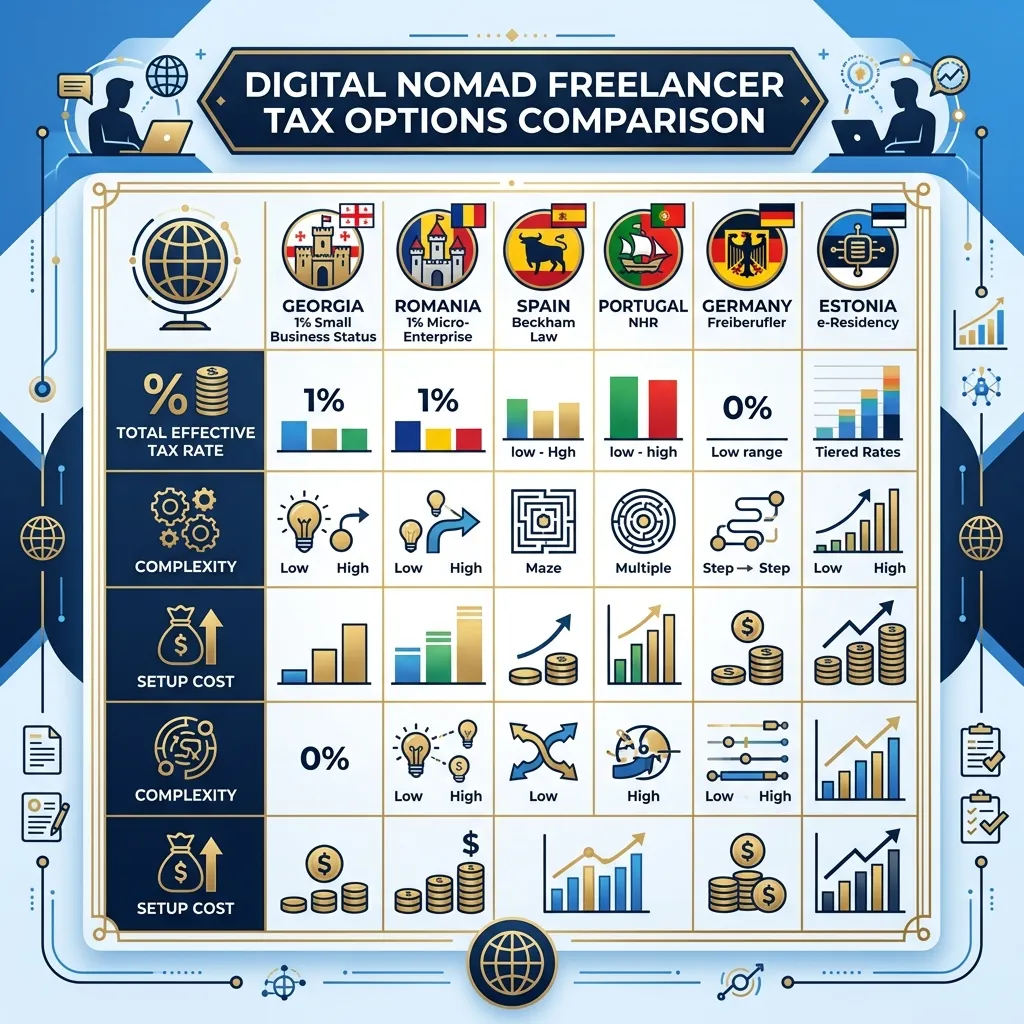
Germany’s Freiberufler visa requires establishing local clients, which makes it harder to obtain than Spain’s Digital Nomad Visa. However, if Germany is your target destination, it offers a robust residency pathway. You can read more about options in our freelancer tax guide.
Cost of Living in German Cities
Germany offers varying costs of living depending on the city you choose. Munich is the most expensive, while Berlin offers a thriving creative culture at a more moderate price.
Monthly Budget Estimates (2026)
| Expense Category | Munich | Berlin / Frankfurt | Leipzig / Dresden |
|---|---|---|---|
| Rent (1-Bedroom Apartment) | €1,100 – €1,600 | €850 – €1,300 | €550 – €800 |
| Utilities (Electricity, Heating) | €150 – €220 | €130 – €190 | €110 – €160 |
| Groceries | €300 – €400 | €280 – €380 | €250 – €330 |
| Dining Out & Beer | €250 – €400 | €220 – €350 | €180 – €280 |
| Coworking Space | €200 – €300 | €150 – €250 | €120 – €180 |
| Public Transport Pass | €49 (Deutschlandticket) | €49 (Deutschlandticket) | €49 (Deutschlandticket) |
| Total Estimated Budget | €2,049 – €2,969 | €1,679 – €2,519 | €1,259 – €1,799 |
The Deutschlandticket (€49/month) is a massive money-saver, granting you unlimited travel on all regional trains, buses, subways, and trams throughout Germany.
Frequently Asked Questions
Can I work with foreign clients on a German Freiberufler Visa?
Yes, you can work with clients worldwide. However, to qualify for the visa, you must show at least 2 letters of intent from clients based in Germany. German authorities want to make sure your work serves a local economic interest and that you pay taxes in Germany. Once approved, your income can be a mix of German and international clients.
Do I need to speak German to get the visa?
There is no formal German language requirement to obtain the Freiberufler Visa. However, the application process, tax registration, and Anmeldung are conducted entirely in German, and immigration officers are not required to speak English. Hiring an English-speaking relocation agent or bringing a German translator to your appointments is highly recommended.
How long does the Freiberufler Visa last?
The initial visa is typically issued for 1 to 2 years. It can be renewed continuously at the Ausländerbehörde, provided your freelance business remains financially stable, you have no tax debt, and you maintain compliant health insurance. After 5 years of continuous residence, you may qualify for permanent residency (Niederlassungserlaubnis) if you pass a basic German language test (B1 level).
What is the solidary surcharge and does it apply to me?
The solidarity surcharge (Solidaritätszuschlag) is a tax surcharge originally introduced to fund the integration of Eastern German states. In recent years, it has been abolished for approximately 90% of taxpayers. It only applies if your personal income tax liability exceeds €18,130 (single filer) or €36,260 (married couple), which corresponds to high incomes.
Can I do trade (Gewerbe) activities under this visa?
No. The Freiberufler Visa is restricted specifically to the “liberal profession” for which you applied. If you want to open a cafe, sell physical goods, or start an e-commerce company, you must apply for a standard self-employment visa (Gewerbevisum), which has different requirements (such as a minimum investment and creating jobs in Germany).
What is the Elster portal?
ELSTER (Elektronische Steuererklärung) is the official online portal of the German tax authorities. It is used to submit your tax registration questionnaire, file monthly or quarterly VAT returns (Umsatzsteuervoranmeldung), and submit your annual income tax returns. You need to register for an ELSTER account using your personal tax ID.
Final Thoughts
Germany’s Freiberufler Visa is a robust and legally secure pathway for freelancers looking to establish themselves in the heart of Europe. While the bureaucratic hurdles — such as address registration, ELSTER tax filing, and securing compliant German health insurance — are high, the reward is access to a stable economy and a path to permanent residency.
Before you make your move, use our Tax Calculator to evaluate how Germany’s progressive tax rates compare to your current tax jurisdiction. And if you are still exploring options, read our guide on double taxation treaties to see how Germany coordinates taxes with your home country. Planning ahead is the key to mastering German compliance and thriving in your freelance career.