Freelancer Tax Guide: How Remote Workers Should Handle Taxes in 2026

Freelancing and remote work have exploded in recent years, but taxes remain the single biggest source of confusion — and costly mistakes — for independent workers. Whether you’re a freelance designer billing clients from Lisbon, a remote software engineer working from Bali, or a content creator earning from multiple platforms, understanding your tax obligations is non-negotiable.
TL;DR: Freelancers and remote workers must pay self-employment tax of 15.3% (per IRS rules) on top of regular income tax, make quarterly estimated payments, and track deductions meticulously. If you work across borders, your tax residency — typically determined by the 183-day rule per OECD guidelines — dictates where you owe tax, and double taxation treaties can prevent being taxed twice.
This comprehensive 2026 guide covers everything freelancers and remote workers need to know about taxes: from self-employment tax and quarterly payments to deductions, international considerations, and the best tools to stay compliant.
Freelancer vs. Employee: The Tax Difference
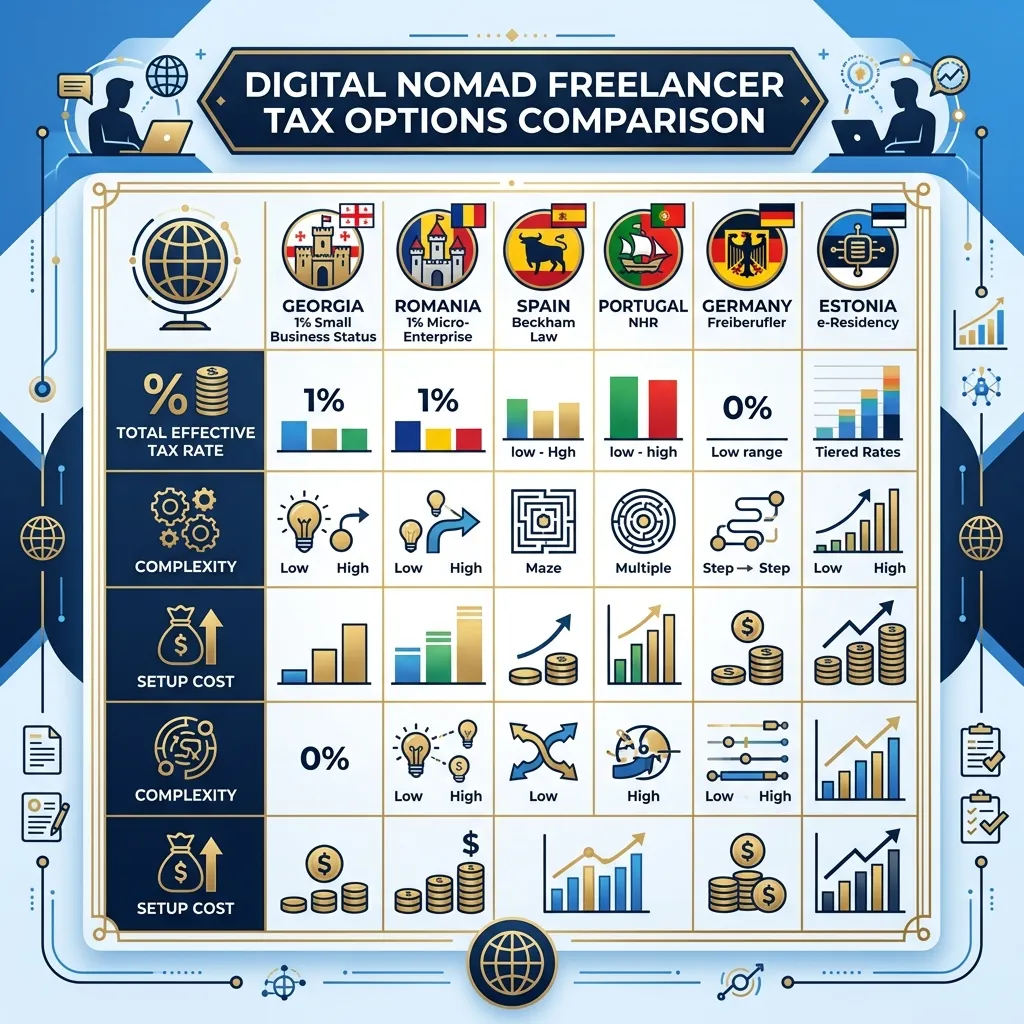
The most fundamental distinction in tax law is between employees (W-2 workers) and independent contractors (1099/freelancers). This classification determines how your taxes are calculated, withheld, and reported.
What Changes When You’re a Freelancer
| Factor | Employee (W-2) | Freelancer (1099/Self-Employed) |
|---|---|---|
| Tax withholding | Employer withholds taxes automatically | You are responsible for paying your own taxes |
| Social Security & Medicare | Split 50/50 with employer (7.65% each) | You pay the full 15.3% yourself |
| Tax filing | Single W-2 form | Schedule C, Schedule SE, 1099 forms |
| Quarterly payments | Not required (withheld per paycheck) | Required if you owe $1,000+ annually |
| Deductions | Limited (standard deduction) | Extensive business deductions available |
| Benefits | Employer-provided (health, retirement) | You fund your own benefits (but can deduct them) |
The biggest shock for new freelancers is the self-employment tax. According to the IRS, self-employed individuals are responsible for paying both halves of Social Security and Medicare contributions — a combined 15.3% on top of your regular income tax.
[!IMPORTANT] Misclassifying yourself as an employee when you’re actually a contractor — or vice versa — can trigger IRS audits, back taxes, and penalties. If you control how, when, and where you work, you’re likely an independent contractor.
Self-Employment Tax: The 15.3% Reality
Self-employment tax is the freelancer’s equivalent of FICA (Social Security + Medicare) contributions. In the United States, here’s how it breaks down for 2026:
- Social Security: 12.4% on the first $168,600 of net self-employment income
- Medicare: 2.9% on all net self-employment income
- Additional Medicare Tax: 0.9% on income above $200,000 (single filers) or $250,000 (married filing jointly)
- Total: 15.3% (up to the Social Security wage base), then 3.8%+ above that
How It’s Calculated
Self-employment tax is calculated on 92.35% of your net self-employment income (not your gross revenue). This adjustment accounts for the fact that employers get to deduct their share of FICA taxes.
Example: If you earn $100,000 net profit from freelancing:
- Taxable SE income: $100,000 × 92.35% = $92,350
- Social Security tax: $92,350 × 12.4% = $11,451
- Medicare tax: $92,350 × 2.9% = $2,678
- Total SE tax: $14,129
You can deduct 50% of your self-employment tax as an above-the-line deduction on your personal return, reducing your adjusted gross income.
Self-Employment Tax Equivalents Globally
| Country | Self-Employed Social Contributions | Notes |
|---|---|---|
| United States | 15.3% (SE tax) | Plus income tax on top |
| United Kingdom | Class 2 (£3.45/week) + Class 4 (6–9%) | National Insurance contributions |
| Germany | ~18.6% pension + ~14.6% health | Mandatory for most freelancers |
| Canada | 11.9% CPP (both portions) | Canada Pension Plan contributions |
| Australia | No mandatory SE contributions | But GST registration required above AUD $75k |
| Netherlands | ~27.65% social contributions | Reduced via zelfstandigenaftrek deduction |
Quarterly Estimated Tax Payments
Unlike employees who have taxes withheld each paycheck, freelancers must make quarterly estimated tax payments to the IRS (or equivalent agency in their country). This applies to both income tax and self-employment tax.
When Quarterly Payments Are Due (US)
| Quarter | Income Period | Due Date |
|---|---|---|
| Q1 | January 1 – March 31 | April 15 |
| Q2 | April 1 – May 31 | June 15 |
| Q3 | June 1 – August 31 | September 15 |
| Q4 | September 1 – December 31 | January 15 (following year) |
How to Calculate Your Quarterly Payments
The IRS provides two safe harbor methods to avoid underpayment penalties:
- 100% of prior year’s tax — Pay at least the total tax you owed last year, divided into four equal payments. This jumps to 110% if your AGI exceeded $150,000.
- 90% of current year’s tax — Estimate your current year’s total tax liability and pay at least 90% across four quarterly installments.
[!TIP] Use IRS Form 1040-ES or the estimated tax worksheet to calculate your payments. Most accounting software like QuickBooks Self-Employed can automate this calculation based on your actual income throughout the year.
Common Freelancer Tax Deductions
Deductions are your most powerful tool for reducing taxable income. As a freelancer, you can deduct ordinary and necessary business expenses — costs that are common in your industry and helpful to your work.
Home Office Deduction
If you use a dedicated space in your home regularly and exclusively for business, you qualify for the home office deduction. Two methods are available:
- Simplified method: Deduct $5 per square foot, up to 300 sq ft (maximum $1,500/year)
- Regular method: Calculate the actual percentage of your home used for business, then deduct that proportion of rent/mortgage interest, utilities, insurance, and maintenance
Travel and Transportation
Business travel is fully deductible, including:
- Flights and trains to client meetings, conferences, or coworking retreats
- Accommodation during business trips
- Meals during business travel (typically 50% deductible)
- Local transportation — mileage rate of $0.70/mile for 2026 (US), or actual vehicle expenses
Equipment and Technology
- Computers, monitors, and peripherals — often fully deductible in the year of purchase via Section 179 or bonus depreciation
- Software subscriptions — design tools, project management, cloud storage
- Phone and internet — the business-use percentage of your monthly bills
Coworking Spaces
Coworking memberships and day passes are fully deductible as a business expense. This includes coworking spaces used while traveling as a digital nomad.
Health Insurance Premiums
Self-employed individuals can deduct 100% of health insurance premiums for themselves, their spouse, and dependents. This is an above-the-line deduction, meaning it reduces your adjusted gross income even if you don’t itemize.
Professional Development
- Courses, certifications, and workshops related to your freelance work
- Books and publications in your field
- Conference and event tickets
- Professional memberships and industry associations
Other Commonly Missed Deductions
- Business banking and merchant processing fees (PayPal, Stripe, Wise fees)
- Accounting and legal services
- Business insurance (professional liability, E&O)
- Marketing and advertising (website hosting, domain names, social media ads)
- Retirement plan contributions (see below)
[!WARNING] Keep meticulous records. The IRS requires contemporaneous documentation for all business deductions — receipts, mileage logs, and a clear business purpose. Digital tools like Expensify or Dext make this painless, but you need to use them consistently.
International Freelancing: Where Do You Pay Tax?
This is where freelancer taxes get complicated. When you’re working from one country while billing clients in another, multiple tax jurisdictions may claim the right to tax your income.
The General Rule: Tax Residency
Per OECD Model Tax Convention guidelines, most countries tax based on residency, not citizenship. If you spend more than 183 days in a country within a calendar year, you’re typically considered a tax resident and owe tax on your worldwide income. Notable exceptions include:
- United States: Taxes citizens and permanent residents on worldwide income regardless of where they live. US freelancers abroad must still file and may owe US tax even while living overseas. The Foreign Earned Income Exclusion (FEIE) can exclude up to $130,000 (2026) of foreign-earned income.
- Eritrea: The only other country that taxes based on citizenship.
Avoiding Double Taxation
If you’re a tax resident in one country while earning from clients in another, you could theoretically be taxed twice on the same income. Double Taxation Treaties (DTAs) exist to prevent this. Based on OECD data, over 3,000 bilateral tax treaties are in force globally.
Key mechanisms include:
- Tax credits: Your home country credits you for taxes already paid abroad
- Exemptions: Certain income types are exempt from tax in one jurisdiction
- Reduced withholding rates: Treaties often lower withholding tax on cross-border payments
Read our in-depth guide on how double taxation treaties work to understand which treaty applies to your situation.
Digital Nomad Visas and Tax
Many countries now offer dedicated digital nomad visas with favorable tax treatment. Some — like Croatia’s 0% tax digital nomad visa — explicitly exempt foreign-sourced freelance income from local taxation. Others, like Portugal’s D8 visa, offer reduced flat rates under programs like NHR 2.0.
[!TIP] Before relocating, always check whether a country’s digital nomad visa creates a tax residency obligation. Some visas deliberately avoid creating tax residency, while others do not. Our guide on common nomad tax mistakes covers the most dangerous assumptions.
VAT/GST Considerations for Freelancers
Value Added Tax (VAT) or Goods and Services Tax (GST) is a consumption tax that may apply to your freelance services, depending on where you and your clients are located.
When VAT/GST Applies
- EU-based freelancers: If your annual revenue exceeds the local VAT threshold (varies by country — e.g., €22,000 in Germany, €85,000 in the UK for VAT), you must register, charge, collect, and remit VAT on your invoices.
- Selling to EU clients from outside the EU: Generally, B2B services are subject to the reverse charge mechanism — your client handles the VAT. B2C services may require you to register for VAT in the client’s country.
- US-based freelancers: The US does not have a federal VAT/GST. State sales taxes generally don’t apply to services, but some states (like Texas and Hawaii) tax certain professional services.
Practical Tips
- Always state your VAT status on invoices (registered, exempt, or reverse charge applies)
- Keep separate records for domestic vs. international sales
- Consider VAT registration even below thresholds if you want to reclaim input VAT on business purchases
Invoicing Best Practices for Tax Compliance
Proper invoicing isn’t just professional — it’s a legal requirement in most jurisdictions and critical for accurate tax reporting.
What Every Freelancer Invoice Should Include
- Your legal name or business name and address
- Client’s name and address
- Unique invoice number (sequential)
- Invoice date and payment due date
- Detailed description of services rendered
- Hours worked and hourly rate, or project-based pricing
- Subtotal, tax (if applicable), and total amount
- Currency (always specify — USD, EUR, GBP)
- Payment instructions (bank details, PayPal, Wise, etc.)
- Your tax identification number (EIN, VAT number, UTR, etc.)
[!TIP] Use invoicing software like FreshBooks, Wave, or Xero to automate numbering, track payments, and generate year-end reports. Manual spreadsheets are error-prone and won’t scale as your freelance business grows.
Retirement Planning for Freelancers
One of the most overlooked aspects of freelancing is retirement savings. Without an employer match, you need to take the initiative — but the tax advantages can be even better than traditional employment.
US Retirement Options for Self-Employed
| Plan | Max Contribution (2026) | Key Benefit |
|---|---|---|
| SEP IRA | Up to 25% of net SE income (max ~$69,000) | Simple setup, high limit |
| Solo 401(k) | $23,500 employee + 25% employer (max ~$69,000 combined) | Highest total contribution potential |
| Traditional IRA | $7,000 ($8,000 if 50+) | Tax-deductible contributions |
| Roth IRA | $7,000 ($8,000 if 50+) | Tax-free withdrawals in retirement |
The Solo 401(k) is the gold standard for high-earning freelancers because it allows both employee deferrals and employer contributions, maximizing your tax-deferred savings. A SEP IRA is simpler to administer and ideal if you don’t want the paperwork of a 401(k) plan.
International Retirement Considerations
If you’re freelancing from abroad, be aware that:
- Contributions to foreign pension schemes may not be tax-deductible in your home country
- Some countries have totalization agreements that coordinate social security benefits
- US citizens abroad can still contribute to IRAs and Solo 401(k)s using foreign-earned income (with some FEIE interactions to navigate)
Best Accounting Tools for Freelancers
The right software eliminates the headaches of manual bookkeeping and helps you stay audit-ready year-round.
| Tool | Best For | Starting Price | Key Features |
|---|---|---|---|
| QuickBooks Self-Employed | US freelancers | $15/month | Mileage tracking, Schedule C, quarterly tax estimates |
| Xero | International freelancers | $15/month | Multi-currency, 1,000+ integrations, VAT support |
| FreshBooks | Invoicing-heavy freelancers | $19/month | Beautiful invoices, time tracking, late payment reminders |
| Wave | Budget-conscious freelancers | Free | Free invoicing and accounting, paid payroll add-on |
| Bench | Hands-off bookkeeping | $299/month | Dedicated bookkeeper, year-end tax package |
| Wise Business | Cross-border payments | Low FX fees | Multi-currency accounts, batch payments |
[!TIP] At a minimum, use separate bank accounts for business and personal finances. This single habit makes tax time dramatically easier and provides clear documentation in case of an audit.
Tax Planning Strategies for Freelancers
Beyond deductions, proactive tax planning can save you thousands each year:
- Estimate income quarterly and adjust payments to avoid underpayment penalties
- Bunch deductions into high-income years (e.g., pre-pay subscriptions or buy equipment in December)
- Maximize retirement contributions before year-end to reduce taxable income
- Consider incorporation — an S-Corp election can reduce self-employment tax for freelancers earning above ~$80,000/year
- Hire a tax professional who specializes in self-employment and international taxation — the cost is itself deductible
- Use our Digital Nomad Tax Calculator to model different scenarios and optimize your tax strategy
Frequently Asked Questions
How much should a freelancer set aside for taxes?
A safe rule of thumb is to set aside 25–30% of your gross income for taxes if you’re in the US. This covers both income tax and self-employment tax. If you’re in a high-tax state like California or New York, consider setting aside 30–35%. Freelancers in lower-tax jurisdictions may only need 20–25%. The exact amount depends on your total income, deductions, filing status, and state of residence.
Do I need to file taxes if I made less than $400 from freelancing?
If your net self-employment income is under $400, you are not required to pay self-employment tax or file a Schedule SE. However, you may still need to file an income tax return if your total income from all sources exceeds the standard filing threshold ($14,600 for single filers in 2026). Always report all income to avoid issues with the IRS.
Can I deduct my coworking membership while traveling abroad?
Yes. Coworking memberships and day passes are deductible as ordinary and necessary business expenses, regardless of where the coworking space is located. If you’re a digital nomad working from coworking spaces in Lisbon, Bali, or Bangkok, those costs are fully deductible against your freelance income. Keep receipts and document the business purpose.
What happens if I miss a quarterly estimated tax payment?
The IRS charges an underpayment penalty calculated as interest on the unpaid amount for each day it remains outstanding. The penalty rate fluctuates with federal short-term interest rates (approximately 7–8% annually in 2026). To minimize penalties, make a catch-up payment as soon as possible and consider using the annualized income installment method if your income is irregular.
Do I need to charge sales tax or VAT on my freelance services?
It depends on your location and the type of services you provide. In the US, most states do not tax professional services, but some states (Texas, New Mexico, Hawaii) do. In the EU, you must charge VAT once your revenue exceeds the local threshold, unless the reverse charge mechanism applies for cross-border B2B transactions. Always check local regulations and consult a tax advisor.
Should I form an LLC or S-Corp for my freelance business?
An LLC provides liability protection and pass-through taxation but doesn’t reduce self-employment tax. An S-Corp election can save significant self-employment tax by allowing you to split income between a “reasonable salary” (subject to FICA) and distributions (not subject to FICA). The S-Corp election generally becomes beneficial when net profit exceeds $80,000–$100,000/year. Consider the added payroll and compliance costs before making the switch.
How do I handle taxes if I freelance for clients in multiple countries?
The key principle is that you generally owe tax in your country of tax residency, not where your clients are located. However, some countries may withhold tax on payments made to foreign contractors. Use double taxation treaties to claim credits or exemptions, and always check whether a country requires you to register for VAT/GST when providing services to local clients. A cross-border tax specialist is invaluable in this situation.
Can I deduct health insurance premiums as a freelancer?
Yes. Self-employed individuals in the US can deduct 100% of health insurance premiums for themselves, their spouse, and dependents as an above-the-line deduction on Form 1040. This includes medical, dental, and qualifying long-term care insurance. The deduction is not available for months when you were eligible to participate in an employer-sponsored health plan (including a spouse’s plan).
Final Thoughts
Freelancer taxes are more complex than traditional employment, but they also come with significant advantages — if you know how to use them. The combination of business deductions, retirement plan contributions, and strategic entity selection can dramatically reduce your effective tax rate compared to a salaried employee earning the same gross income.
The most important steps you can take right now:
- Separate your business and personal finances immediately
- Set aside 25–30% of every payment in a dedicated tax savings account
- Track all business expenses from day one using accounting software
- Make quarterly estimated payments on time to avoid penalties
- Consult a tax professional — especially if you earn internationally or work from multiple countries
For more tax optimization strategies, check out our guides on the Foreign Earned Income Exclusion (FEIE), common nomad tax mistakes to avoid, and our Digital Nomad Tax Calculator to model your specific situation.