US LLC vs. Estonia e-Residency: Which is Best for Non-US Digital Nomads? (2026)

When establishing a remote business, choosing the right corporate structure is the single most critical decision you will make. For non-U.S. digital nomads and freelancers, the choice almost always boils down to two highly popular pathways: forming a single-member U.S. LLC or registering an Estonian OÜ company via the Estonia e-Residency program.
TL;DR: For most solo freelancers, a U.S. LLC is the cheapest and most tax-efficient structure, offering 0% corporate and dividend tax if you have no physical presence or operations in the U.S. However, if you need a European VAT number, deal heavily with EU clients, or prefer the prestige and corporate stability of an EU-based entity, Estonia e-Residency (OÜ) is the superior choice despite its higher setup and accounting costs.
This guide provides a comprehensive head-to-head comparison of costs, tax regimes, banking setups, and administrative burdens to help you choose the best company structure for digital nomads in 2026.
The Core Contenders
Before diving into the numbers, let’s define both corporate entities:
1. The Single-Member U.S. LLC
A U.S. Limited Liability Company (LLC) formed by a non-U.S. citizen who does not reside in the United States is classified by the IRS as a “disregarded entity” for tax purposes by default. This means the company itself pays 0% corporate tax; instead, all profits and losses “pass through” directly to the owner personally.
2. The Estonian OÜ (Osaühing)
An Estonian OÜ is a private limited company registered through the Estonia e-Residency program. E-Residency grants you a secure digital ID card to manage Estonian business affairs completely online. The OÜ is a standard European corporation but operates under Estonia’s unique tax deferral system.
Head-to-Head Comparison: US LLC vs. Estonia OÜ
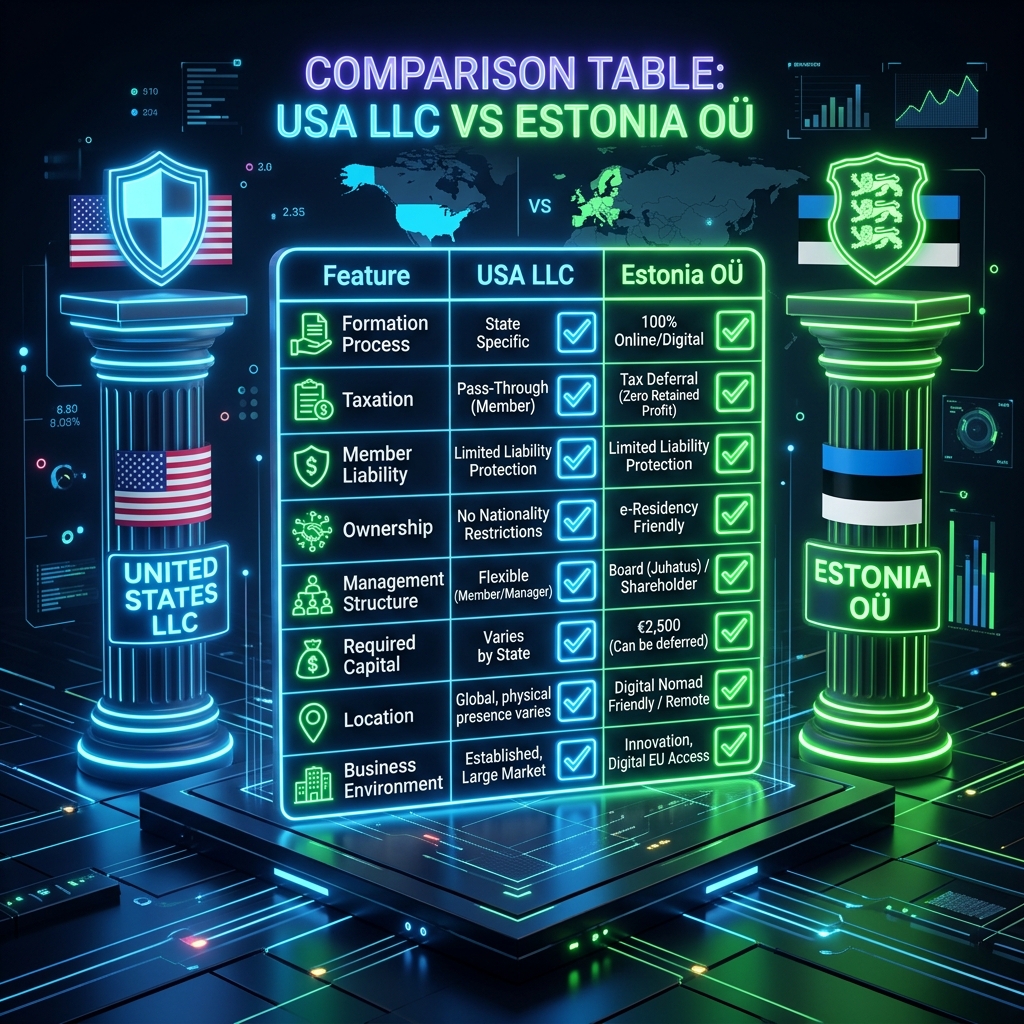
1. Tax Comparison: LLC vs. Estonia
Taxation is the main differentiator between these two structures.
- U.S. LLC (0% Tax): If you are a Non-Resident Alien (NRA) with no U.S. Trade or Business (USTOB), your LLC owes 0% U.S. federal income tax. To maintain this 0% status, you must have no physical office, no employees, and perform no services while physically present inside the U.S. All income received by the LLC is classified as foreign-source income and is only subject to tax in your personal country of tax residency.
- Estonian OÜ (0% Tax on Retained Profits): Estonia does not tax corporate profits when they are earned. Instead, you pay a flat 20% corporate income tax (CIT) (calculated as 20/80 on net distributions) only when you distribute profits as dividends. As long as you keep the money inside the company to reinvest in marketing, software, travel, or equipment, you pay 0% tax.
[!CAUTION] If you are a tax resident of a high-tax country (e.g., Germany, UK, Australia), both structures are subject to Controlled Foreign Corporation (CFC) rules. Your home country may tax your U.S. LLC profits or Estonian OÜ profits immediately, even if undistributed. To avoid this, digital nomads must formally break tax residency or establish a low-tax home base. For more details, see our guide on breaking state tax residency.
Setup and Maintenance Costs (2026 Estimates)
Running an offshore business carries recurring costs that eat into your margins. Here is how they compare in 2026:
| Cost Category | U.S. LLC (Wyoming/Delaware) | Estonian OÜ (via e-Residency) |
|---|---|---|
| Digital ID / e-Residency Fee | $0 | €120 – €130 (One-time) |
| State / Government Registration | $100 – $200 | €265 (One-time) |
| Registered Agent / Contact Person | $39 – $150/year | €150 – €300/year (Mandatory) |
| Annual State Franchise Fee | $60 (Wyoming) or $300 (Delaware) | €0 |
| Bookkeeping & Accounting | $0 (DIY filing) | €50 – €150/month (Recommended) |
| Annual Tax Filing Fees | $0 (Form 5472 + 1120 DIY) | €100 – €250/year (Annual Report) |
| Average First Year Cost | $150 – $350 | €600 – €1,200 |
| Average Recurring Annual Cost | $100 – $450/year | €800 – €2,000/year |
Banking and Payment Gateways
Receiving client payments and connecting payment processors is a critical bottleneck.
- U.S. LLC Banking: U.S. LLCs have excellent banking options. You can open a business account remotely with fintech platforms like Mercury or Wise Business using your EIN (Employer Identification Number). You can also easily open Stripe and PayPal Business accounts to accept credit cards globally.
- Estonian OÜ Banking: While Estonia has advanced banking, traditional Estonian banks (like LHV) require a physical visit or strong ties. E-residents typically rely on Wise Business or Revolut Business which provide EU IBANs. Stripe and PayPal integrate natively with Estonian companies, but getting approved can sometimes require showing local business substance. Learn more about these setups in our digital nomad banking guide.
Administrative and Reporting Requirements
The administrative burden varies significantly between the two systems:
- U.S. LLC (Low Burden): Disregarded U.S. LLCs owned by non-U.S. citizens have no bookkeeping audit requirements. You only need to file two forms annually with the IRS: Form 5472 and Form 1120 (Pro Forma). Missing the filing deadline carries a strict $25,000 penalty, so hiring a tax preparer or using specialized software is highly recommended.
- Estonian OÜ (Medium-High Burden): Estonia mandates strict accounting. If your company is registered for VAT, you must submit monthly VAT declarations and annexes. Every Estonian company must submit a detailed Annual Report (majandusaasta aruanne) prepared in accordance with Estonian GAAP or IFRS.
Pros and Cons Summary
Single-Member U.S. LLC
- Pros: Lowest setup and annual fees; 0% tax on distributions (if no USTOB); no monthly bookkeeping filing requirements; easy access to US Stripe/PayPal.
- Cons: Lacks the prestige of an EU entity; no EU VAT number (harder to deal with EU B2B clients); filing errors carry a massive $25,000 IRS penalty.
Estonian OÜ
- Pros: Prestigious EU business entity; 100% online management with digital signatures; 0% tax on reinvested/retained profits; native EU VAT registration.
- Cons: High recurring accounting and contact person fees; distributed profits are taxed at 20%; opening a traditional bank account is difficult.
The Verdict: Which Structure Should You Choose?
Choose a U.S. LLC if:
- You are a solo freelancer, consultant, or software developer selling services primarily to clients in the U.S. or outside the EU.
- You want the lowest possible annual maintenance costs (under $150/year).
- You want to keep accounting simple and avoid monthly bookkeeping submissions.
Choose Estonia e-Residency (OÜ) if:
- You sell products or services to European businesses (B2B) and need a European VAT number to participate in the VAT OSS scheme.
- You want to pool profits inside a corporate piggy bank to reinvest in investments, equipment, or other startups without triggering personal income tax.
- You value the digital security and convenience of Estonia’s e-governance system.
Authoritative Reference Sources
- IRS Single-Member LLC Guidelines: IRS Disregarded Entities Rules
- IRS USTOB & Foreign Source Income Definitions: USTOB Source Rules
- Estonian e-Residency Portal: Official e-Residency Website
- Estonia Tax and Customs Board (EMTA): Estonian Corporate Income Tax Rules