Best Banks & Financial Tools for Digital Nomads (2026): Wise, Revolut, Mercury & More

Setting up a reliable digital nomad banking system is the invisible infrastructure of the remote work lifestyle. You can find the perfect visa, nail your tax strategy, and line up remote clients — but if you can’t efficiently receive payments, convert currencies, and move money across borders without hemorrhaging fees, your bottom line suffers every single month.
TL;DR: The best digital nomad banking setup in 2026 is a combination of Wise (for multi-currency receiving and FX conversion at the mid-market rate), Revolut (for daily spending and ATM withdrawals), and a US or EU business account like Mercury or LHV for formal invoicing. If you hold over $10,000 in aggregate across foreign accounts at any point during the year, US persons must file an FBAR with FinCEN — and over 100 jurisdictions now share account data automatically under the OECD’s Common Reporting Standard (CRS).
This guide compares every major banking and financial tool digital nomads actually use in 2026, breaks down the real costs, and covers the tax compliance obligations — like FBAR and CRS — that most nomads don’t learn about until it’s too late.
Why Traditional Banks Don’t Work for Nomads
Traditional banks were built for people with a permanent address, a domestic salary, and a single currency. Digital nomads break all of those assumptions — foreign transaction fees of 1.5–3%, international wire costs of $15–$45 per transfer (per the World Bank’s Remittance Prices Worldwide database), address requirements that don’t accommodate nomadic living, and fraud detection systems that freeze your account when you log in from a new country.
Fintech banks and multi-currency platforms — Wise, Revolut, N26, Mercury — solve these problems with borderless accounts, real exchange rates, and dramatically lower fees.
Multi-Currency Personal Accounts
Multi-currency accounts are the foundation of nomad banking. They let you hold, receive, and convert money in dozens of currencies without the punishing fees of traditional banks.
Wise (formerly TransferWise)
Wise is a financial technology company regulated by the Financial Conduct Authority (FCA) in the UK and FinCEN in the United States. It is the gold standard for multi-currency accounts among nomads.
- Currencies: Hold 40+ currencies; send to 80+ countries
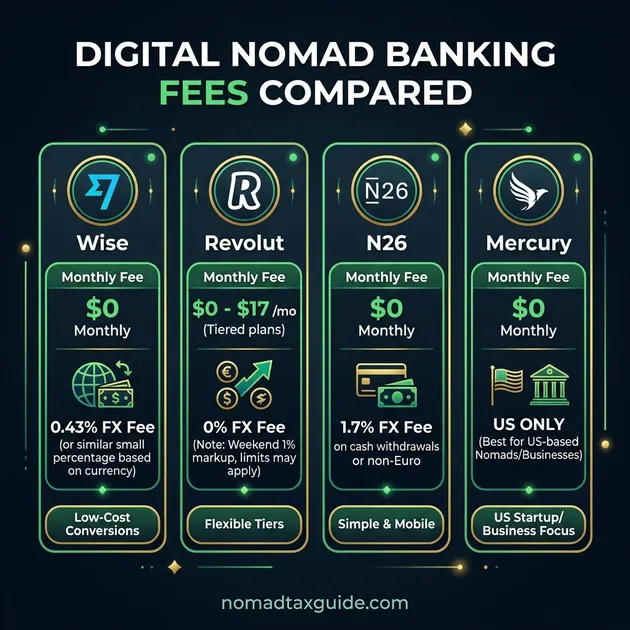
- Exchange rate: The mid-market rate with no markup — Wise charges a transparent fee per conversion (0.33–0.61%)
- Local account details: Get local bank details in USD, EUR, GBP, AUD, NZD, SGD, TRY, RON, HUF, and CAD
- Card: Visa/Mastercard debit card that auto-converts at the mid-market rate
- ATM withdrawals: Free up to $100/month; 1.75% fee above that
- Monthly cost: Free
- Best for: Receiving client payments, FX conversion, invoicing internationally
[!TIP] Wise’s local account details are a game-changer for freelancers. If your US client pays you via ACH to your Wise USD account details, they pay zero international wire fees — and you receive the full amount. No $30–$45 incoming wire fee. This alone can save hundreds per year. For more on freelancer financial setup, see our freelancer tax guide.
Revolut
Revolut is a global neobank authorized by the European Central Bank (ECB) through its Lithuanian banking license. It has become the most popular day-to-day spending tool for nomads.
- Currencies: 36 currencies to hold and exchange
- Exchange rate: Mid-market rate on weekdays; 1% markup on weekends
- ATM withdrawals: Free up to $200/month (Standard); up to $800/month (Metal)
- Plans: Standard (free), Plus ($3.99/month), Premium ($9.99/month), Metal ($16.99/month)
- Extras: Crypto trading, disposable virtual cards, budgeting tools, travel insurance (Premium+)
- Best for: Daily spending abroad, ATM withdrawals, budgeting
N26
N26 is a German neobank supervised by BaFin (Federal Financial Supervisory Authority). EUR-based accounts only, with plans from free to €16.90/month. EU/EEA address required — best for nomads with a European base who want a full IBAN.
Comparison: Multi-Currency Personal Accounts
| Feature | Wise Personal | Revolut Standard | Revolut Premium | N26 Standard |
|---|---|---|---|---|
| Monthly fee | Free | Free | $9.99/month | Free |
| Currencies held | 40+ | 36 | 36 | EUR only |
| FX rate | Mid-market (always) | Mid-market (weekdays) | Mid-market (weekdays) | Mastercard rate |
| FX fee | 0.33–0.61% (transparent) | Free up to $1,000/month, then 0.5% | Free up to $3,000/month, then 0.5% | 1.7% (free on Smart+) |
| Local account details | USD, EUR, GBP + 7 more | EUR, GBP, USD (EEA residents) | EUR, GBP, USD (EEA residents) | EUR (IBAN) |
| Free ATM withdrawals | $100/month | $200/month | $400/month | 3 withdrawals/month |
| Card type | Visa / Mastercard | Visa / Mastercard | Visa / Mastercard | Mastercard |
| Crypto | No | Yes | Yes | No |
| Availability | Global (most countries) | Global (most countries) | Global (most countries) | EU/EEA only |
US Business Banking for Nomads
If you operate a US LLC, C-Corp, or sole proprietorship, you need a US business bank account — and you need one that won’t freeze your account the moment you log in from Chiang Mai.
Mercury
Mercury is a fintech providing FDIC-insured banking (via Choice Financial Group and Evolve Bank & Trust). It’s the default for US-incorporated nomads running LLCs from abroad.
- Monthly fee: Free (no minimum balance)
- Features: Checking, savings (up to 5.00% APY), QuickBooks/Xero/Stripe integrations, virtual and physical Visa cards
- International wires: $5 per outgoing transfer
- Key advantage: Nomad-friendly — explicitly serves remote founders; won’t flag foreign logins
- Requirements: US-registered business entity with EIN; no US residential address needed
Relay
Relay (FDIC-insured via Thread Bank) offers free business banking with up to 20 sub-accounts per business — ideal for profit-first budgeting. Pro plan at $30/month adds advanced features. Integrates with QuickBooks and Xero.
Comparison: US Business Banking
| Feature | Mercury | Relay | Traditional Bank (Chase Business) |
|---|---|---|---|
| Monthly fee | Free | Free (Pro: $30/month) | $15/month (waivable) |
| Minimum balance | None | None | $2,000 (to waive fee) |
| International wires | $5 outgoing | $5 outgoing | $40–$50 outgoing |
| Nomad-friendly | Yes | Yes | No (foreign login flags) |
| API access | Yes | Limited | No |
| Savings APY | Up to 5.00% | Up to 4.00% | 0.01% |
| FDIC insured | Yes (via partner banks) | Yes (via Thread Bank) | Yes |
| EIN required | Yes | Yes | Yes |
| Card | Visa debit + corporate credit | Visa debit | Debit + credit (separate app) |
[!IMPORTANT] Even if you live abroad full-time, the IRS requires US LLCs to maintain proper US business banking records. Commingling personal and business funds — or running business income through a personal Wise account — can jeopardize your LLC’s liability protection and create tax complications. See our guide on common nomad tax mistakes for more on this.
EU Business Banking for Nomads
European business banking has become increasingly accessible thanks to fintech platforms and programs like Estonia’s e-Residency, which allows non-residents to register and manage an EU company entirely online.
Wise Business
- Monthly fee: Free (pay-per-use fees on conversions and transfers)
- Currencies: 40+ currencies with local account details
- Multi-user access: Add team members with role-based permissions
- Batch payments: Pay multiple invoices or contractors in one batch
- Integrations: Xero, QuickBooks, FreeAgent
- Best for: Freelancers and small businesses that invoice internationally in multiple currencies
Revolut Business
- Plans: Free (limited), Grow (€25/month), Scale (€100/month)
- Currencies: 36+ currencies
- Cards: Physical and virtual cards with per-card spending controls
- Features: Expense management, invoicing, team member cards, accounting integrations
- Best for: Small teams and businesses that need expense management alongside banking
LHV Bank (Estonia)
LHV Pank is a licensed Estonian bank commonly used by Estonia e-Residency company owners. It is fully regulated by the Estonian Financial Supervision Authority (Finantsinspektsioon) and offers traditional banking with an EU IBAN.
- Monthly fee: €7/month for business accounts
- Account type: Full Estonian business bank account with SEPA IBAN
- Onboarding: Can be opened remotely for e-Residency company holders (video verification)
- Best for: Estonia e-Residency OÜ (company) owners who need a proper EU bank account for their business
[!TIP] Combining Estonia e-Residency with an LHV or Wise Business account creates a powerful EU business structure that you can manage from anywhere. For a deep dive, read our Estonia e-Residency guide.
Crypto-Friendly Banking Options
For nomads receiving crypto payments, Revolut supports 200+ cryptocurrencies with in-app trading and card spending, while Wirex (FCA-registered) offers a Visa card that auto-converts crypto to fiat at point of sale. Key tax considerations: per IRS guidance (Notice 2014-21), crypto is treated as property — every conversion to fiat is a taxable event. US persons must report crypto on foreign exchanges on their FBAR if aggregate foreign account values exceed $10,000. Use CoinTracker or Koinly for accurate tax reporting.
How to Open a Digital Nomad Bank Account Remotely
One of the biggest practical challenges nomads face is satisfying Know Your Customer (KYC) and address verification requirements when you don’t have a traditional permanent address.
Step 1: Establish a Home-Country Anchor Address
Most financial institutions require a residential address for regulatory reasons. Options include:
- Family member’s address: The simplest solution — use a parent’s or sibling’s address as your registered address
- Virtual mailbox services: Services like Traveling Mailbox, iPostal1, or Earth Class Mail provide a real US street address (not a P.O. box) that satisfies bank requirements, and they scan your mail for you
- Registered agent address: If you have a US LLC, your registered agent’s address can serve as your business address
Step 2: Prepare Your KYC Documents
Gather these before applying:
- Valid passport (not expired within 6 months)
- Proof of address: Utility bill, bank statement, or government letter dated within 3 months. Virtual mailbox statements often work
- Tax identification number: SSN or ITIN (US), TIN (EU), or your national tax number
- Proof of income: Some banks (especially EU banks) ask for recent pay stubs, contracts, or tax returns
Step 3: Choose Your Account Opening Strategy
| Platform | Can open remotely? | Address required? | ID verification |
|---|---|---|---|
| Wise | Yes (fully online) | Home country address | Passport + selfie |
| Revolut | Yes (fully online) | Home country address | Passport + selfie |
| Mercury | Yes (fully online) | US business address (EIN) | Passport + business docs |
| N26 | Yes (video call) | EU/EEA address required | Passport + video ID |
| LHV (Estonia) | Yes (video call) | Estonia e-Residency + OÜ | e-Residency card + video |
| Traditional US bank | In-person (usually) | US residential address | SSN + in-person ID |
Step 4: Build Your Banking Stack
The ideal nomad banking setup uses multiple accounts for different purposes:
- Home-country anchor account: Keep one traditional bank account in your home country for tax payments, government interactions, and emergency access (e.g., Chase, Barclays, or your local bank)
- Multi-currency hub: Wise for receiving international payments, converting currencies, and holding balances in 40+ currencies
- Daily spending card: Revolut for day-to-day purchases, ATM withdrawals, and budgeting
- Business account: Mercury (US) or Wise Business (EU) for invoicing, payroll, and business expenses
- Emergency backup: A second card on a different network (Visa + Mastercard) in case one is declined or blocked
[!WARNING] Never rely on a single bank account or a single card. ATMs eat cards, accounts get temporarily frozen for security reviews, and fintech apps occasionally go down. Always carry at least two cards on different networks and keep emergency cash in local currency.
Real Monthly Cost Comparison
Let’s model the actual monthly banking costs for a typical digital nomad earning $5,000/month from US clients while living in Southeast Asia (spending in THB/VND/IDR):
| Cost Category | Traditional Bank (Chase) | Wise + Revolut | Mercury + Wise + Revolut |
|---|---|---|---|
| Monthly account fees | $15 | $0 | $0 |
| Receiving $5k wire from client | $15 incoming fee | $0 (ACH to Wise USD) | $0 (ACH to Mercury) |
| Converting $3k to local currency | $60–$150 (2–5% markup) | $12–$18 (0.4–0.6% Wise fee) | $12–$18 (convert via Wise) |
| 8 ATM withdrawals/month | $24–$56 ($3–$7 each) | $0–$10 (free tiers) | $0–$10 (free tiers) |
| 10 card purchases abroad | $15–$45 (1–3% FX fee) | $0 (mid-market rate) | $0 (mid-market rate) |
| 1 international wire out | $45 | $3–$7 | $5 (Mercury) |
| Total estimated monthly cost | $114–$326 | $15–$35 | $17–$33 |
| Annual savings vs. traditional | — | $948–$3,492 | $972–$3,516 |
These savings are conservative. Nomads who receive payments in multiple currencies, convert larger sums, or make more frequent international transfers save even more.
Tax Implications: FBAR, CRS, and Foreign Account Reporting
This is the section most nomad banking guides skip — and it’s arguably the most important. Holding bank accounts in foreign countries creates tax reporting obligations that carry severe penalties if ignored.
FBAR (Report of Foreign Bank and Financial Accounts)
The FBAR is a reporting requirement administered by the Financial Crimes Enforcement Network (FinCEN), a bureau of the US Department of the Treasury. Under the Bank Secrecy Act (31 U.S.C. § 5314), any US person (citizen, resident, or green card holder) who has a financial interest in, or signature authority over, foreign financial accounts must file an FBAR if the aggregate value of all foreign accounts exceeds $10,000 at any point during the calendar year.
Key FBAR rules:
- Who must file: US citizens, residents, and green card holders — regardless of where they live
- Threshold: $10,000 aggregate across all foreign accounts (not per account)
- What counts: Bank accounts, brokerage accounts, mutual funds, and yes — Wise, Revolut, and N26 accounts if held at a foreign financial institution
- Filing deadline: April 15 (with automatic extension to October 15)
- How to file: Electronically through FinCEN’s BSA E-Filing System (FinCEN Form 114)
- Penalties for non-filing: Up to $10,000 per violation for non-willful violations; up to $100,000 or 50% of account balance (whichever is greater) for willful violations, plus potential criminal prosecution
[!CAUTION] Wise and Revolut accounts may trigger FBAR filing requirements. Wise holds funds in partner banks outside the US (primarily in the UK and Belgium). Revolut operates under a Lithuanian banking license. If the combined balance of these accounts plus any other foreign accounts exceeds $10,000 at any point during the year, you must file an FBAR. Many nomads don’t realize this until they’re already non-compliant. Read about more pitfalls like this in our common nomad tax mistakes guide.
FATCA (Foreign Account Tax Compliance Act)
FATCA is a separate US reporting requirement that applies at higher thresholds: US persons living abroad must report foreign financial assets on IRS Form 8938 if the total value exceeds $200,000 on the last day of the year or $300,000 at any point (single filers abroad). FATCA also requires foreign institutions to report US account holders to the IRS automatically.
CRS (Common Reporting Standard)
The Common Reporting Standard (CRS) is a framework developed by the Organisation for Economic Co-operation and Development (OECD) for automatic exchange of financial account information between tax authorities. Over 110 jurisdictions participate, including all EU member states, the UK, Singapore, and Canada. You cannot hide foreign accounts from your tax authority — your bank reports your name, tax ID, and account balance to the relevant jurisdiction automatically.
FBAR vs. FATCA Quick Reference
| Feature | FBAR (FinCEN Form 114) | FATCA (IRS Form 8938) |
|---|---|---|
| Who files | US persons | US persons |
| Threshold (abroad) | $10,000 aggregate (any point) | $200,000 end of year / $300,000 any point |
| What’s reported | Foreign financial accounts | Foreign financial assets (broader) |
| Filed with | FinCEN (Treasury) | IRS (with tax return) |
| Penalty (non-willful) | Up to $10,000/violation | $10,000/violation |
| Penalty (willful) | Up to $100,000 or 50% of balance | $40,000 (continued non-filing) |
| Deadline | April 15 (auto-extension Oct 15) | With tax return (April 15 / extension) |
For comprehensive guidance on determining your tax residency status — which directly affects where and how you report foreign accounts — see our tax residency certificate guide.
PSD2 and Open Banking in Europe
The EU Payment Services Directive (PSD2), enacted by the European Parliament, introduced Strong Customer Authentication (SCA) — requiring two-factor auth for EEA payments over €30 — and Open Banking, which lets accounting tools like Xero pull transactions directly from your Revolut or N26 account. If you use EU bank accounts, PSD2’s open banking saves hours of manual bookkeeping.
Best Practices: Your Nomad Banking Checklist
Here’s a step-by-step checklist to build and maintain a compliant, cost-effective banking setup:
- Audit your current accounts: List every bank account, fintech account, and crypto wallet you hold — including Wise, Revolut, PayPal, and exchange wallets
- Check FBAR/FATCA thresholds: If you’re a US person, determine whether your aggregate foreign account balances exceed $10,000 (FBAR) or $200,000/$300,000 (FATCA)
- Set up a multi-currency hub: Open a Wise account for receiving payments and FX conversion
- Get a daily spending card: Open a Revolut account for everyday purchases and ATM withdrawals
- Establish business banking: Mercury (US LLC) or Wise Business (EU company) for business finances
- Separate business and personal: Never commingle funds — it’s a tax and liability risk
- Carry backup cards: At least two cards on different networks, plus emergency cash
- File your FBAR on time: April 15 deadline (auto-extension to October 15) via FinCEN BSA E-Filing
- Track your tax residency: Where you’re a tax resident determines your reporting obligations. Use our tax residency certificate guide and double taxation treaties guide
- Review annually: Fintech products change fast — re-evaluate your banking stack every year
Frequently Asked Questions
Do I need to report my Wise account on an FBAR?
Yes, in most cases. Per FinCEN guidance, Wise holds funds in foreign partner banks (UK and Belgium), making it a reportable foreign account. If your combined foreign balances (Wise + Revolut + others) exceed $10,000 at any point during the year, you must file an FBAR listing all foreign accounts — not just those individually over the threshold.
Is Revolut a bank or an e-money institution?
It depends on your region. In the EU, Revolut holds a full banking license (deposits protected up to €100,000). In the UK, it has a PRA banking license (£85,000 FSCS protection). In the US, it’s not a bank — it partners with Metropolitan Commercial Bank for potential pass-through FDIC insurance. Always check deposit protection in your specific country.
Can I open a Mercury account if I live outside the US?
Yes. You need a US-registered business entity with an EIN — no SSN or US residential address required. Many nomads register a Wyoming or Delaware LLC through services like Firstbase or doola, then open a Mercury account entirely remotely.
How does Wise compare to PayPal for receiving international payments?
Wise is dramatically cheaper. PayPal charges 2.9% + $0.30 per transaction plus 3–4% on currency conversion. Wise charges no fee for local transfers (ACH, SEPA) and 0.33–0.61% for conversion. On a $5,000 payment, PayPal costs ~$175–$345; Wise costs ~$0–$30. PayPal also has a history of freezing accounts and holding funds for 21 days.
What happens to my bank accounts if I change my tax residency?
You must update your tax residency declaration with each financial institution. Under the OECD’s CRS, banks report your account information to the tax authority of your declared residence. Failing to update creates compliance issues. US citizens are always reported to the IRS regardless, due to FATCA. Our tax residency certificate guide explains how to formally document your new residency.
Are there any countries where opening a local bank account is especially easy or hard for nomads?
Easy: Georgia (passport only, under an hour), Thailand (tourist visa holders accepted), Estonia (via e-Residency). Hard: Germany (requires Anmeldung + tax ID), Japan (residence card + 6-month wait), UAE (Emirates ID required). In most cases, Wise and Revolut eliminate the need for a local account entirely. See our guide to the best digital nomad countries in 2026.
Should I use a VPN when accessing my bank accounts abroad?
Generally, no. VPNs can trigger fraud detection, account freezes, or restrictions. Wise, Revolut, and Mercury are designed for global use and expect logins from various countries. If you’re concerned about security, use mobile data rather than public Wi-Fi — and never access banking on unsecured networks.
Final Thoughts
Your banking setup is the financial plumbing of your nomad life — invisible when it works well, and catastrophic when it doesn’t. The combination of Wise + Revolut + a proper business account covers 90% of what most digital nomads need: multi-currency receiving, cheap FX conversion, daily spending, and compliant business finances.
But the tools are only half the equation. The compliance side — FBAR, FATCA, and CRS reporting — is where nomads most often get into trouble. If you hold money outside your home country (and you almost certainly do), make sure you understand your reporting obligations before you learn about them from a penalty notice.
Your key action steps:
- Set up Wise and Revolut if you haven’t already — the combined savings over traditional banking pay for themselves within weeks
- Open a Mercury or Wise Business account for your business entity to keep business and personal finances separate
- File your FBAR if your aggregate foreign account balances exceeded $10,000 at any point this year
- Review your banking stack annually as fintech products, fees, and regulations change frequently
- Use our Digital Nomad Tax Calculator to model the full picture of how your financial setup, location, and tax strategy fit together
For more on building a tax-efficient nomad life, explore our guides on double taxation treaties, the Foreign Earned Income Exclusion (FEIE), and the best digital nomad countries for 2026.