Croatia Digital Nomad Visa: 0% Tax & How to Apply (2026)
Croatia has become one of the most attractive destinations in Europe for remote workers, thanks to its dedicated Digital Nomad Visa that offers 0% Croatian income tax on foreign-sourced earnings. Combine that with stunning Adriatic coastlines, fast internet, and EU membership, and you’ve got a near-perfect base for location-independent professionals.
TL;DR: Croatia’s Digital Nomad Visa offers 0% Croatian income tax on all foreign-sourced income for up to 12 months. You must earn at least €2,540/month, work exclusively for non-Croatian employers or clients, and hold valid health insurance. It’s one of the only true zero-tax digital nomad visas in the EU.
In this comprehensive 2026 guide, we’ll walk you through everything you need to know — from eligibility requirements and the application process to the real cost of living in Split, Zagreb, and Dubrovnik.
What Is the Croatia Digital Nomad Visa?
According to Croatia’s Ministry of Interior, Croatia introduced its Digital Nomad Visa (officially called the Temporary Stay Permit for Digital Nomads) in January 2021. It allows non-EU/EEA citizens to live and work remotely from Croatia for up to 12 months, provided they work exclusively for foreign employers or their own foreign-registered companies.
The visa was updated in 2025 to streamline the application process under Croatia’s new immigration framework following its full Schengen Area membership (effective January 2023). As of 2026, Croatia remains one of only a handful of European countries offering a true 0% income tax arrangement for digital nomads.
Key Features at a Glance
| Feature | Details |
|---|---|
| Visa Duration | Up to 12 months (non-renewable for 6 months after expiry) |
| Croatian Income Tax | 0% on foreign-sourced income |
| Minimum Income | €2,540/month (approx. €30,480/year) |
| Work Restriction | Cannot work for Croatian companies or clients |
| Schengen Access | Full Schengen travel rights |
| Dependents | Spouse and children can apply separately |
| Processing Time | 30–60 days |
Eligibility Requirements
To qualify for Croatia’s Digital Nomad Visa in 2026, you must meet the following criteria:
- Citizenship: You must be a non-EU/EEA/Swiss citizen. EU citizens already have the right to live and work in Croatia freely.
- Remote employment: You must work for a company registered outside Croatia, or own a business registered outside Croatia.
- Minimum monthly income: You must prove a steady income of at least €2,540 per month (this threshold is updated periodically and pegged to the Croatian average salary).
- Health insurance: You must hold valid health insurance covering Croatia for the full duration of your stay.
- Clean criminal record: A police clearance certificate from your home country or country of most recent residence is required.
- No Croatian tax obligations: You cannot provide services to Croatian-based companies or clients.
[!TIP] Freelancers and self-employed nomads qualify too — you just need to show that your clients and business registration are based outside Croatia. Contracts, invoices, and bank statements are all accepted as proof.
How to Apply: Step-by-Step
Step 1: Gather Your Documents
Prepare the following documents before starting your application:
- Valid passport (must remain valid for at least 3 months beyond your planned stay)
- Proof of income — bank statements from the last 3–6 months showing at least €2,540/month, employment contracts, or proof of business ownership
- Health insurance policy — must be valid in Croatia and cover the entire stay
- Criminal background check — apostilled and translated into Croatian by a certified translator
- Proof of accommodation — rental agreement, hotel booking, or a notarized letter from a host
- Completed application form — available on the Croatian Ministry of Interior website
Step 2: Submit Your Application
You have two options for submitting your application:
- Online: Through the Croatian Ministry of Interior’s e-services portal. This is the recommended method for 2026 applicants as it significantly reduces processing times.
- In person: At the nearest Croatian embassy or consulate in your home country, or at a local police administration office if you’re already in Croatia on a tourist visa.
Step 3: Pay the Application Fee
The application fee for the Digital Nomad Visa is approximately €80 (subject to minor changes). Dependent family members each pay a separate fee of the same amount.
Step 4: Wait for Processing
Processing typically takes 30 to 60 days. During peak season (May–August), expect timelines closer to the 60-day mark. You’ll receive notification via email or through the e-services portal.
Step 5: Register Your Temporary Stay
Once approved, you must register your address with the local police station within 3 days of arriving in Croatia (or within 3 days of receiving approval if you’re already in the country). Your landlord can also handle this registration on your behalf.
[!WARNING] The Digital Nomad Visa is non-renewable in sequence. After your 12-month stay expires, you must leave Croatia and wait at least 6 months before reapplying. Plan accordingly if Croatia is your long-term base.
Tax Implications: The 0% Advantage
The most compelling feature of Croatia’s Digital Nomad Visa is the complete exemption from Croatian income tax. Here’s how it works:
- Croatian tax residency: Per the Croatian Tax Administration, digital nomad visa holders are not considered Croatian tax residents, even though they may live in the country for up to 12 months.
- Foreign income: All income earned from foreign employers or foreign-registered businesses is exempt from Croatian taxation.
- Home country obligations: You are still subject to the tax laws of your home country or country of tax residency. Croatia’s 0% tax does not automatically exempt you from taxes owed elsewhere.
What About Social Security Contributions?
Digital nomad visa holders are not required to pay Croatian social security contributions. However, you should verify whether your home country requires continued contributions while you are abroad.
[!TIP] Use our Tax Calculator to estimate your total tax burden based on your home country obligations and the Croatia 0% exemption. Understanding both sides of the equation is critical to avoiding surprises at tax time.
Comparison: Croatia vs. Other European Nomad Visas
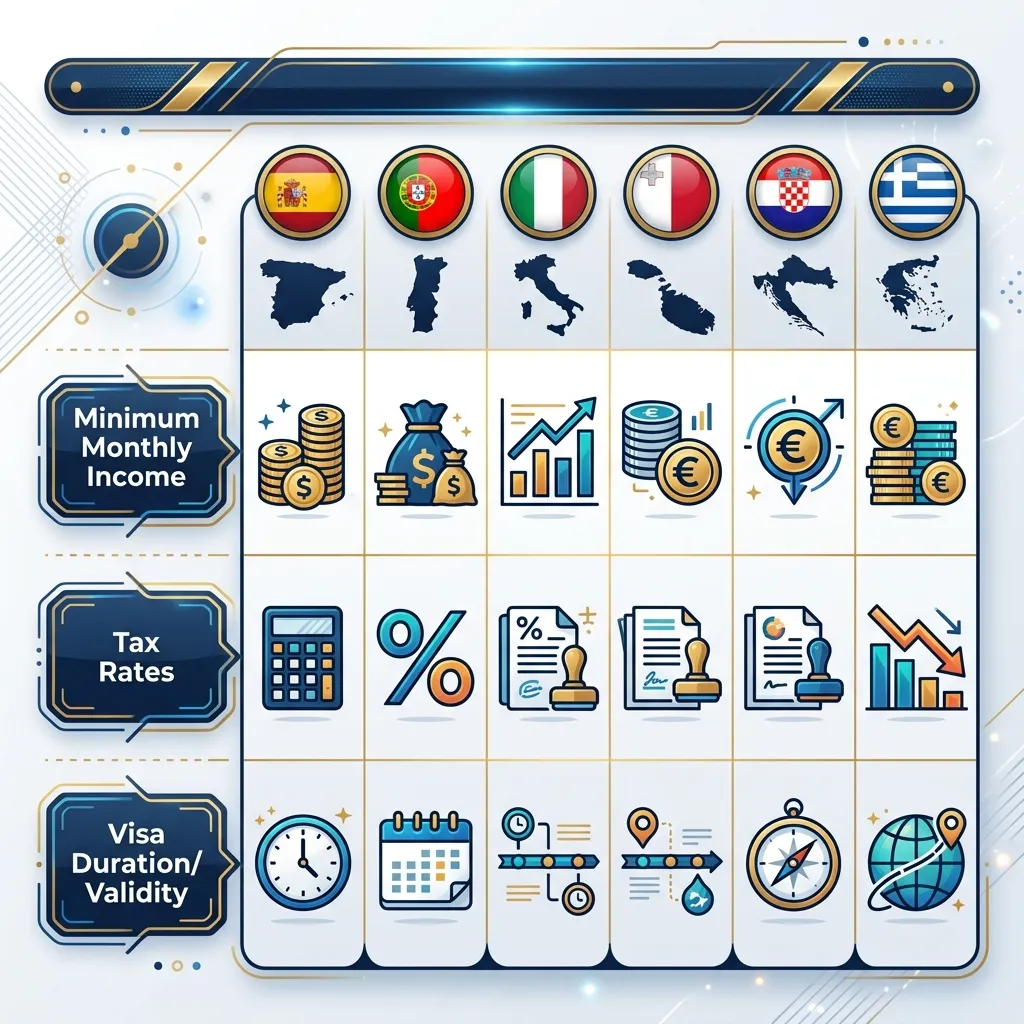
| Country | Tax on Foreign Income | Min. Income Requirement | Visa Duration |
|---|---|---|---|
| Croatia | 0% | €2,540/month | 12 months |
| Portugal | 20% flat (NHR regime ending) | €3,510/month | 12 months |
| Spain | 24% flat (Beckham Law) | €3,256/month | 12 months |
| Greece | 7% flat (special regime) | €3,500/month | 12 months |
| Estonia | Standard rates apply | €4,500/month | 12 months |
Croatia’s 0% tax rate is unmatched in Europe. While Portugal’s Non-Habitual Resident regime has been popular, its phase-out makes Croatia an even more attractive alternative for 2026.
Cost of Living: Split, Zagreb & Dubrovnik
One of Croatia’s biggest draws is its relatively affordable cost of living compared to Western Europe. Here’s a breakdown for the three most popular digital nomad cities.
Zagreb (Capital City)
Zagreb offers the best infrastructure, largest coworking community, and most affordable living among Croatia’s major cities.
| Expense | Monthly Cost (€) |
|---|---|
| One-bedroom apartment (city center) | €500–€700 |
| One-bedroom apartment (outside center) | €350–€500 |
| Coworking space | €100–€200 |
| Groceries | €250–€350 |
| Dining out (mid-range) | €150–€250 |
| Public transport pass | €40 |
| Utilities (electricity, water, internet) | €150–€200 |
| Total estimated | €1,250–€1,800 |
Split (Coastal Living)
Split combines a historic old town, beach lifestyle, and a growing tech scene. Prices are slightly higher, especially during the summer tourist season.
| Expense | Monthly Cost (€) |
|---|---|
| One-bedroom apartment (city center) | €600–€900 |
| One-bedroom apartment (outside center) | €400–€600 |
| Coworking space | €120–€220 |
| Groceries | €250–€350 |
| Dining out (mid-range) | €180–€280 |
| Total estimated | €1,400–€2,100 |
Dubrovnik (Premium Destination)
Dubrovnik is the most expensive option but offers a world-class setting. It’s best suited for higher earners or those staying short term.
| Expense | Monthly Cost (€) |
|---|---|
| One-bedroom apartment (city center) | €800–€1,200 |
| One-bedroom apartment (outside center) | €550–€800 |
| Coworking space | €150–€250 |
| Groceries | €280–€380 |
| Dining out (mid-range) | €200–€300 |
| Total estimated | €1,700–€2,500 |
[!TIP] For the best value, consider Zagreb from October to April and Split during the shoulder seasons (April–June, September–October). Dubrovnik is gorgeous but tourist-heavy and pricey from June to September.
Schengen Access and Travel Benefits
Based on the EU Schengen Agreement, since Croatia joined the Schengen Area on January 1, 2023, holding a Croatian Digital Nomad Visa grants you significant travel flexibility:
- Free movement across all 29 Schengen member states without additional visas
- 90/180-day rule still applies for Schengen travel — you can spend up to 90 days in other Schengen countries within any 180-day rolling period
- Direct flights from Zagreb and Split to most major European cities
This makes Croatia an ideal home base for exploring Europe while maintaining a stable, tax-efficient residence.
Health Insurance Options
Croatia requires comprehensive health insurance for the full visa duration. Here are the most popular options among digital nomads:
- SafetyWing Nomad Insurance — Starting around $83/month, this is the most popular choice among nomads for its flexibility and global coverage.
- World Nomads — Offers adventure-activity coverage but can be pricier at $120–$180/month.
- Croatian public health insurance (HZZO) — Available to foreigners for approximately €60–€80/month, but enrollment can be bureaucratic.
- Private Croatian providers — Companies like Allianz Croatia offer local policies starting from €50/month.
[!WARNING] Travel insurance (like basic policies from credit cards) is generally not accepted for the visa application. You need a policy that explicitly covers medical treatment in Croatia for the duration of your stay.
Pros and Cons of Croatia’s Digital Nomad Visa
Pros
- 0% Croatian income tax — the single biggest advantage
- EU and Schengen membership — travel freely across Europe
- Affordable cost of living — especially in Zagreb
- High quality of life — Mediterranean climate, excellent food, safe cities
- Fast internet — average speeds of 80–120 Mbps in major cities
- Growing nomad community — especially in Split and Zagreb
Cons
- Non-renewable — you must wait 6 months before reapplying
- Cannot work with Croatian clients — limits local networking opportunities
- Home country taxes still apply — the 0% only covers Croatian tax
- Language barrier — Croatian is not widely spoken outside tourist areas, though English proficiency is high in cities
- Seasonal pricing — coastal cities can be expensive during summer
Frequently Asked Questions
Can I extend my Croatia Digital Nomad Visa beyond 12 months?
No. The Croatia Digital Nomad Visa is valid for a maximum of 12 months and cannot be renewed consecutively. After your visa expires, you must leave Croatia and wait at least 6 months before applying again. Some nomads alternate between Croatia and other digital nomad visa destinations during the gap period.
Do I need to pay taxes in Croatia on my freelance income?
No, as long as your freelance clients and business registration are outside Croatia, your income is fully exempt from Croatian taxation. However, you remain liable for taxes in your home country or country of tax residency. Check our guide on double taxation treaties to understand how to avoid being taxed twice.
Can my family join me on the Digital Nomad Visa?
Yes. Your spouse and dependent children can apply for their own temporary stay permits as family members of a digital nomad visa holder. Each family member must submit a separate application and pay the application fee. They will need their own health insurance coverage as well.
Is the €2,540/month requirement gross or net income?
The requirement refers to gross income (before taxes). You’ll need to demonstrate this through bank statements, pay stubs, or contracts showing consistent earnings at or above this threshold over the previous 3–6 months.
Can I open a bank account in Croatia with a Digital Nomad Visa?
Yes, several Croatian banks allow digital nomad visa holders to open personal bank accounts. Erste Bank, PBZ, and Zagrebačka banka are the most foreigner-friendly options. You’ll need your passport, visa permit, and proof of address. Opening an account typically takes 1–2 weeks.
How does Croatia compare to Portugal for digital nomads?
With Portugal’s Non-Habitual Resident (NHR) regime being phased out for new applicants, Croatia now offers a significantly better tax deal at 0% vs. Portugal’s 20%+. Croatia also has a lower income requirement (€2,540 vs. €3,510) and a lower cost of living. However, Portugal offers a path to permanent residency and EU citizenship, which Croatia’s Digital Nomad Visa does not.
Final Thoughts
Croatia’s Digital Nomad Visa stands out as one of the best options in Europe for 2026 — particularly for nomads prioritizing tax efficiency. The combination of 0% income tax, Schengen access, affordable Mediterranean living, and a straightforward application process makes it hard to beat.
Before you apply, make sure to calculate your total tax obligations considering both Croatia’s exemption and your home country’s requirements. And if you’re weighing multiple destinations, check out our guides on Indonesia’s digital nomad visa and Malaysia’s DE Rantau Pass for Asia-based alternatives.