Bali/Indonesia Digital Nomad Visa: Complete 2026 Guide

Bali has long been the unofficial capital of the digital nomad world, and Indonesia has finally caught up with formal visa options to match. With the introduction of the E33G Digital Nomad Visa alongside the well-established B211A visa, remote workers now have clear, legal pathways to live and work from Indonesia’s most iconic island — all while paying 0% Indonesian income tax on foreign-sourced earnings.
TL;DR: Indonesia’s B211A visa (60–180 days) and the newer E33G Digital Nomad Visa (12 months, renewable) both allow remote workers to live in Bali with 0% Indonesian income tax on foreign-sourced earnings. Per Indonesia’s Directorate General of Immigration, the E33G requires a minimum income of $2,000/month and provides explicit tax-exempt status for foreign income under Indonesian tax law (PPh 21).
This comprehensive 2026 guide covers everything from visa types and tax implications to the best coworking spaces, cost of living, and banking options in Bali and beyond.
Indonesia’s Digital Nomad Visa Options
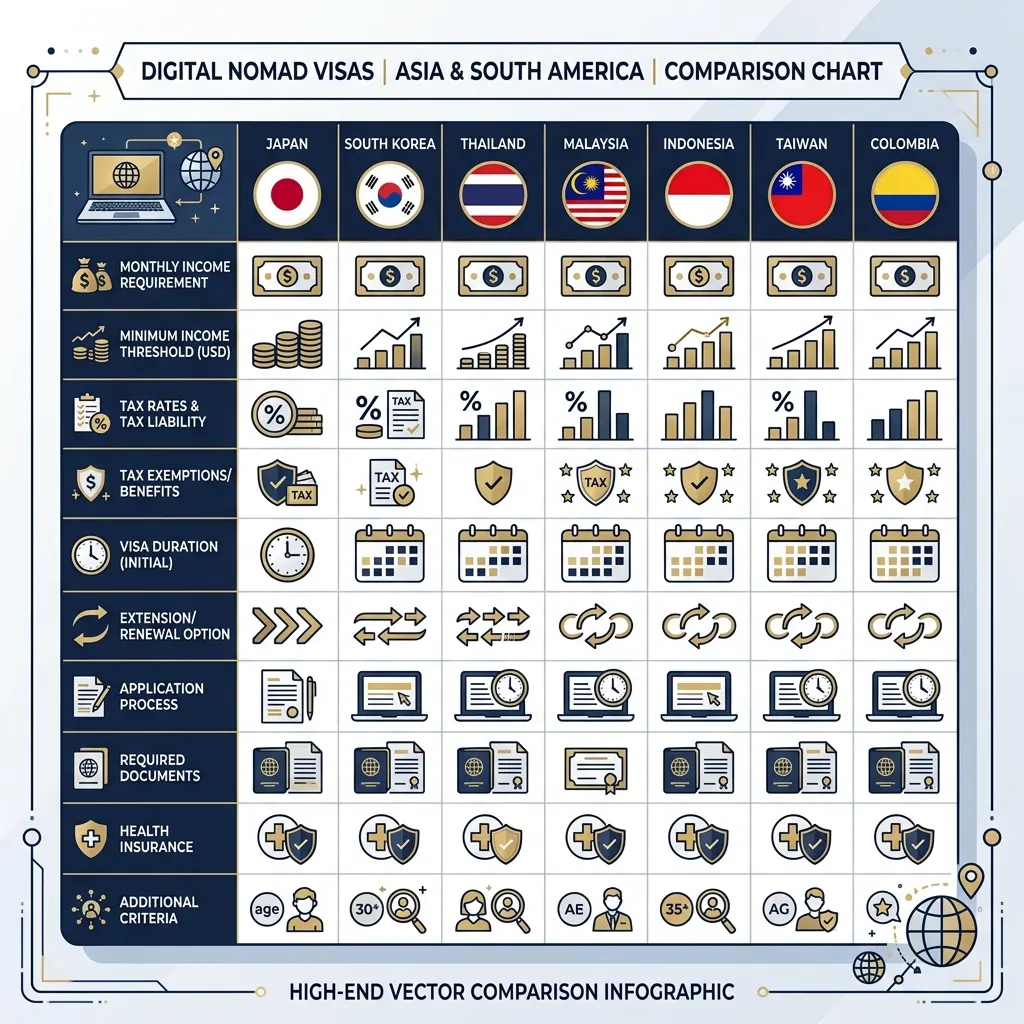
Indonesia offers two primary visa categories for digital nomads in 2026. Understanding the differences is crucial to choosing the right one for your situation.
B211A Visa (Social/Cultural Visit Visa)
The B211A is Indonesia’s most popular visa among digital nomads, though it’s technically classified as a social or cultural visit visa rather than a work visa. In practice, it’s widely used by remote workers who earn income from foreign sources.
| Feature | Details |
|---|---|
| Duration | 60 days (extendable up to 180 days total) |
| Extensions | Up to 4 extensions of 30 days each |
| Cost | $150–$300 (varies by sponsor/agent) |
| Income Requirement | None officially |
| Work Permitted | Remote work for foreign employers (gray area) |
| Tax Status | Not a tax resident if under 183 days |
| Sponsor Required | Yes — visa agent or Indonesian sponsor |
E33G Digital Nomad Visa (Second Home Visa for Remote Workers)
The E33G visa was formally introduced as Indonesia’s dedicated Digital Nomad Visa in late 2024 and expanded in 2025. It provides a clear legal framework specifically designed for remote workers.
| Feature | Details |
|---|---|
| Duration | Up to 12 months |
| Extensions | Renewable for additional 12 months |
| Cost | $350–$500 (government fees) |
| Income Requirement | $2,000/month or $24,000/year |
| Work Permitted | Remote work for foreign employers/clients only |
| Tax Status | Exempt from Indonesian income tax on foreign income |
| Sponsor Required | No — direct government application |
[!TIP] If you’re planning to stay in Indonesia for more than 6 months, the E33G is the better choice. For shorter stays of 2–4 months, the B211A remains more practical and affordable.
Tax Implications: How 0% Works in Indonesia
Indonesia’s tax treatment of digital nomads is one of its strongest selling points. Here’s the breakdown:
Foreign Income Exemption
Under Indonesian tax law (PPh 21), income earned from foreign sources by non-tax-residents is not subject to Indonesian income tax. This applies to both the B211A and E33G visa holders, provided:
- Your employer or clients are based outside Indonesia
- Your business is registered outside Indonesia
- You do not perform services for Indonesian companies
The 183-Day Rule
According to Indonesia’s Directorate General of Taxation, Indonesia uses a 183-day threshold to determine tax residency:
- Under 183 days: You are a non-resident and owe 0% Indonesian income tax on all foreign-sourced income.
- Over 183 days: You technically become a tax resident. However, E33G visa holders are explicitly exempted from this rule — your foreign income remains tax-free regardless of how long you stay.
For B211A holders staying longer than 183 days, the situation becomes murkier. While enforcement has historically been lax, the E33G eliminates this ambiguity entirely.
Home Country Tax Obligations
Indonesia’s 0% exemption only covers Indonesian tax. You are still responsible for:
- Filing tax returns in your home country (if required)
- Paying taxes on worldwide income to your country of tax residency
- Reporting foreign bank accounts if applicable (e.g., FBAR for US citizens)
[!WARNING] US citizens and green card holders are taxed on worldwide income regardless of where they live. The FEIE can exclude up to $130,000 for 2026, but self-employment tax still applies. Read our FEIE guide for details.
Use our Tax Calculator to estimate your combined tax obligations from both Indonesia and your home country.
How to Apply for the E33G Digital Nomad Visa
Step 1: Check Your Eligibility
Confirm you meet the basic requirements:
- Valid passport with at least 18 months remaining validity
- Proof of $2,000/month or $24,000/year in income
- Remote employment with a company or clients based outside Indonesia
- Health insurance valid in Indonesia
- No criminal record
Step 2: Prepare Your Documents
Gather the following:
- Passport (color scan of bio page)
- Passport-sized photo (white background, recent)
- Proof of income — 3–6 months of bank statements, employment contract, or business registration
- Health insurance certificate — must cover Indonesia
- CV/resume — outlining your remote work experience
- Statement of purpose — brief letter explaining your work and intention to live in Indonesia
Step 3: Apply Online
Per the Directorate General of Immigration, submit your application through Indonesia’s official online portal (visa-online.imigrasi.go.id). The process is fully digital for E33G applicants.
Step 4: Pay the Fee
Government processing fees range from $350 to $500, payable online. Additional service fees may apply if you use an immigration agent.
Step 5: Receive Your E-Visa
Approved applications receive an e-visa via email within 5–15 business days. Print the e-visa and present it upon arrival at any Indonesian international airport.
Step 6: Convert to Stay Permit (ITAS)
Within 30 days of arrival, visit the local immigration office to convert your e-visa into an ITAS (Izin Tinggal Terbatas) — your temporary stay permit card. This step is mandatory and involves biometric registration.
[!TIP] Many nomads use a visa agent for the ITAS conversion process. Budget $100–$200 for agent fees. Popular agents include Bali Visas, LetsMoveIndonesia, and ICA Visa Services.
Bali’s Coworking and Coliving Scene
Bali’s coworking ecosystem is arguably the best-developed in the world for digital nomads. Here are the top spots across the island’s most popular areas.
Canggu
Canggu is the undisputed nomad capital of Bali. It offers the highest density of coworking spaces, cafes with fast WiFi, and a vibrant social scene.
| Coworking Space | Day Pass | Monthly |
|---|---|---|
| Dojo Bali | $20 | $200 |
| Outpost Canggu | $25 | $250 |
| Tropical Nomad | $12 | $120 |
| B-Work Bali | $15 | $150 |
Ubud
Ubud offers a quieter, more nature-focused environment. It’s ideal for writers, designers, and anyone seeking a slower pace.
| Coworking Space | Day Pass | Monthly |
|---|---|---|
| Outpost Ubud | $22 | $220 |
| Hubud | $20 | $200 |
| Genius Café | $10 | $80 |
Uluwatu / Bukit Peninsula
The Bukit area has emerged as a premium surf-and-work destination with upscale coworking options.
| Coworking Space | Day Pass | Monthly |
|---|---|---|
| Matra Bali | $18 | $180 |
| Roam Uluwatu | $30 | $280 |
Coliving Options
Coliving spaces bundle accommodation, coworking, and community events. Popular choices include:
- Outsite Bali — from $800/month (private room + coworking)
- Roam Bali — from $1,000/month (all-inclusive)
- Dojo Coliving — from $600/month (shared room + coworking)
- Tribal Bali — from $500/month (hostel-style + coworking)
Cost of Living in Bali (2026)
Bali remains one of the most affordable digital nomad destinations globally, though prices have risen steadily since 2022. Here’s a realistic breakdown.
Budget Nomad (Shared Accommodation)
| Expense | Monthly Cost (USD) |
|---|---|
| Shared room / hostel | $300–$500 |
| Coworking | $100–$150 |
| Food (warungs + some cafes) | $250–$400 |
| Scooter rental | $60–$80 |
| Phone/data (local SIM) | $10–$15 |
| Entertainment | $100–$200 |
| Total | $820–$1,345 |
Mid-Range Nomad (Private Villa/Apartment)
| Expense | Monthly Cost (USD) |
|---|---|
| Private villa / apartment | $600–$1,000 |
| Coworking (premium) | $200–$280 |
| Food (mixed local + Western) | $400–$600 |
| Scooter rental | $60–$80 |
| Phone/data | $10–$15 |
| Health / gym | $50–$80 |
| Entertainment | $200–$400 |
| Total | $1,520–$2,455 |
Premium Nomad (Luxury Villa)
| Expense | Monthly Cost (USD) |
|---|---|
| Luxury villa with pool | $1,500–$3,000 |
| Coworking / private office | $280–$400 |
| Food (restaurants + delivery) | $600–$900 |
| Car rental with driver | $400–$600 |
| Wellness / spa | $150–$300 |
| Total | $2,930–$5,200 |
Banking and Money in Indonesia
Managing money in Bali requires some planning. Here’s what you need to know.
Opening a Local Bank Account
Opening an Indonesian bank account as a foreigner is possible with an ITAS (stay permit) but can be bureaucratic. The most foreigner-friendly banks are:
- Bank Central Asia (BCA) — most widely accepted, best ATM network
- Bank Mandiri — good online banking, English support
- Bank Negara Indonesia (BNI) — easy foreigner account opening
Requirements typically include your passport, ITAS, local address proof, and a minimum deposit of IDR 500,000–1,000,000 (~$30–$60).
ATM Withdrawals and Fees
- Most ATMs dispense a maximum of IDR 2,500,000 (~$150) per transaction
- Withdrawal fees range from IDR 30,000–50,000 ($2–$3) per transaction
- Wise (TransferWise) and Revolut debit cards offer the best exchange rates for withdrawals
Digital Payment Options
- GoPay and OVO are Indonesia’s dominant e-wallets, widely accepted across Bali
- QRIS (QR-based payment) works at most merchants, from warungs to upscale restaurants
- Cash is still king in rural areas and small warungs — always carry some IDR
[!TIP] Open a Wise multi-currency account before arriving in Bali. It offers the best exchange rates, a free debit card for ATM withdrawals, and the ability to hold and convert between 50+ currencies with minimal fees.
Bali vs. Other Southeast Asian Nomad Destinations
| Feature | Bali (Indonesia) | Chiang Mai (Thailand) | Kuala Lumpur (Malaysia) |
|---|---|---|---|
| Nomad Visa | E33G (12 months) | DTV (5 years, 180-day stays) | DE Rantau (12 months) |
| Tax on Foreign Income | 0% | 0% (if not remitted) | 0% |
| Min. Income Requirement | $2,000/month | ~$1,400/month (est.) | $2,000/month |
| Cost of Living | $1,200–$2,500 | $800–$1,800 | $1,000–$2,200 |
| Internet Speed | 30–80 Mbps | 50–150 Mbps | 100–300 Mbps |
| Coworking Scene | ★★★★★ | ★★★★☆ | ★★★☆☆ |
| Nightlife/Social | ★★★★★ | ★★★★☆ | ★★★☆☆ |
| Visa Simplicity | ★★★☆☆ | ★★★★☆ | ★★★★★ |
For a deep dive into Malaysia’s program, see our DE Rantau Pass guide.
Practical Tips for Living in Bali
- Get a local SIM card immediately. Telkomsel offers the best coverage island-wide. A monthly data plan with 30GB costs around $6–$10.
- Rent a scooter — it’s the primary mode of transportation. Expect $60–$80/month for a Honda Vario or similar.
- Use Grab and Gojek for rides, food delivery, and errands. They’re cheaper than taxis and widely available.
- Beware of rainy season (November–March). Internet outages and flooding in low-lying areas like parts of Canggu are common.
- Join the community — Facebook groups like “Bali Digital Nomads” and “Canggu Community” are essential for finding housing, events, and local tips.
- Health insurance is non-negotiable — Bali’s private hospitals (BIMC, Siloam) are good but expensive. A medical evacuation to Singapore can cost $20,000+ without insurance.
Frequently Asked Questions
Can I legally work on a B211A visa in Bali?
The B211A is officially a social/cultural visit visa and does not explicitly authorize remote work. However, the Indonesian government has largely tolerated remote workers using this visa, provided they are not working for Indonesian companies. The E33G visa was created to formalize this arrangement and is the recommended choice for full legal compliance.
How fast is the internet in Bali?
Internet speeds in Bali vary significantly by location. Coworking spaces typically offer 50–100 Mbps fiber connections. Home WiFi in Canggu and Seminyak averages 20–50 Mbps via fiber (IndiHome or Biznet). Ubud and rural areas may be slower at 10–30 Mbps. Always test the internet before committing to a rental.
Do I need a visa agent to apply for the E33G?
No, the E33G can be applied for directly online through Indonesia’s immigration portal. However, many nomads still use agents for convenience, especially for the ITAS conversion step that requires in-person visits to the immigration office.
Can I travel to other Indonesian islands on my digital nomad visa?
Yes. Both the B211A and E33G visa allow you to travel freely throughout all of Indonesia. Popular side trips include Lombok, Komodo Islands, Yogyakarta, Raja Ampat, and Nusa Penida. Domestic flights are cheap — often $30–$80 between major islands.
What happens if I overstay my visa?
Indonesia imposes a fine of IDR 1,000,000 per day (approximately $60/day) for overstays. Overstaying by more than 60 days can result in detention, deportation, and a re-entry ban. Do not risk it — set reminders for your visa extension deadlines.
Is Bali safe for digital nomads?
Bali is generally very safe for foreigners. Petty theft (bag snatching, villa break-ins) is the most common issue. Use a safe for valuables, lock your villa, and be cautious with belongings at beaches and cafes. Violent crime against foreigners is rare.
Final Thoughts
Bali remains the gold standard for digital nomad living in 2026, and Indonesia’s E33G visa finally gives remote workers a legitimate, tax-efficient way to base themselves on the island. With 0% tax on foreign income, an unmatched coworking scene, and a cost of living that stretches your earnings further than almost anywhere else, it’s easy to see why tens of thousands of nomads call Bali home.
Before you book your flight, calculate your tax obligations to understand exactly what you’ll owe back home — because while Indonesia won’t tax you, your home country likely will.