Malaysia DE Rantau Pass: 0% Tax Digital Nomad Visa (2026)

Malaysia’s DE Rantau Pass is Southeast Asia’s most streamlined digital nomad visa — offering 0% tax on foreign-sourced income, a 12-month stay, and access to one of the region’s most modern, affordable, and well-connected countries. Whether you’re drawn to the skyscrapers of Kuala Lumpur, the street food paradise of Penang, or the beaches of Langkawi, the DE Rantau makes Malaysia a compelling 2026 base.
TL;DR: The DE Rantau Pass, administered by the Malaysia Digital Economy Corporation (MDEC), grants digital nomads a 12-month renewable visa with 0% tax on foreign-sourced income — as established by the Inland Revenue Board of Malaysia (LHDN) under the Income Tax Act 1967. Applicants need a minimum income of $24,000/year, at least 3 years of digital-economy experience, and foreign-based employment.
In this guide, we’ll cover the full application process, tax benefits, cost of living across Malaysia’s top cities, and how the DE Rantau stacks up against Thailand’s Digital Nomad Visa (DTV).
What Is the DE Rantau Pass?
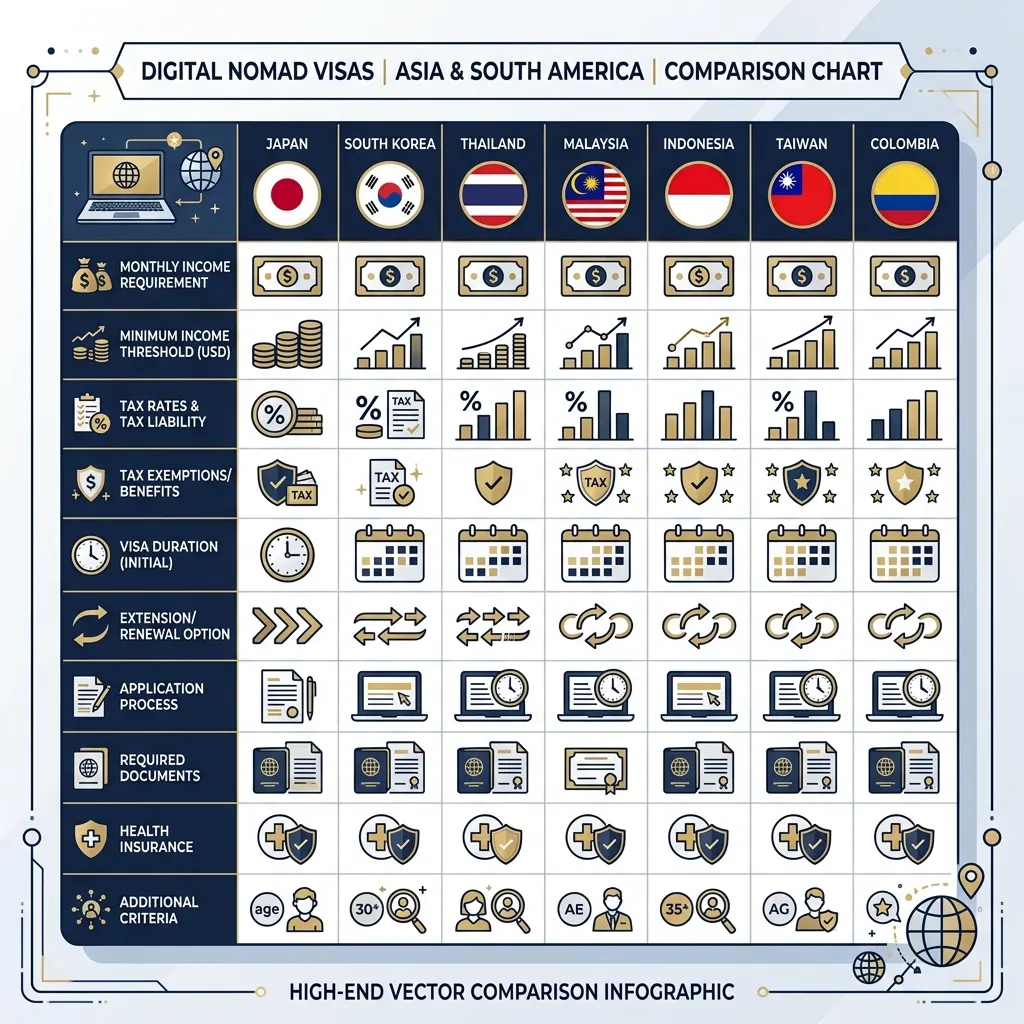
According to the Malaysia Digital Economy Corporation (MDEC), the DE Rantau (short for Digital Economy Rantau) is Malaysia’s official digital nomad program, launched by MDEC in partnership with the Immigration Department. The word “rantau” means “to wander” in Malay — fitting for a program designed for location-independent workers.
Originally launched in 2022, the program was significantly expanded in 2024–2025 to simplify the application process and broaden eligibility. As of 2026, it remains one of the easiest and most affordable digital nomad visas in the world.
Key Features
| Feature | Details |
|---|---|
| Visa Duration | 12 months |
| Renewals | Renewable for additional 12-month periods |
| Tax on Foreign Income | 0% |
| Minimum Income | $24,000/year (~$2,000/month) |
| Eligible Professions | IT, digital marketing, creative professionals, and more |
| Dependents | Spouse and children included |
| Work Restriction | Cannot work for Malaysian companies |
| Processing Time | 10–20 business days |
| Application Fee | ~$218 (MYR 1,000) |
Eligibility Requirements
The DE Rantau Pass is available to citizens of all countries (no nationality restrictions). To qualify, you must meet these criteria:
-
Income threshold: Minimum annual income of $24,000 (approximately MYR 105,000). This is one of the lowest thresholds among global digital nomad visas.
-
Professional background: You must work in a digital economy-related field. Eligible sectors include:
- Software development and IT
- Digital marketing and content creation
- UI/UX and graphic design
- Cybersecurity
- Data science and analytics
- E-commerce management
- Video production and animation
- Freelance writing and journalism (digital media)
-
Employment type: You must be employed by or freelancing for companies registered outside Malaysia. Self-employed professionals with foreign-registered businesses also qualify.
-
Experience: Minimum 3 years of professional experience in your field (or equivalent portfolio evidence for freelancers).
-
Health insurance: Valid health insurance covering Malaysia. See our comprehensive guide to health insurance for digital nomads for recommendations.
-
Clean criminal record: No criminal convictions.
[!TIP] The “digital economy” requirement is interpreted broadly. If your work involves any significant digital component — from online teaching to remote project management — you likely qualify. When in doubt, apply and let MDEC make the determination.
How to Apply: Step-by-Step
The DE Rantau application is fully online and processed through MDEC’s digital portal.
Step 1: Create an Account on the MDEC Portal
Visit the official DE Rantau website (mdec.my/derantau) and create an applicant account. You’ll need a valid email address and passport details.
Step 2: Prepare Your Documents
Gather the following documents in PDF format:
- Valid passport — minimum 18 months validity remaining
- Professional CV/resume — highlighting relevant digital economy experience
- Proof of income — bank statements (3–6 months), employment contract, or tax returns showing $24,000+/year
- Portfolio or work samples — especially important for freelancers
- Health insurance certificate — valid in Malaysia
- Passport-sized photo — white background, recent
Step 3: Submit Your Application
Complete the online application form and upload all required documents. The form includes sections on your professional background, employer details, and intended stay in Malaysia.
Step 4: Pay the Application Fee
The application fee is approximately $218 (MYR 1,000), payable online via credit card or bank transfer. Dependent applications incur additional fees of approximately $109 (MYR 500) each.
Step 5: Receive MDEC Endorsement
MDEC reviews your application within 5–10 business days. If approved, you’ll receive an endorsement letter via email.
Step 6: Apply for the Professional Visit Pass
With the MDEC endorsement, apply for your Professional Visit Pass through the Malaysian Immigration Department. This is processed concurrently and typically takes an additional 5–10 business days.
Step 7: Collect Your Pass on Arrival
Upon arriving in Malaysia, visit the nearest Immigration office to collect your physical DE Rantau pass. Bring your endorsement letter, passport, and a printed copy of your application approval.
[!WARNING] The DE Rantau Pass does not allow you to work for Malaysian clients or companies. Violating this restriction can result in pass revocation and a ban from re-entry. Keep all your work contracts with foreign entities.
Tax Benefits: 0% on Foreign Income
The DE Rantau’s tax treatment is straightforward and highly favorable:
How It Works
- Per the Inland Revenue Board of Malaysia (LHDN), foreign-sourced income earned by DE Rantau pass holders is exempt from Malaysian income tax
- This includes salary, freelance income, dividends from foreign companies, and capital gains from foreign investments
- Under the Income Tax Act 1967, Malaysia does not tax foreign-sourced income for non-residents, and DE Rantau holders are classified as non-residents for tax purposes
What You Still Need to Consider
- Malaysian-sourced income: If you earn any income from Malaysian sources (which would violate your pass conditions anyway), standard Malaysian tax rates apply (0–30% progressive)
- Home country obligations: You remain liable for taxes in your home country or country of tax residency
- Double taxation treaties: Malaysia has DTAs with over 75 countries. These can help prevent double taxation if your home country tries to tax income already covered by the Malaysian exemption. See our guide to double taxation treaties
[!TIP] Use our Tax Calculator to model your exact tax situation under the DE Rantau arrangement. Factor in your home country rates, any applicable exclusions (like the US FEIE), and Malaysia’s 0% rate to find your optimal setup.
Cost of Living: KL, Penang & Langkawi
Malaysia offers some of the lowest costs of living in Asia for the quality of infrastructure you get. Here’s what to expect in the three most popular nomad cities.
Kuala Lumpur (KL)
KL is a modern metropolis with world-class infrastructure, fast internet, and a massive food scene. It’s the most popular base for DE Rantau holders.
| Expense | Monthly Cost (MYR) | Monthly Cost (USD) |
|---|---|---|
| Studio / 1-bed condo (city center) | MYR 1,500–2,500 | $330–$550 |
| Studio / 1-bed condo (outside center) | MYR 1,000–1,800 | $220–$400 |
| Coworking space | MYR 400–800 | $90–$175 |
| Groceries | MYR 600–1,000 | $130–$220 |
| Dining out | MYR 500–1,000 | $110–$220 |
| Public transport (monthly pass) | MYR 100–200 | $22–$44 |
| Utilities + Internet | MYR 200–400 | $44–$88 |
| Total | MYR 3,300–6,700 | $730–$1,480 |
Penang (Georgetown)
Penang combines colonial charm, arguably the best street food in Asia, and a growing tech community. It’s significantly cheaper than KL.
| Expense | Monthly Cost (MYR) | Monthly Cost (USD) |
|---|---|---|
| Studio / 1-bed condo | MYR 1,000–2,000 | $220–$440 |
| Coworking space | MYR 300–600 | $66–$130 |
| Groceries | MYR 500–800 | $110–$175 |
| Dining out (hawker stalls + restaurants) | MYR 400–800 | $88–$175 |
| Scooter rental | MYR 300–400 | $66–$88 |
| Utilities + Internet | MYR 150–300 | $33–$66 |
| Total | MYR 2,650–4,900 | $585–$1,080 |
Langkawi
Langkawi is a duty-free island off Malaysia’s northwest coast. It’s quieter and more beach-focused — ideal for nomads who want a resort-like setting with low costs.
| Expense | Monthly Cost (MYR) | Monthly Cost (USD) |
|---|---|---|
| Villa / apartment | MYR 1,200–2,500 | $265–$550 |
| Coworking (limited options) | MYR 300–500 | $66–$110 |
| Groceries + dining | MYR 800–1,500 | $175–$330 |
| Car / scooter rental | MYR 400–800 | $88–$175 |
| Utilities + Internet | MYR 200–350 | $44–$77 |
| Total | MYR 2,900–5,650 | $640–$1,245 |
[!TIP] Langkawi’s duty-free status means alcohol, chocolate, and imported goods are significantly cheaper than anywhere else in Malaysia. It also means no state sales tax (SST) on many products — a small but notable perk.
Malaysia vs. Thailand DTV: Head-to-Head Comparison
Thailand’s Destination Thailand Visa (DTV), launched in 2024, is the DE Rantau’s closest competitor in Southeast Asia. Here’s how they compare:
| Feature | Malaysia DE Rantau | Thailand DTV |
|---|---|---|
| Visa Duration | 12 months | 5 years (180-day stays) |
| Stay Per Entry | 12 months continuous | 180 days per entry |
| Tax on Foreign Income | 0% | 0% (if not remitted to Thailand) |
| Minimum Income | $24,000/year | ~$17,000/year (500,000 THB) |
| Application Fee | ~$218 | ~$285 (10,000 THB) |
| Renewability | Yes, unlimited renewals | Re-entry within 5-year window |
| Dependents Included | Yes | Yes |
| Internet Speed | 100–300 Mbps | 50–150 Mbps |
| English Proficiency | High (official language of business) | Moderate |
| Banking Access | Moderate (with pass) | Difficult |
| Coworking Scene | Growing (KL, Penang) | Mature (Chiang Mai, Bangkok) |
| Food Cost | Extremely low | Extremely low |
When to Choose Malaysia
- You want continuous 12-month stays without having to leave and re-enter
- You value fast, reliable internet (Malaysia’s fiber infrastructure is superior)
- You prefer English-speaking environments (Malaysia’s official business language)
- You want a clear, enforceable 0% tax position without remittance complications
When to Choose Thailand
- You want a 5-year visa with flexibility to come and go
- You prefer Chiang Mai’s mature nomad community over KL or Penang’s smaller scenes
- You have a lower income (Thailand’s threshold is ~30% lower)
- You’re drawn to Thailand’s culture, cuisine, and lifestyle
Practical Tips for Living in Malaysia
-
Internet is world-class: Malaysia’s fiber broadband (Unifi, Maxis) regularly delivers 100–500 Mbps at home. Mobile 5G coverage is widespread in KL and Penang.
-
Food is incredibly cheap: Street food meals (nasi lemak, roti canai, char kway teow) cost MYR 5–10 ($1–$2). Even sit-down restaurants rarely exceed MYR 30–50 ($7–$11) per person.
-
Healthcare is excellent and affordable: Private hospitals like Gleneagles, Sunway Medical, and Prince Court offer world-class care at a fraction of Western prices. A GP visit costs MYR 30–80 ($7–$18).
-
Transportation: KL has an efficient LRT/MRT/monorail system. Outside KL, Grab (Southeast Asia’s Uber) is the go-to for rides. Scooter rental is popular in Penang and Langkawi.
-
Cultural diversity: Malaysia’s multicultural society (Malay, Chinese, Indian, and indigenous communities) means incredible food variety, vibrant festivals, and generally high tolerance for foreigners.
-
Safety: Malaysia is generally safe for foreigners. Petty crime exists (snatch theft in KL), but violent crime against foreigners is rare.
Banking and Financial Setup
Opening a Bank Account
While you can open a local digital nomad bank account as a DE Rantau holder, the process can vary by bank:
- Maybank — largest bank, most foreigner-friendly
- CIMB — good online banking, English support
- Public Bank — straightforward foreigner account opening
You’ll need your passport, DE Rantau pass, proof of address, and a minimum deposit of MYR 250–500 ($55–$110). To manage your international invoicing, maintaining a dedicated digital nomad bank account is highly recommended.
Recommended Fintech Options
- Wise — best for receiving international payments and currency conversion
- Revolut — good multi-currency card for ATM withdrawals
- BigPay (local) — excellent Malaysian e-wallet linked to a Mastercard
Currency and Exchange
The Malaysian Ringgit (MYR) trades at approximately MYR 4.5 = $1 USD as of 2026. The relatively weak ringgit makes Malaysia exceptionally good value for anyone earning in USD, EUR, or GBP.
Frequently Asked Questions
Can I renew my DE Rantau Pass indefinitely?
Yes, the DE Rantau Pass is renewable in 12-month increments with no current limit on the number of renewals. This makes it one of the few digital nomad visas that can effectively serve as a long-term residence solution, provided you continue to meet the income and employment requirements.
Do I need to be in a tech-related job to qualify?
The DE Rantau targets digital economy professionals, but the definition is broad. If your work involves digital tools, online platforms, or technology in any significant way, you likely qualify. MDEC has approved applications from remote teachers, virtual assistants, online coaches, and e-commerce managers — not just software developers.
Can I bring my family on the DE Rantau Pass?
Yes. Your spouse and children under 18 can be included in your application as dependents. They’ll receive their own passes tied to yours. Dependents can attend international schools and access healthcare, but they cannot work in Malaysia.
Is Malaysia’s 0% tax on foreign income permanent?
According to the Inland Revenue Board of Malaysia (LHDN), Malaysia’s tax exemption on foreign-sourced income for non-residents is established in the Income Tax Act 1967 and has been consistently maintained. While the government briefly considered taxing foreign-sourced income remitted to Malaysia (similar to Thailand), this proposal was deferred indefinitely as of 2025. For DE Rantau holders classified as non-residents, the exemption is clear and stable.
How does Malaysia compare to Indonesia for digital nomads?
Both are excellent options. Malaysia offers better infrastructure, faster internet, higher English proficiency, and a more straightforward visa process. Indonesia (Bali specifically) offers a stronger nomad community, better surfing and nature, and a more laid-back lifestyle. Tax treatment is similar (0% on foreign income) in both countries. See our full Bali/Indonesia guide for comparison.
Can I use the DE Rantau Pass to travel to other ASEAN countries?
The DE Rantau Pass is valid for Malaysia only. However, Malaysian passport holders and residents enjoy easy access to ASEAN neighbors. Most ASEAN countries offer visa-free entry for DE Rantau holders based on their nationality. Malaysia’s central location makes it an excellent hub for exploring Southeast Asia.
Final Thoughts
The DE Rantau Pass is a hidden gem among global digital nomad visas. Its combination of 0% tax on foreign income, low cost of living, world-class internet, and unlimited renewability makes it one of the smartest long-term options for remote workers in 2026. The income threshold of just $24,000/year means it’s accessible to a wide range of nomads, from junior freelancers to senior professionals.
If you’re considering Malaysia as your next base, start by calculating your tax obligations to understand the full financial picture. And if you’re comparing options across Southeast Asia, don’t miss our guides to Bali’s E33G visa and Croatia’s European alternative.