FBAR and FATCA Filing Checklist for Digital Nomads (2026)

TL;DR: US digital nomads and expats with foreign financial assets are legally required to file two primary disclosure forms: FinCEN Form 114 (FBAR) and IRS Form 8938 (FATCA). The FBAR is triggered if the aggregate value of your foreign accounts exceeds $10,000 at any point during the calendar year, while the FATCA filing threshold starts at $200,000 for single expats living abroad. Non-compliance carries severe civil penalties, starting at $16,117 per violation for non-willful errors, making annual reporting a top priority.
For the international traveler, holding foreign bank accounts is a matter of convenience and necessity. Whether you use a local account in Georgia to manage business expenses, a Wise account to hold Euros, or a savings account in your digital nomad host country, these financial tools keep your remote business running.
However, for US citizens and green card holders, these accounts trigger strict federal reporting requirements. Under the Bank Secrecy Act and the Foreign Account Tax Compliance Act (FATCA), the US government requires detailed disclosures of your offshore wealth.
Failing to understand these laws can result in devastating penalties that far exceed your actual US income tax liability. This guide provides a comprehensive checklist, clear thresholds, and step-by-step filing instructions for FBAR and FATCA compliance in 2026.
What Is the FBAR? (FinCEN Form 114)
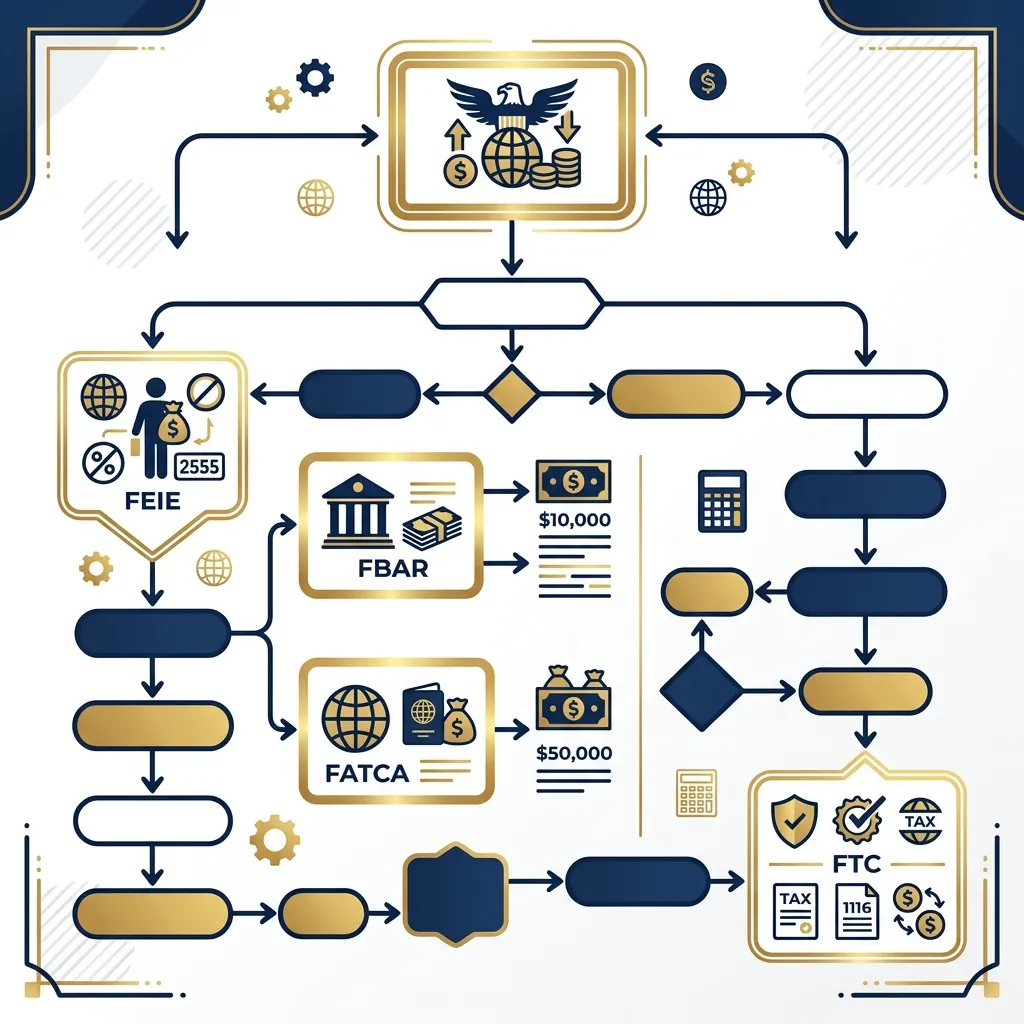
The Report of Foreign Bank and Financial Accounts (FBAR), officially known as FinCEN Form 114, is a disclosure form required by the Financial Crimes Enforcement Network, a bureau of the US Department of the Treasury.
The $10,000 FBAR Threshold
You must file an FBAR if the aggregate maximum balance of all your foreign financial accounts exceeds $10,000 at any point during the calendar year.
It is important to emphasize the word aggregate. This does not mean you must have $10,000 in a single account.
If you have three foreign bank accounts, and each holds $3,500 on the same day, your aggregate balance is $10,500. You must file the FBAR and list all three accounts.
Furthermore, the threshold is based on the maximum balance reached during the year, not the end-of-year balance. If you transfer $12,000 into a foreign account, hold it there for two hours, and then transfer it back to the US, you have exceeded the $10,000 threshold for that tax year. You are legally required to file an FBAR.
Types of Accounts to Report
Under FinCEN regulations, a “foreign financial account” includes:
- Checking and Savings Accounts held at foreign banks.
- Securities and Investment Accounts (foreign brokerage accounts).
- Digital Banks and Payment Processors holding foreign balances (such as foreign-domiciled Wise multi-currency accounts, Revolut accounts outside the US, and local fintech accounts).
- Foreign Pension and Retirement Accounts (such as a UK Self-Invested Personal Pension or an Australian Superannuation fund).
- Cash-Value Life Insurance Policies issued by foreign insurers.
- Accounts with Signatory Authority: If you are a director of a foreign company (e.g., a UK LTD) and have signing authority over its bank accounts, you must report those accounts on your personal FBAR.
FBAR Deadlines and Extensions
The official due date for the FBAR is April 15, matching the federal income tax deadline.
However, FinCEN grants an automatic 6-month extension to October 15 each year. You do not need to file a formal request to obtain this extension; if you miss the April deadline, you simply file by October 15 without penalty.
FBAR Penalties: The Bittner Ruling
FBAR penalties are among the most severe in the US tax system. They are divided into two categories:
Non-Willful Violations
A non-willful violation occurs when a taxpayer fails to file due to negligence, oversight, or lack of knowledge about the law.
- The Penalty: The base penalty is $10,000 per violation, adjusted annually for inflation. For 2026, the inflation-adjusted penalty is approximately $16,117.
- The Supreme Court Ruling: In the landmark case Bittner v. United States (143 S. Ct. 713), the US Supreme Court ruled that the $10,000 non-willful FBAR penalty applies per form (per year), rather than per account. Before this ruling, the IRS attempted to penalize taxpayers $10,000 for every foreign account they failed to report. The Supreme Court capped the penalty at $10,000 per annual unfiled FBAR, providing significant relief for negligent expats.
Willful Violations
A willful violation occurs when a taxpayer intentionally hides foreign accounts or ignores reporting obligations.
- The Penalty: The penalty is the greater of $100,000 (inflation-adjusted to approximately $161,170 in 2026) or 50% of the maximum balance in the unreported accounts at the time of the violation.
- Criminal Penalties: Willful failure to file can also lead to criminal prosecution, resulting in fines up to $250,000 and up to 5 years in federal prison.
What Is FATCA? (IRS Form 8938)
The Foreign Account Tax Compliance Act (FATCA) was enacted in 2010 to combat offshore tax evasion. While FBAR is filed with FinCEN, FATCA reporting is filed directly with the IRS using Form 8938 (Statement of Specified Foreign Financial Assets), which you attach to your Form 1040 tax return.
FATCA Filing Thresholds
The thresholds for filing Form 8938 are much higher than the FBAR threshold, and they vary depending on whether you live in the US or abroad.
For US Expats Living Abroad (Meeting the FEIE residency tests):
- Single Filers: You must file Form 8938 if the total value of your specified foreign financial assets is more than $200,000 on the last day of the tax year, or more than $300,000 at any time during the tax year.
- Married Filing Jointly: You must file if the total value of your assets is more than $400,000 on the last day of the tax year, or more than $600,000 at any time during the tax year.
For Taxpayers Living in the United States:
- Single Filers: The threshold is $50,000 on the last day of the tax year, or $75,000 at any time during the year.
- Married Filing Jointly: The threshold is $100,000 on the last day of the tax year, or $150,000 at any time during the year.
Assets to Report on Form 8938
Form 8938 requires disclosure of “specified foreign financial assets.” This category is broader than the FBAR bank account list:
- All financial accounts reported on the FBAR.
- Foreign Stock or Securities not held in a financial account (e.g., physical stock certificates of a foreign company).
- Ownership Interests in Foreign Entities, including shares in a UK LTD, an Estonian OÜ, or a foreign partnership.
- Foreign Mutual Funds and ETFs.
- Interests in Foreign Trusts or Estates.
- Foreign Real Estate held through a foreign entity (note: physical real estate held directly in your name is not a specified foreign financial asset, but if you own it through a foreign corporation, the corporation shares must be reported).
Form 8938 Deadlines
Because Form 8938 is part of your federal tax return, its deadline matches your Form 1040 deadline. For expats, this is June 15 (automatic 2-month extension for living abroad) or October 15 (if you file for an extension).
Comparison Table: FBAR vs. FATCA (Form 8938)
| Feature | FBAR (FinCEN Form 114) | FATCA (IRS Form 8938) |
|---|---|---|
| Filing Threshold (Expat Single) | $10,000 aggregate at any point | $200,000 at year-end / $300,000 peak |
| Governing Agency | FinCEN (Treasury Dept) | IRS (Treasury Dept) |
| Filing Portal | BSA E-Filing System (Online only) | Attached to Form 1040 (Tax Return) |
| Due Date (with Extension) | October 15 | October 15 (or Dec 15 with special request) |
| Foreign Real Estate (Direct) | No | No |
| Foreign Corporate Shares | No (Unless signatory on bank account) | Yes (Direct ownership must be reported) |
| Non-Willful Penalty | $16,117 per form (2026 inflation-adjusted) | Up to $10,000 flat penalty |
| Willful Penalty | Up to 50% of account balance | Up to $50,000 plus interest |
The Digital Nomad Compliance Checklist
To ensure you remain fully compliant, complete this step-by-step audit of your financial assets every January.
1. Catalog All Worldwide Accounts
Make a spreadsheet listing every financial account you hold outside the United States. Include:
- Traditional bank accounts (checking, savings, term deposits).
- Multi-currency accounts (Wise, Revolut, Payoneer).
- Foreign investment accounts.
- Foreign pension schemes.
- Business bank accounts over which you have signatory authority.
2. Determine Maximum Balances
For each account, review the 12 monthly statements for the tax year. Identify the single highest balance reached in that account during the year in the local currency.
3. Convert to USD
Convert each maximum balance to USD using the Treasury Department’s Bureau of the Fiscal Service official exchange rates for December 31 of the tax year. Do not use daily spot rates or commercial rates from Wise. You must use the official government rate.
4. Sum the Balances
Add up the USD-converted maximum balances of all accounts.
- If the total is $10,000 or less: You have no FBAR filing obligation.
- If the total is $10,001 or more: Proceed to file FinCEN Form 114.
5. Check FATCA Thresholds
Evaluate if your foreign assets exceed the FATCA limits ($200,000 for single expats).
- Remember to include the value of any foreign corporate entities you own (such as a UK LTD or Estonian OÜ).
- If you exceed the threshold, complete Form 8938 and attach it to your Form 1040.
6. Submit the FBAR
Log onto the BSA E-Filing System portal. Fill out FinCEN Form 114 online. You will need:
- The name and address of each foreign financial institution.
- The account number.
- The maximum balance converted to USD.
- Submit the form and download the PDF receipt for your records. Keep FBAR records for at least 5 years as required by law.
Special Accounts: Wise, Revolut, and Cryptocurrency
Digital nomads heavily rely on fintech services. Here is how the IRS and FinCEN view these assets in 2026.
Wise and Revolut Accounts
- Wise: Wise is a US MSB (Money Services Business), but it holds client funds in various partner banks worldwide. If you hold funds in a Wise account with a foreign routing number or IBAN (such as a EUR account based in Belgium or a GBP account based in the UK), those balances are classified as foreign financial accounts. You must include them in your FBAR and FATCA calculations.
- Revolut: If you opened your Revolut account using a US address, the funds are typically held in Revolut’s US partner bank (Metropolitan Commercial Bank) and are not foreign. However, if you opened the account using a European address (e.g., via a digital nomad visa), the account is held by Revolut Bank UAB in Lithuania. This is a foreign account and must be reported.
Cryptocurrency and Digital Assets
The reporting of digital assets on the FBAR is a changing legal landscape.
- Current FinCEN Guidance (Notice 2020-2): FinCEN has stated that virtual currency is not currently defined as a reportable account under current regulations (31 CFR § 1010.350). Therefore, you do not need to report cryptocurrency held in a self-custodial wallet (like a Ledger or MetaMask) or on a decentralized exchange.
- Foreign Exchanges: If you hold cryptocurrency on a foreign centralized exchange (such as Binance, KuCoin, or Bybit), FinCEN has indicated that it intends to amend the regulations to require reporting of these accounts. To avoid potential penalties, tax professionals recommend reporting foreign exchange accounts if your aggregate balances exceed the $10,000 threshold.
- IRS Form 1040: On page 1 of your Form 1040, you must answer “Yes” to the digital assets question if you received, sold, exchanged, or otherwise disposed of any digital assets during the year.
Frequently Asked Questions
What happens if I didn’t know about FBAR and haven’t filed for years?
If you have unreported foreign accounts from prior years, do not simply file them late without a plan. This is called a “quiet disclosure” and can trigger automated IRS audits and penalties.
Instead, utilize the IRS Streamlined Filing Compliance Procedures.
This program is designed for taxpayers whose failure to file was non-willful. It allows you to file the last 3 years of tax returns and 6 years of FBARs, pay any outstanding tax, and completely avoid FBAR penalties.
Do I have to report a foreign credit card on the FBAR?
No. You do not need to report foreign credit cards, provided they only represent a line of credit.
However, if you pre-pay your credit card and maintain a positive balance (e.g., you have a credit limit of $5,000 but deposit $12,000 to make a purchase), that positive balance is considered a financial account. If it exceeds $10,000, it must be reported.
Are joint accounts with non-US citizens subject to FBAR?
Yes. If you are a US citizen and hold a joint bank account with a non-US spouse, business partner, or relative, the account must be reported on your FBAR.
You must report the full maximum balance of the account, not just your half. The non-US citizen partner does not have to file an FBAR (unless they are a US tax resident), but your filing will disclose the account details.
Do I report foreign retirement accounts if I cannot withdraw the money yet?
Yes. Even if your foreign pension is locked until retirement (such as a UK workplace pension or a Canadian RRSP), it is a foreign financial account.
You must report the maximum value of the pension plan during the year on both the FBAR and Form 8938. You can obtain the annual balance from your pension provider’s statements.
How long does the IRS have to audit my FBAR filings?
The statute of limitations for the IRS to assess penalties for FBAR non-compliance is 6 years from the date the FBAR was due.
For income tax returns (including Form 8938), the standard statute of limitations is 3 years.
However, if you fail to file Form 8938 or omit more than $5,000 of foreign income, the statute of limitations is extended to 6 years, or remains indefinitely open if you fail to file the return at all.
Final Thoughts
FBAR and FATCA compliance are critical for any US digital nomad operating internationally. While the FBAR’s $10,000 threshold is low and easily triggered by modern multi-currency accounts, the filing process is straightforward and carries $0 in tax liability. It is simply an information disclosure.
Make sure you review your foreign bank statements every year, convert your balances using the correct Treasury exchange rates, and file your disclosures on time.
If you are unsure of your compliance status or have multiple foreign entities like a UK LTD, model your situation using our Tax Calculator and consult an expat tax specialist. A proactive approach to reporting is the only way to safeguard your wealth while living the nomad lifestyle.