US LLC vs UK LTD for Digital Nomads: Which is Better in 2026?

TL;DR: The choice between a US Single-Member LLC and a UK Private Limited Company (LTD) is one of the most critical decisions for a digital nomad in 2026. For non-US residents with no physical US presence, a US LLC operates as a tax-neutral, disregarded entity where profits are taxed only in their country of personal tax residence. Conversely, a UK LTD is a corporate taxpayer subject to a flat 19% to 25% corporation tax rate, but it offers easier local banking and access to European payment rails.
Deciding where to incorporate your freelance, consulting, or e-commerce business is a milestone for any remote entrepreneur. Setting up a remote business structure provides credibility, shields you from personal liability, and unlocks access to international payment processors like Stripe and PayPal.
Choosing the wrong jurisdiction, however, can result in double taxation, severe administrative burdens, and compliance penalties that eat away at your hard-earned revenue. This guide breaks down the structural, financial, and tax implications of the US LLC and UK LTD in 2026 to help you choose the ideal vehicle for your nomad journey.
The Basics of Offshore incorporation for Digital Nomads
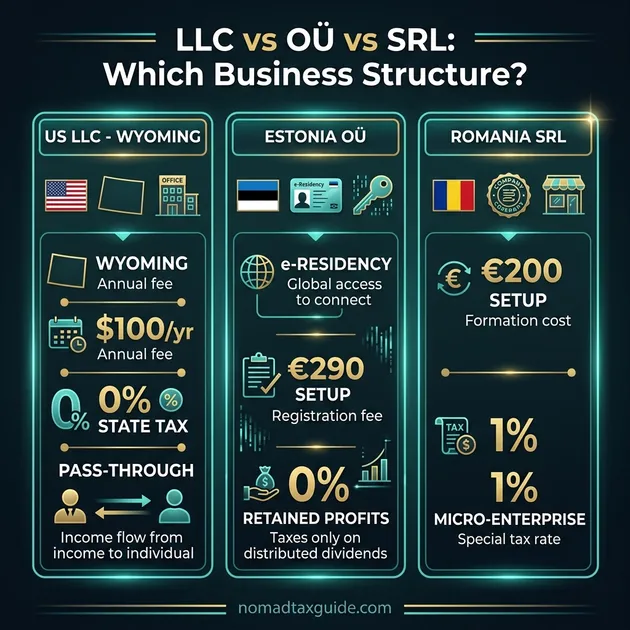
Most digital nomads do not remain in one country long enough to establish tax residency, or they utilize specific digital nomad visas that exempt them from local corporate taxes. To operate globally, they require an entity that is recognized by global banks, merchants, and clients.
The two most popular vehicles for this purpose are the US Single-Member LLC (Limited Liability Company) and the UK LTD (Private Limited Company).
The US Single-Member LLC: A Disregarded Entity
A US LLC is a hybrid structure that combines the limited liability protection of a corporation with the tax flexibility of a partnership or sole proprietorship. By default, the Internal Revenue Service (IRS) treats a single-member LLC owned by a single individual as a “disregarded entity” for tax purposes.
This means that the LLC itself does not pay federal income tax. Instead, the profits and losses “pass through” to the owner’s personal tax return, avoiding double taxation at the corporate level.
The UK LTD: A Separate Legal Entity
A UK Private Limited Company (LTD) is a completely separate legal personality from its shareholders and directors. Unlike a US LLC, a UK LTD is always treated as a corporate taxpayer by Her Majesty’s Revenue and Customs (HMRC).
The company must calculate its net profits, file corporate tax returns, and pay UK Corporation Tax before distributing dividends to its owners. It cannot be treated as a transparent or pass-through entity.
US LLC Deep Dive: Taxes, Setup, and Fees
For non-US citizens who do not live in the United States, the US LLC is often referred to as a “tax haven” structure, though it is fully transparent and legal. Understanding how the IRS views this entity is crucial.
Tax Treatment for Non-US Residents
If you are a non-US resident and own a US Single-Member LLC, your business profits are only subject to US federal income tax if you are Engaged in a Trade or Business in the United States (ETBUS).
According to Internal Revenue Code (IRC) Section 864, you are generally only considered ETBUS if you meet two specific conditions:
- You have at least one Dependent Agent in the US (such as an exclusive employee or contractor working solely for you).
- That dependent agent performs substantial services in the US to further your business, or you have a physical location (office, warehouse, or store) in the US.
If you are a solo software developer, writer, or consultant sitting in Spain, Bali, or Buenos Aires, and you do not have physical operations or employees in the US, you are not ETBUS. Consequently, your LLC’s income is classified as foreign-source income and is subject to 0% US federal tax.
However, you must still declare this income in your personal country of tax residence, unless you live in a territorial tax country or qualify for a tax-free regime.
[!WARNING] While your federal income tax may be 0%, you still have strict annual reporting requirements. Failure to file Form 5472 and Form 1120 (Pro Forma) by the April 15 deadline carries an automatic $25,000 penalty under IRC Section 6038A.
Tax Treatment for US Citizens and Green Card Holders
If you are a US citizen or green card holder, the tax neutrality disappears. The IRS taxes you on your worldwide income, regardless of where the LLC’s activities take place.
Your LLC profits will be reported on Schedule C of Form 1040. These profits are subject to both US federal income tax and the 15.3% self-employment tax (covering Social Security and Medicare).
You can use the Foreign Earned Income Exclusion (FEIE) to exclude up to $130,000 (for 2026) of earned income from income tax, but this does not reduce your self-employment tax. You can model this liability using our Tax Calculator.
Setup and Annual Maintenance Fees
Setting up a US LLC is relatively inexpensive, but costs vary widely by state. Digital nomads typically choose “nomad-friendly” states like Wyoming, Delaware, or New Mexico because they do not charge state income tax on non-residents.
- Wyoming: Setup fees are $100, and the annual state report fee is $60. Wyoming offers excellent asset protection and privacy.
- Delaware: Setup fees are $90, and the annual franchise tax is a flat $300. Delaware is the gold standard for startups seeking venture capital but is more expensive for solo nomads.
- New Mexico: Setup fees are $50, and there are $0 annual state filing fees. It also offers complete ownership anonymity.
In addition to state fees, you will need a Registered Agent (ranging from $39 to $150/year) to receive legal notices on behalf of your LLC.
UK LTD Deep Dive: Taxes, Setup, and Fees
The United Kingdom has structured its corporate framework to be highly competitive, but it operates on a traditional corporate tax model.
UK Corporation Tax Brackets
Unlike the US LLC, a UK LTD must pay corporation tax on its worldwide profits. Following the tax reforms enacted under the UK Finance Act, the corporation tax rates for 2026 are structured as follows:
- Small Profits Rate: A flat 19% tax rate applies to companies with taxable profits of £50,000 or less.
- Marginal Relief Bracket: Profits between £50,000 and £250,000 are taxed at a sliding scale, effectively introducing a marginal rate of 26.5% on profits within this bracket.
- Main Rate: A flat 25% tax rate applies to companies with taxable profits exceeding £250,000.
If you run a UK LTD and make £80,000 in net profit, your corporation tax bill will be calculated using the marginal relief formula, resulting in an effective tax rate of approximately 20.8%.
Extracting Profits: Dividends and Salaries
Once your UK LTD has paid corporation tax, you must formally extract the remaining profits.
- If you are a UK tax resident: You are subject to progressive dividend tax rates (8.75% for basic rate, 33.75% for higher rate, and 39.35% for additional rate) after a small tax-free dividend allowance of £500.
- If you are a non-UK resident: The UK does not levy withholding tax on dividends paid by a UK company to foreign shareholders. However, you may owe tax on these dividends in your country of residence under local tax rules or double taxation treaties.
Setup and Annual Maintenance Fees
The UK is one of the cheapest places in the world to incorporate a company.
- Setup Fee: Filing online directly with UK Companies House costs only £50 (updated for 2026 administrative fees).
- Registered Office Address: You must have a physical address in the UK. A mail forwarding or registered office service costs between £30 and £100/year.
- Confirmation Statement: An annual filing confirming company details costs £34 online.
[!TIP] While UK setup is cheap, the accounting costs are higher. You will need to prepare annual statutory accounts matching UK GAAP or IFRS standards and file a CT600 Company Tax Return with HMRC annually. This usually requires hiring a chartered accountant, which costs £600 to £1,500/year.
Comparison Table: US LLC vs. UK LTD (2026)
| Feature | US LLC (Single-Member, Non-US Owner) | UK LTD (Single Shareholder, Non-UK Owner) |
|---|---|---|
| Tax Classification | Disregarded (Pass-Through) | Corporate Entity (Taxpayer) |
| Federal/Corporate Tax Rate | 0% (if not ETBUS) | 19% to 25% (on all net profits) |
| Setup Cost (State/Gov) | $50 to $100 (Wyoming/New Mexico) | £50 (Companies House) |
| Annual State/Gov Fees | $0 to $300 (New Mexico: $0, Wyoming: $60) | £34 (Confirmation Statement) |
| Filing Requirements | Form 1120 (Pro Forma) & Form 5472 | Confirmation Statement, Accounts, CT600 |
| Public Registry Privacy | Yes (New Mexico & Wyoming hide owners) | No (All directors/shareholders on public record) |
| Payment Gateway Access | Full access (Stripe US, PayPal US) | Full access (Stripe UK, PayPal UK) |
| Accounting Standards | Low (Internal bookkeeping sufficient) | High (Strict UK GAAP statutory accounts) |
Payment Processor Compatibility: Stripe and PayPal
For e-commerce sellers, agency owners, and SaaS founders, payment gateway stability is the lifeblood of their business. Both jurisdictions provide access to tier-1 payment rails, but they behave differently.
Stripe and PayPal with a US LLC
When you open a US LLC, you can apply for a US Stripe account or US PayPal Business account. To do this, you will need:
- An Employer Identification Number (EIN) from the IRS. Non-US residents can obtain this by faxing Form SS-4 to the IRS, which takes 2–4 weeks.
- A US business address (provided by your registered agent or a mail forwarding service).
- A US bank account (opened digitally via fintechs like Mercury, Wise, or Payoneer).
- A US phone number (via VoIP apps like Zadarma or OpenPhone).
Stripe US is highly stable and supports payouts directly to US banks in USD. Transaction fees for US cards are 2.9% + $0.30, but international cards incur an additional 1.5% cross-border fee.
Stripe and PayPal with a UK LTD
A UK LTD allows you to open a UK Stripe or UK PayPal account. The requirements are:
- A Company Registration Number (CRN) from Companies House.
- A UK business address.
- A UK bank account (opened via Wise, Revolut Business, or Payoneer).
Stripe UK offers lower transaction fees for domestic cards (1.5% + £0.20 for UK cards). However, for international cards, the fee rises to 3.25% + £0.20. If your primary client base is in the United States, running a UK LTD will lead to higher transaction fees compared to a US LLC due to cross-border processing fees.
Non-US Residents vs. US Citizens: Structural Impact
Your citizenship and tax residence are the ultimate deciders when selecting an entity.
The Non-US Resident Scenario
If you do not hold US citizenship or residency, a US LLC is almost always the superior choice for service-based businesses. It allows you to operate with 0% corporate tax and minimal administrative overhead.
If you choose a UK LTD instead, you are immediately giving up 19% to 25% of your net business profits to the UK government, regardless of where you live. You only receive the remaining 75% to 81% as dividends, which may then be taxed again in your home country.
The US Citizen/Expat Scenario
If you are a US citizen living abroad, a UK LTD is categorized as a Controlled Foreign Corporation (CFC) under IRC Section 957. This triggers the complex GILTI (Global Intangible Low-Taxed Income) regime introduced by the Tax Cuts and Jobs Act.
GILTI requires US citizens to pay US tax on the undistributed earnings of their foreign corporation, effectively eliminating the tax deferral benefit. The filing requirements for CFCs (Form 5471) are notoriously complex, with CPA fees often exceeding $2,000 per year per form.
For US expats, a US LLC is far simpler. Since it is a disregarded entity, it is not a CFC. You report your business income on your personal Form 1040, apply the FEIE via Form 2555, or use the Foreign Tax Credit (FTC) to offset your liabilities without triggering GILTI or Form 5471 filing burdens. Refer to our FTC vs FEIE guide for more details.
Step-by-Step Incorporation Checklist
Here is how to set up both entities in 2026.
US LLC Setup Checklist
- Choose a State: Select Wyoming (best asset protection), New Mexico (cheapest, private), or Delaware (VC focus).
- Hire a Registered Agent: Select a service provider in your chosen state to provide a registered address.
- File Articles of Organization: Submit the filing online to the Secretary of State and pay the state fee.
- Draft an Operating Agreement: Establish that you are the sole member and manager of the LLC.
- Apply for an EIN: File Form SS-4 with the IRS. Non-US residents must call or fax the IRS; US residents can apply online.
- Open a Business Bank Account: Apply to Mercury, Wise Business, or Payoneer using your EIN, Articles, and Passport.
- Set Up Payment Gateways: Connect your bank account to Stripe or PayPal.
UK LTD Setup Checklist
- Choose a Company Name: Ensure the name is not already registered at Companies House.
- Purchase a Registered Office Address: Secure a mailing address in the UK for official government correspondence.
- Register with Companies House: Complete the online registration form, pay the £50 fee, and receive your CRN.
- Register for Corporation Tax: Within 3 months of starting business activities, log into HMRC and register.
- Open a UK Business Bank Account: Register with Wise Business, Revolut Business, or a traditional UK bank if you have UK residency.
- Register for VAT (if applicable): If your UK-source taxable sales exceed the £90,000 threshold (for 2026), you must register for VAT.
Frequently Asked Questions
Do I need a physical address in the US to open a US LLC?
No. You do not need a physical residential or commercial address of your own. You are required to have a Registered Agent with a physical address in the state of incorporation. Your agent receives official government mail and lawsuits on your behalf and scans them to you digitally.
Can a non-US resident open a US bank account online?
Yes. Modern digital business banks like Mercury, Wise, and Payoneer allow non-US founders to open US business accounts entirely online. You will need your approved Articles of Organization, an EIN, a copy of your passport, and proof of your foreign physical address.
What is the penalty for not filing Form 5472 for a US LLC?
The IRS imposes a flat $25,000 penalty for failure to file Form 5472 and the pro forma Form 1120 by the annual deadline. The penalty applies even if your LLC generated $0 in revenue or owed no tax. The IRS has automated its penalty assessments for foreign-owned LLCs, making compliance critical.
Will a UK LTD protect me from paying taxes in my local country?
No. Incorporating a UK company does not automatically exempt you from personal income taxes. If you are a tax resident in a country like Spain, Germany, or Japan, your local tax authority may apply Place of Effective Management (POEM) rules. They can argue that because you run the company from Spain, the company is tax resident in Spain and subject to Spanish corporate taxes.
Can I change my US LLC to a corporation later?
Yes. The IRS allows you to change the tax classification of your LLC by filing Form 8832 (Entity Classification Election), known as a “check-the-box” election. You can elect to have your LLC taxed as a C-Corporation or an S-Corporation (if you meet the shareholder requirements), giving you long-term structural flexibility.
Final Thoughts
For most digital nomads, the US LLC remains the undisputed king of remote business structures. Its combination of pass-through taxation, lower administrative costs, privacy, and zero US corporate tax for non-residents makes it highly efficient.
The UK LTD is a robust alternative, but it is best reserved for nomads who have a specific commercial reason to be based in the UK, require access to European payment systems, or intend to raise capital in the UK.
Before making your decision, ensure you run your numbers through our Tax Calculator and evaluate how your entity selection will interact with your personal tax residency status. Making the right choice now will save you thousands of dollars in compliance fees and taxes down the road.