US Expat Taxes: FEIE & Foreign Earned Income Exclusion Guide (2026)
If you’re a US citizen or green card holder living abroad, here’s the uncomfortable truth: the United States taxes you on your worldwide income, no matter where you live. Whether you’re coding from a café in Bali, consulting from a coworking space in Lisbon, or running an e-commerce business from Medellín, Uncle Sam wants his share.
The good news? The Foreign Earned Income Exclusion (FEIE) lets you exclude up to $130,000 of foreign earned income from US federal income tax in 2026. But it comes with strict requirements, tricky tests, and a few gotchas that catch even experienced expats off guard — starting with the fact that self-employment tax still applies.
TL;DR: The Foreign Earned Income Exclusion (FEIE) under Internal Revenue Code Section 911 allows US citizens and green card holders living abroad to exclude up to $130,000 (2026) of foreign earned income from federal income tax. You must pass either the Physical Presence Test (330 days outside the US in 12 months) or the Bona Fide Residence Test, and claim it on IRS Form 2555 — but self-employment tax of 15.3% still applies regardless.
This guide breaks down everything you need to know to use the FEIE correctly and avoid costly mistakes.
What Is the Foreign Earned Income Exclusion (FEIE)?
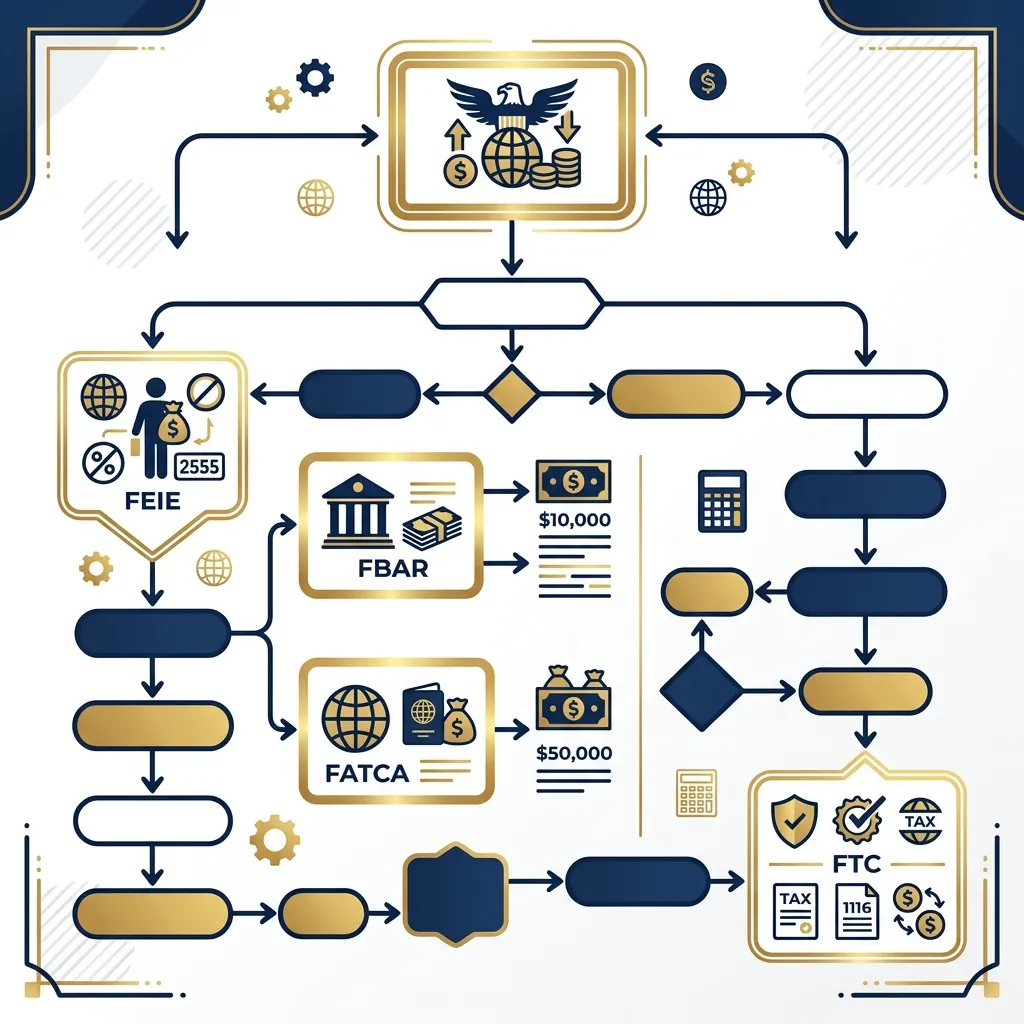
The FEIE, codified under Internal Revenue Code Section 911, allows qualifying US taxpayers living and working abroad to exclude a set amount of foreign earned income from their US federal income tax return. Per IRS Publication 54 (Tax Guide for U.S. Citizens and Resident Aliens Abroad), the exclusion is available to any qualifying individual who has a tax home in a foreign country and meets one of two residency tests.
2026 FEIE Key Numbers
| Item | 2026 Amount |
|---|---|
| Maximum FEIE exclusion | $130,000 |
| Foreign housing exclusion base | $18,200 (14% of FEIE) |
| Foreign housing exclusion max (general) | $39,000 (30% of FEIE) |
| Filing deadline (automatic extension) | June 15, 2027 |
| Extended filing deadline | October 15, 2027 |
| Form required | Form 2555 |
The exclusion amount is adjusted annually for inflation. For reference, it was $126,500 in 2024 and $128,400 in 2025.
[!TIP] The FEIE only applies to federal income tax. It does not reduce your self-employment tax (Social Security + Medicare), state income tax (if your state still claims you), or NIIT (Net Investment Income Tax). We’ll cover these separately below.
Who Qualifies for the FEIE?
To claim the FEIE, you must meet all three of the following criteria:
- US tax filing obligation — You must be a US citizen, US national, or US resident alien (green card holder)
- Foreign earned income — Your income must be earned from work performed in a foreign country (not from US-based sources)
- Tax home in a foreign country — Your regular or principal place of business must be in a foreign country
- Pass one of two residency tests — Either the Physical Presence Test or the Bona Fide Residence Test
What Counts as “Foreign Earned Income”?
The FEIE covers earned income from services performed while your tax home is in a foreign country:
- Salary and wages from a foreign or US employer (as long as the work is performed abroad)
- Self-employment income from freelancing, consulting, or running a business
- Bonuses and commissions tied to foreign-performed work
- Professional fees for services rendered abroad
What Does NOT Qualify?
The following income types are excluded from the FEIE:
- Passive income: dividends, interest, capital gains, rental income
- Pension and retirement distributions (401k, IRA withdrawals)
- US government employee pay (military, federal civilians)
- Income earned in the US (even if you live abroad)
- Income earned during US visits that exceed incidental travel
The Two Qualifying Tests
You must pass one of these two tests to claim the FEIE. Choose the one that best fits your situation.
Physical Presence Test (PPT)
The Physical Presence Test is the more popular choice among digital nomads because it’s purely mathematical — no subjective judgments involved.
Requirements:
- You must be physically present in a foreign country (or countries) for at least 330 full days during any 12-month period
- The 12-month period does not have to align with the calendar year
- According to the IRS Form 2555 instructions, a “full day” means midnight to midnight — travel days between countries count only if you’re in a foreign country for the full 24 hours
- Days spent over international waters or airspace do not count as foreign days
How to count:
- Choose any 12-month period that includes part of the tax year you’re filing for
- Count every full day (midnight to midnight) you spent outside the US
- You need at least 330 days — that means you can spend a maximum of 35 days in the US during your 12-month period
[!WARNING] Those 35 days include all time in the US — vacations, family visits, layovers, medical trips, everything. A common mistake is not counting travel days or layover days. If your flight from Bangkok lands in Los Angeles at 11 PM, that entire day counts as a US day, even though you were mostly in transit.
Bona Fide Residence Test (BFR)
The Bona Fide Residence Test is more subjective and requires you to be a genuine resident of a foreign country.
Requirements:
- You must be a bona fide resident of a foreign country for an uninterrupted period that includes a full calendar year
- “Bona fide” means you’ve established genuine residency — not just physically being there, but intending to make it your home. As established in US Tax Court rulings (e.g., Sochurek v. Commissioner), the determination considers the totality of your circumstances, not any single factor.
- You must demonstrate ties to the foreign country: housing lease, local bank accounts, social connections, club memberships, driver’s license, etc.
- Per IRS Publication 54, short trips to the US do not break your bona fide residence, as long as you maintain your foreign home
Best for:
- Expats who have settled in one foreign country for 1+ years
- People who may spend more than 35 days in the US but maintain genuine foreign residency
- Those with a digital nomad visa that establishes clear legal residency abroad
Which Test Should You Choose?
| Factor | Physical Presence Test | Bona Fide Residence Test |
|---|---|---|
| Objectivity | Purely mathematical | Subjective (IRS judgment) |
| US days allowed | Max 35 days in 12 months | No strict limit |
| Multi-country nomads | Works well | Harder to prove (no single home) |
| Single-country expats | Works well | Ideal |
| First year abroad | Available immediately | Need full calendar year first |
| Risk of IRS challenge | Low (clear math) | Moderate (subjective elements) |
[!TIP] Most digital nomads should default to the Physical Presence Test. It’s cleaner, less susceptible to IRS challenges, and works regardless of how many countries you visit. The Bona Fide Residence Test is better if you’ve genuinely settled in one country and want the flexibility to visit the US more frequently.
How to File: Form 2555
The FEIE is claimed on IRS Form 2555, which you attach to your regular Form 1040 tax return.
Step-by-Step Filing Guide
-
Complete Part I — General information (name, address abroad, employer details)
-
Complete Part II or Part III — Choose which qualifying test you’re using:
- Part II: Bona Fide Residence Test
- Part III: Physical Presence Test (list all countries and dates)
-
Complete Part IV — Calculate your foreign earned income
- List all earned income from foreign sources
- Subtract any income earned in the US
-
Complete Part V — Calculate your housing exclusion (if applicable)
- List your qualifying housing expenses (rent, utilities, insurance — NOT mortgage or purchased property)
- The housing exclusion amount = actual expenses minus the base amount ($18,200 for 2026)
- Cannot exceed the maximum for your location (varies by city — high-cost cities like London, Hong Kong, and Tokyo have higher limits)
-
Complete Parts VI–VIII — Final calculations and the exclusion amount
-
Transfer to Form 1040 — The excluded amount reduces your adjusted gross income
Key Filing Notes
- The FEIE is not automatic. You must file Form 2555 to claim it, even if your income is below $130,000.
- If you miss the filing deadline, you can claim the FEIE retroactively, but you may need to file amended returns (Form 1040-X).
- Once you revoke the FEIE election, you cannot re-elect it for 5 years without IRS approval.
[!WARNING] Do not skip filing. Even if you owe $0 in US tax after the FEIE, you are still required to file a tax return if your gross income exceeds the filing threshold ($14,600 for single filers in 2026). Failure to file can result in penalties and loss of your FEIE election.
The Self-Employment Tax Trap
Here’s the catch that surprises most US expat freelancers and self-employed nomads: the FEIE does NOT exclude self-employment tax.
How Self-Employment Tax Works
Self-employment (SE) tax covers Social Security (12.4%) and Medicare (2.9%), totaling 15.3% on net self-employment earnings up to the Social Security wage base ($176,100 for 2026). Above that threshold, only the 2.9% Medicare portion applies.
| Component | Rate | 2026 Wage Base |
|---|---|---|
| Social Security | 12.4% | $176,100 |
| Medicare | 2.9% | No limit |
| Additional Medicare Tax | 0.9% | Over $200,000 (single) |
| Total SE Tax | 15.3% | Up to wage base |
Example: Freelancer Earning $120,000
Let’s say you’re a US freelance developer earning $120,000/year while living in Bali on an E33G visa:
| Item | Amount |
|---|---|
| Gross self-employment income | $120,000 |
| Net SE income (after 50% deduction adjustment) | $110,280 |
| FEIE exclusion | $120,000 (full income excluded from income tax) |
| Federal income tax owed | $0 |
| Self-employment tax owed | $120,000 × 92.35% × 15.3% = $16,960 |
| Total US tax | $16,960 |
That $16,960 is real money — and many nomads don’t budget for it.
Strategies to Reduce SE Tax
-
S-Corp election: If you form a US LLC and elect S-Corp status, you can pay yourself a “reasonable salary” and take the rest as distributions, which are not subject to SE tax. For a $120,000 income, setting a salary of $60,000 could cut your SE tax roughly in half.
-
Totalization agreements: The US has Social Security agreements (Totalization Agreements) with about 30 countries. If you’re contributing to a foreign country’s social security system, you may be exempt from US SE tax. Countries with agreements include the UK, Germany, France, Canada, Australia, Japan, and South Korea.
-
Foreign tax credits: If you pay social security contributions in a country without a Totalization Agreement, you generally cannot credit those against US SE tax. However, you may be able to deduct them.
[!TIP] Use our Tax Calculator to model the impact of SE tax on your specific income. The difference between W-2 employment and self-employment can be $15,000–$25,000+ in annual tax liability, even with the FEIE applied.
FBAR and FATCA: Reporting Foreign Accounts
Living abroad means you likely have foreign bank accounts, investment accounts, or signatory authority over foreign financial accounts. The US requires reporting these under two separate regimes.
FBAR (FinCEN Form 114)
The Report of Foreign Bank and Financial Accounts must be filed if the aggregate value of all your foreign financial accounts exceeds $10,000 at any point during the calendar year.
| FBAR Detail | Requirement |
|---|---|
| Threshold | $10,000 aggregate across all foreign accounts |
| Due date | April 15 (auto-extension to October 15) |
| Filed with | FinCEN (not the IRS) — electronic filing only |
| Penalties (non-willful) | Up to $16,117 per violation (2026) |
| Penalties (willful) | Up to $161,170 or 50% of account balance |
| Criminal penalties | Up to $250,000 fine and/or 5 years imprisonment |
FATCA (Form 8938)
The Foreign Account Tax Compliance Act requires reporting foreign financial assets on Form 8938, attached to your tax return.
| Filing Status | Threshold (Living Abroad) |
|---|---|
| Single | $200,000 (end of year) or $300,000 (any time during year) |
| Married filing jointly | $400,000 (end of year) or $600,000 (any time during year) |
FBAR vs. FATCA: What’s the Difference?
| Feature | FBAR | FATCA (Form 8938) |
|---|---|---|
| Threshold | $10,000 | $200,000+ (abroad) |
| What’s reported | Bank accounts only | All financial assets (accounts, securities, interests) |
| Filed with | FinCEN | IRS (with tax return) |
| Penalties | Severe ($16,117+/violation) | Up to $10,000 per violation |
| Who must file | US persons | US persons |
[!WARNING] FBAR and FATCA are not alternatives — if you meet both thresholds, you must file both. Many expats have been penalized for filing one but not the other. The $10,000 FBAR threshold is extremely low; even a single foreign checking account can trigger it.
Common Mistakes US Expats Make
1. Assuming the FEIE Eliminates All US Tax
The FEIE only covers federal income tax on earned income up to $130,000. It does not cover:
- Self-employment tax (15.3%)
- State income tax (if your state still claims you)
- Tax on passive income (dividends, capital gains, rental income)
- Net Investment Income Tax (3.8%)
- Income above $130,000
2. Not Filing a Tax Return
Many expats assume that if they owe nothing after the FEIE, they don’t need to file. Wrong. You must file if your gross income exceeds the filing threshold. Failure to file can result in losing your FEIE election and facing penalties.
3. Miscounting Days for the Physical Presence Test
Common day-counting errors include:
- Counting partial days as full foreign days (they’re not — only midnight-to-midnight counts)
- Forgetting to count US layovers
- Not accounting for time zone differences on border crossings
- Including days in international waters or airspace
4. Forgetting About State Taxes
Several US states continue to tax residents even after they move abroad, including:
- California — notoriously aggressive; considers you a resident until you establish domicile elsewhere
- New York — audits departures frequently
- Virginia, New Mexico, South Carolina — maintain residency claims even for overseas expats
If you’re from one of these states, formally severing state residency (changing driver’s license, voter registration, and domicile) is essential before relying on the FEIE.
5. Missing FBAR Deadlines
FBAR non-compliance carries some of the harshest penalties in the US tax code. Non-willful penalties alone can exceed $16,000 per account per year. If you have foreign bank accounts — even just a Wise or Revolut account with a foreign IBAN — you likely need to file.
6. Taking the FEIE When the Foreign Tax Credit Is Better
If you’re living in a high-tax country (UK, Germany, France, Scandinavian countries), the Foreign Tax Credit (FTC) may save you more money than the FEIE. The FTC gives you a dollar-for-dollar credit against US tax for foreign taxes paid. If your foreign tax rate exceeds the US rate, the FTC can eliminate your US liability entirely — and you can carry unused credits forward.
| Strategy | Best When |
|---|---|
| FEIE | Living in low/zero-tax countries (Dubai, Bali, Croatia) |
| Foreign Tax Credit | Living in high-tax countries (UK, Germany, France) |
| Both (partial) | Income above $130,000 in moderate-tax countries |
[!TIP] You can use the FEIE and FTC together, but not on the same dollar of income. Income excluded by the FEIE cannot generate a foreign tax credit. Consult a cross-border tax advisor to determine the optimal strategy for your specific situation.
Practical Example: Full Tax Calculation
Let’s walk through a complete example for a typical US digital nomad.
Profile
- Name: Alex, US citizen
- Status: Single, no dependents
- Location: Croatia (digital nomad visa)
- Income: $140,000 from freelance software development
- Foreign bank accounts: €15,000 in a Croatian bank + $8,000 in Wise
Tax Calculation
| Item | Amount |
|---|---|
| Gross freelance income | $140,000 |
| FEIE exclusion (max) | -$130,000 |
| Taxable earned income | $10,000 |
| Standard deduction | -$15,700 |
| Taxable income after deduction | $0 |
| Federal income tax | $0 |
| Self-employment tax ($140,000 × 92.35% × 15.3%) | $19,774 |
| Deductible half of SE tax | -$9,887 |
| Total federal tax owed | ~$19,774 |
Reporting Requirements
- Form 1040 — required (income over filing threshold)
- Form 2555 — required (FEIE claim)
- Schedule SE — required (self-employment tax)
- Schedule C — required (freelance business income)
- FBAR (FinCEN 114) — required (foreign accounts exceed $10,000)
- Form 8938 (FATCA) — not required (foreign assets under $200,000 threshold)
Croatia Tax
- Croatian income tax: $0 (digital nomad visa exemption)
Total Global Tax Burden
- $19,774 — all owed to the US, primarily self-employment tax
Frequently Asked Questions
Can I claim the FEIE if I’m a digital nomad moving between countries?
Yes, as long as you pass the Physical Presence Test (330 days outside the US in a 12-month period). You don’t need to be in any single foreign country — you can travel across multiple countries. Your tax home needs to be in a foreign country, which is typically wherever you spend the most time or have the strongest work-related ties.
Does the FEIE apply to investment income or capital gains?
No. The FEIE only covers earned income — salary, wages, self-employment income, and professional fees. Passive income like dividends, interest, capital gains, rental income, and retirement distributions are taxed at normal US rates regardless of where you live.
What happens if I earn more than $130,000?
Income above the $130,000 FEIE threshold is subject to US federal income tax at the rates that would apply as if the excluded income still counted for rate-setting purposes. This means the first dollar above the exclusion is taxed at the marginal rate corresponding to $130,000+ in income — not at the lowest bracket. The Foreign Housing Exclusion can provide additional relief, and the Foreign Tax Credit can offset tax on the excess if you’ve paid taxes abroad.
Do I still owe self-employment tax with the FEIE?
Yes. This is the most misunderstood aspect of the FEIE. Self-employment tax (15.3%) applies to your net self-employment income regardless of the FEIE. For a freelancer earning $130,000, this means approximately $18,400 in SE tax even if your federal income tax is $0.
Can I use the FEIE and the Foreign Tax Credit together?
Yes, but not on the same income. You can exclude up to $130,000 using the FEIE, then use the Foreign Tax Credit on income above $130,000 that’s been taxed by a foreign country. You cannot claim a credit for foreign taxes on income that was already excluded by the FEIE.
What if I work remotely for a US company while living abroad?
The FEIE does apply to income from US employers, as long as the work is performed in a foreign country. The employer’s location doesn’t matter — what matters is where you physically sit when doing the work. However, make sure your employer is comfortable with the arrangement and aware of any tax treaty implications.
Final Thoughts
The FEIE is one of the most valuable tax tools available to US citizens living abroad, potentially saving you $20,000–$35,000+ per year in federal income tax. But it’s not a silver bullet — self-employment tax remains a significant burden for freelancers, and the reporting requirements (FBAR, FATCA, Form 2555) are non-trivial.
The key to maximizing your tax efficiency as a US expat is understanding how the FEIE interacts with other tools: double taxation treaties, Foreign Tax Credits, S-Corp elections, and your choice of nomad visa destination.
Start by calculating your estimated tax burden using our Tax Calculator, and if your situation involves self-employment income above $100,000 or multiple countries, consider consulting a US expat tax specialist. The cost of professional advice is almost always less than the cost of getting it wrong with the IRS.