Digital Nomad Tax Calculator: Compare Your Tax in 16 Countries (Free Tool)

Your choice of country as a digital nomad can mean the difference between paying $0 and $40,000+ in annual income tax on the exact same income. That’s not a rounding error — it’s a life-changing amount of money that compounds year after year, affecting your savings rate, retirement timeline, and financial freedom.
TL;DR: Our free Digital Nomad Tax Calculator compares estimated income tax across 16 countries — from 0% in the UAE to 30%+ in Italy — based on your gross income, employment type, and filing status. It covers special regimes like Spain’s Beckham Law (24%), Portugal’s NHR (20%), and Georgia’s 1% Small Business rate, helping you identify potential savings of $10,000–$30,000+ per year before you relocate.
Yet most digital nomads choose their next destination based on weather, cost of living, and visa requirements. Tax rarely enters the equation until April rolls around and the bill arrives. Our free Digital Nomad Tax Calculator was built to change that — giving you side-by-side tax estimates across 16 countries so you can make informed decisions before you book the flight.
This guide explains exactly how to use the calculator, walks through country-by-country breakdowns at real income levels, and helps you avoid the most common tax mistakes digital nomads make.
Why Tax Comparison Matters for Digital Nomads
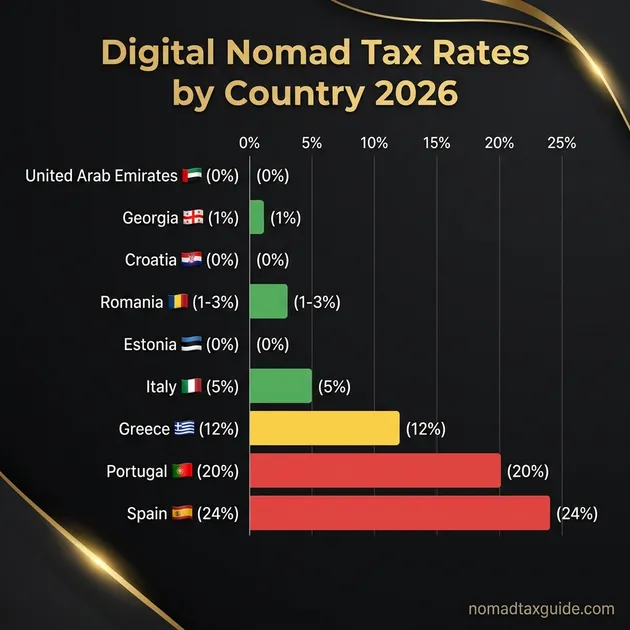
Most people who work in a single country never think about tax optimization — their rate is their rate, and there’s not much they can do about it. Digital nomads are fundamentally different. Your tax residency is a variable, not a constant. By choosing where you establish tax residency, you effectively choose your tax rate.
Consider a freelance developer earning $100,000 per year:
| Country | Estimated Annual Tax | Effective Rate | Annual Savings vs. US |
|---|---|---|---|
| United States | ~$26,000 | ~26% | — |
| Germany | ~$33,000 | ~33% | -$7,000 |
| Spain (standard) | ~$28,000 | ~28% | -$2,000 |
| Spain (Beckham Law) | ~$24,000 | ~24% | +$2,000 |
| Portugal (NHR) | ~$20,000 | ~20% | +$6,000 |
| Georgia (Small Business) | ~$1,000 | ~1% | +$25,000 |
| UAE (Dubai) | $0 | 0% | +$26,000 |
The gap between the highest and lowest options is over $33,000 per year. Over five years of nomad life, that’s $165,000 — enough for a down payment on a home, a fully funded retirement account, or the seed capital for a new business.
[!IMPORTANT] Tax comparison is not about tax evasion. Every country on our calculator list has legitimate, legal pathways for digital nomads to establish residency and pay the rates shown. The key is understanding the rules, meeting the requirements, and filing correctly.
How the Calculator Works
Our Tax Calculator is designed to give you a fast, realistic comparison without requiring a tax degree. Here’s what it does under the hood.
Input Parameters
You provide three key inputs:
- Annual Income — Your total gross earned income in USD (or equivalent). This includes freelance revenue, salary, consulting fees, and other earned income.
- Employment Type — Whether you’re self-employed (freelancer, contractor) or employed by a company. This matters because self-employment triggers additional taxes in some jurisdictions (notably the US).
- Filing Status — Single or married filing jointly, which affects bracket thresholds in progressive tax systems.
What the Calculator Estimates
For each of the 16 countries, the calculator provides:
- Estimated income tax based on that country’s current tax brackets and rates
- Effective tax rate — your total tax as a percentage of gross income
- Any special regime rates — such as Portugal’s NHR 20% flat rate, Spain’s Beckham Law 24% rate, or Georgia’s 1% small business rate
- Social security contributions where applicable
- Net take-home income after all estimated obligations
What the Calculator Does NOT Cover
To keep the tool practical and honest, there are things it intentionally excludes:
- State or provincial taxes (e.g., California, New York)
- Deductions and credits beyond the standard deduction
- Passive income (dividends, capital gains, rental income)
- VAT or sales tax obligations
- Health insurance costs (which vary wildly)
- Double taxation treaty interactions — based on the OECD Model Tax Convention framework, treaty details vary by country pair. See our complete guide to double taxation treaties
[!NOTE] The calculator provides estimates for planning purposes. Your actual tax liability depends on your specific situation, the tax treaties between your home country and your residence country, and how you structure your business. Always confirm with a qualified tax advisor before making residency decisions.
Country-by-Country Breakdown
Here’s what the calculator shows for three representative income levels: $40,000, $60,000, and $100,000. All figures are approximate annual amounts in USD for a single, self-employed filer.
Zero-Tax and Ultra-Low-Tax Countries
UAE (Dubai)
| Income | Estimated Tax | Effective Rate |
|---|---|---|
| $40,000 | $0 | 0% |
| $60,000 | $0 | 0% |
| $100,000 | $0 | 0% |
The UAE has no personal income tax, no capital gains tax, and no social security for freelancers. The trade-off is a higher cost of living — particularly rent in Dubai — and the requirement to obtain a freelance or virtual working visa. You’ll need to budget roughly $15,000–$25,000 per year for visa, Emirates ID, and health insurance costs.
Georgia (1% Small Business Status)
| Income | Estimated Tax | Effective Rate |
|---|---|---|
| $40,000 | $400 | 1% |
| $60,000 | $600 | 1% |
| $100,000 | $1,000 | 1% |
Georgia’s Small Business Status offers a flat 1% tax on gross revenue for qualifying businesses earning under 500,000 GEL (approximately $185,000). This is one of the most favorable tax regimes in the world for digital nomads. The cost of living in Tbilisi is extremely low — $1,200–$1,800/month covers a comfortable lifestyle — making the effective savings even more dramatic.
Low-Tax Countries with Special Regimes
Portugal (NHR Regime)
| Income | Estimated Tax | Effective Rate |
|---|---|---|
| $40,000 | $8,000 | 20% |
| $60,000 | $12,000 | 20% |
| $100,000 | $20,000 | 20% |
Portugal’s Non-Habitual Resident (NHR) regime provides a flat 20% rate on Portuguese-source income from “high value” professional activities for up to 10 years. Foreign-source passive income may be exempt entirely. Without NHR, Portugal uses progressive rates up to 48%, so the regime provides substantial savings for higher earners.
Spain (Beckham Law)
| Income | Estimated Tax | Effective Rate |
|---|---|---|
| $40,000 | $9,600 | 24% |
| $60,000 | $14,400 | 24% |
| $100,000 | $24,000 | 24% |
Spain’s Beckham Law offers a flat 24% rate on Spanish-source income up to €600,000 for qualifying new residents, including digital nomad visa holders. Spain’s standard progressive rates go up to 47%, so the Beckham Law saves higher earners tens of thousands annually. Social security contributions apply on top but are capped.
Greece (50% Exemption)
| Income | Estimated Tax | Effective Rate |
|---|---|---|
| $40,000 | ~$4,400 | ~11% |
| $60,000 | ~$6,600 | ~11% |
| $100,000 | ~$13,200 | ~13.2% |
Greece offers a 50% income tax exemption for new tax residents transferring employment or self-employment activity to Greece. Under this scheme, half your employment or self-employment income is simply tax-exempt for up to 7 years. Combined with Greece’s already moderate progressive rates, this creates effective rates between 11–15%.
Moderate-Tax Countries
Romania (Micro-Enterprise)
| Income | Estimated Tax | Effective Rate |
|---|---|---|
| $40,000 | ~$1,200 | ~3% |
| $60,000 | ~$1,800 | ~3% |
| $100,000 | ~$3,000 | ~3% |
Romania’s micro-enterprise tax regime charges just 1% on gross revenue (with employees) or 3% on gross revenue (without employees) for companies with revenue under €500,000. This applies to company-level income — you’ll still owe 5% dividend tax plus social security contributions when extracting profits. The total effective burden is still remarkably low.
Croatia
| Income | Estimated Tax | Effective Rate |
|---|---|---|
| $40,000 | ~$4,000 | ~10% |
| $60,000 | ~$7,200 | ~12% |
| $100,000 | ~$15,000 | ~15% |
Croatia’s digital nomad visa exempts holders from Croatian income tax entirely, but you still owe tax to your home country. If you establish full tax residency, Croatia uses progressive rates of 20% and 30% — but the lower brackets and standard deductions keep the effective rate moderate.
Malaysia (DE Rantau)
| Income | Estimated Tax | Effective Rate |
|---|---|---|
| $40,000 | ~$2,600 | ~6.5% |
| $60,000 | ~$5,400 | ~9% |
| $100,000 | ~$14,000 | ~14% |
Malaysia’s progressive tax rates range from 0% to 30%, but generous personal reliefs and the DE Rantau pass program make it an affordable option. Foreign-source income remitted to Malaysia is currently exempt from tax for most non-resident categories, which benefits nomads with income from overseas clients.
Thailand (DTV Visa)
| Income | Estimated Tax | Effective Rate |
|---|---|---|
| $40,000 | ~$2,800 | ~7% |
| $60,000 | ~$5,400 | ~9% |
| $100,000 | ~$14,000 | ~14% |
Thailand’s Destination Thailand Visa (DTV) opened new doors for remote workers. Thailand’s progressive rates run from 5% to 35%, but tax residency triggers only after 180 days, and foreign-source income is taxed only when remitted into Thailand in the same tax year it’s earned. Careful timing can significantly reduce your effective rate.
Vietnam
| Income | Estimated Tax | Effective Rate |
|---|---|---|
| $40,000 | ~$4,800 | ~12% |
| $60,000 | ~$9,000 | ~15% |
| $100,000 | ~$20,000 | ~20% |
Vietnam’s progressive rates range from 5% to 35%. Tax residency triggers after 183 days, and the tax system is applied on worldwide income for residents. The cost of living is extremely low, which partially offsets the moderate tax rates.
Higher-Tax Countries
Malta
| Income | Estimated Tax | Effective Rate |
|---|---|---|
| $40,000 | ~$6,000 | ~15% |
| $60,000 | ~$11,400 | ~19% |
| $100,000 | ~$24,000 | ~24% |
Malta uses a remittance-based tax system for non-domiciled residents — you’re taxed on Maltese-source income and foreign income remitted to Malta, but not on foreign income kept abroad. This structure, combined with progressive rates from 0% to 35%, offers optimization opportunities for nomads who can control how they bring funds into the country.
Italy
| Income | Estimated Tax | Effective Rate |
|---|---|---|
| $40,000 | ~$10,400 | ~26% |
| $60,000 | ~$16,200 | ~27% |
| $100,000 | ~$31,000 | ~31% |
Italy’s standard progressive rates run from 23% to 43%, making it one of the higher-tax options. However, Italy’s digital nomad visa and flat-tax regime for new residents offers a €100,000 flat annual substitute tax on foreign income, which benefits very high earners. For most nomads earning under $150,000, Italy’s tax burden is significant.
Indonesia (Bali)
| Income | Estimated Tax | Effective Rate |
|---|---|---|
| $40,000 | ~$3,600 | ~9% |
| $60,000 | ~$7,200 | ~12% |
| $100,000 | ~$17,000 | ~17% |
Indonesia’s progressive rates go from 5% to 35%, but the E33G digital nomad visa provides a unique framework. Tax residency triggers after 183 days, and the lower brackets provide moderate effective rates. Bali’s exceptionally low cost of living means your after-tax income stretches further than almost anywhere else.
[!TIP] Try the calculator now → Input your actual income to get personalized estimates. The country-by-country comparison takes less than 30 seconds and could reveal savings opportunities you hadn’t considered.
Common Tax Mistakes Digital Nomads Make
Even with a calculator showing you the numbers, there are critical mistakes that can turn a smart move into an expensive one.
1. Confusing “No Tax Residency” with “No Tax Obligation”
Many nomads believe that by constantly moving and never establishing tax residency anywhere, they can avoid all tax obligations. This is false and dangerous. Most countries determine tax residency based on the 183-day rule — if you spend more than 183 days in a country during a calendar year, you’re typically considered a tax resident. But some countries use other criteria: economic ties, center of vital interests, habitual abode, or even nationality (per IRS Publication 54, US citizens are taxed on worldwide income regardless of residency).
Not being a resident anywhere doesn’t mean you owe nothing — it often means multiple countries could claim you as a resident. Read our article on common nomad tax mistakes for detailed examples.
2. Ignoring Home Country Exit Requirements
Many countries require formal procedures to cease tax residency: filing departure declarations, demonstrating a new tax home, or meeting minimum absence periods. Simply leaving doesn’t end your obligations. This is especially relevant for US citizens (FEIE requirements), Australians, Canadians, and UK nationals.
3. Choosing a Country Solely for Tax Rates
A 0% tax rate means nothing if the cost of living eats your savings, the visa process is unreliable, or the country lacks adequate healthcare and infrastructure. Always evaluate the total cost of living abroad, including:
- Visa fees and renewals
- Health insurance (mandatory in most visa programs)
- Housing costs (Dubai at 0% tax but $2,500/month rent vs. Georgia at 1% tax and $500/month rent)
- Banking and remittance costs
- Travel costs to maintain visa status or visit home
4. Not Accounting for Social Security
Many countries require social security contributions in addition to income tax. In Spain, mandatory contributions can add €3,600+ per year. In Italy, INPS contributions can exceed 25% of income. The calculator shows income tax, but always factor in social security costs when comparing destinations.
5. Overlooking Double Taxation Treaties
If you’re paying tax in one country, a double taxation treaty may allow you to credit that tax against obligations in your home country. Without understanding which treaties apply to you, you could end up paying tax twice on the same income — or missing out on legitimate savings.
How to Use the Calculator Results to Make Decisions
The tax calculator gives you data. Here’s how to turn that data into an actionable plan.
Step 1: Run Your Baseline
Start by entering your current income and seeing what you’d owe in your home country. This is your baseline — the number you’re trying to improve upon.
Step 2: Filter by Visa Eligibility
Not every country on the list will grant you a visa. Check our digital nomad visa guides to confirm you meet the income thresholds, nationality requirements, and professional criteria for your shortlisted countries.
Step 3: Calculate Total Cost of Living
Use the tax savings figure and subtract the difference in cost of living. A country with $20,000 in tax savings but $15,000 higher annual living costs only nets you $5,000. A country with $10,000 in tax savings and $10,000 lower living costs nets you $20,000.
Step 4: Consider the Soft Factors
Beyond taxes and cost of living, weigh:
- Time zone overlap with clients or employer
- Internet reliability (critical for remote work)
- Community and social scene for digital nomads
- Healthcare quality and access
- Political and economic stability
- Language barriers and cultural fit
Step 5: Consult a Professional
Once you’ve narrowed to 2–3 countries, consult a cross-border tax advisor who specializes in digital nomad taxation. The cost of a consultation ($200–$500) is negligible compared to the potential savings — and compared to the penalties for getting it wrong.
[!WARNING] Never make a residency decision based solely on a calculator. Tax codes change, special regimes expire, and your personal circumstances (citizenship, existing treaties, business structure) create nuances that no calculator can capture. Use the tool for directional guidance, then verify with a professional.
Maximizing Your Tax Calculator Results
Here are advanced strategies to get more value from the comparison:
Structure Your Business Before You Move
In Georgia, the 1% rate requires Small Business Status registration. In Romania, you need a micro-enterprise SRL. In Spain, you must apply for the Beckham Law within six months of establishing residency. These aren’t things you set up after arrival — plan your business structure before you relocate.
Time Your Move Strategically
Many special tax regimes are tied to the calendar year. If you arrive in Portugal in November, you may trigger NHR for a partial year and “waste” one of your 10 eligible years on just two months of income. Moving in January maximizes the benefit.
Stack Multiple Benefits
Some of the most powerful tax strategies combine multiple tools:
- US citizens can use the FEIE ($130,000 exclusion) — as outlined in IRS Publication 54 (Tax Guide for U.S. Citizens Abroad) — while living in a zero-tax country like the UAE, eliminating both US and local tax on the first $130,000
- EU citizens can leverage freedom of movement plus special regimes (e.g., move to Greece for the 50% exemption with no visa required)
- UK nationals can use the remittance basis in Malta or the UK’s own Statutory Residence Test to optimize their exposure
Frequently Asked Questions
Is the digital nomad tax calculator free to use?
Yes, completely free. Our Tax Calculator requires no registration, no email, and no payment. You enter your income, select your employment type, and instantly see estimated tax across all 16 countries. We built it as a public resource because we believe tax transparency helps nomads make better decisions.
How accurate is the digital nomad tax calculator?
The calculator provides reasonable estimates for planning purposes, typically within 5–15% of actual liability for straightforward situations. It uses current published tax rates and brackets for each country. However, it cannot account for every deduction, credit, treaty interaction, or personal circumstance. For precision, always consult a tax professional after using the calculator to narrow your options.
Which country has the lowest tax for digital nomads?
The UAE (Dubai) offers 0% personal income tax, making it the lowest-tax option on paper. However, when you factor in the cost of living, visa fees, and health insurance, Georgia (1% under Small Business Status) often provides the highest net savings for nomads earning under $150,000 due to its dramatically lower cost of living. Use the calculator to see the exact comparison for your income level.
Does the calculator include social security contributions?
Partially. The calculator focuses primarily on income tax obligations, which is the largest variable between countries. Social security contributions are noted where they’re significant (e.g., Spain, Italy), but the exact amounts depend on your specific visa type, employment status, and whether bilateral social security agreements apply. We recommend researching social security separately for your shortlisted countries.
Can I compare tax as a freelancer vs. employee?
Yes. The calculator lets you toggle between self-employed and employed status. This distinction matters because self-employment triggers additional taxes in several countries — most notably the 15.3% US self-employment tax that applies even after the FEIE exclusion. The calculator adjusts estimates accordingly.
What income should I enter — gross or net?
Enter your gross (pre-tax) income. This is your total earned income before any deductions, taxes, or business expenses. If you’re a freelancer, use your total annual revenue minus direct business costs (hosting, software, subcontractors) but before personal taxes. The calculator applies each country’s standard deductions and brackets to your gross figure.
How often is the calculator updated with new tax rates?
We update the calculator at the beginning of each tax year to reflect published rate changes, new bracket thresholds, and modifications to special regimes. Major mid-year changes (such as a country introducing or ending a digital nomad visa program) are reflected within 30 days of official announcement.
Start Comparing Your Tax Today
The gap between the best and worst tax outcomes for a digital nomad can exceed $30,000 per year. Over a decade of location-independent work, that’s the difference between retiring early and working an extra five years.
Our Tax Calculator gives you the data you need to start making strategic decisions about where to live and work. Combine it with our country-specific guides — Georgia, UAE, Portugal, Spain, and more — to build a complete picture of your tax optimization options.
→ Try the Digital Nomad Tax Calculator now — it takes less than 30 seconds and could save you thousands.