Malta Digital Nomad Residence Permit: 10% Tax & Application Guide

Malta, a sun-drenched archipelago in the heart of the Mediterranean Sea, has firmly established itself as one of the ultimate hubs for remote work in Europe. With English as an official language, rich history, excellent flight connectivity, and robust digital infrastructure, it offers an exceptionally high standard of living. For remote professionals outside the EU, Malta’s Nomad Residence Permit (NRP) provides the ideal legal gateway to live in this island paradise.
TL;DR: Malta’s Nomad Residence Permit requires a gross monthly income of at least €3,500/month (€42,000/year). In a major update, Malta now offers a flat 10% income tax rate specifically for remote work income earned by permit holders who become tax residents, making it a highly tax-efficient option in the EU. The visa is valid for one year, renewable up to a maximum of three years, and includes full Schengen travel rights.
In this comprehensive 2026 guide, we’ll walk you through the income requirements, the new 10% flat tax framework, the application steps, and how it compares to Malta’s traditional remittance tax system.
What is the Malta Nomad Residence Permit?
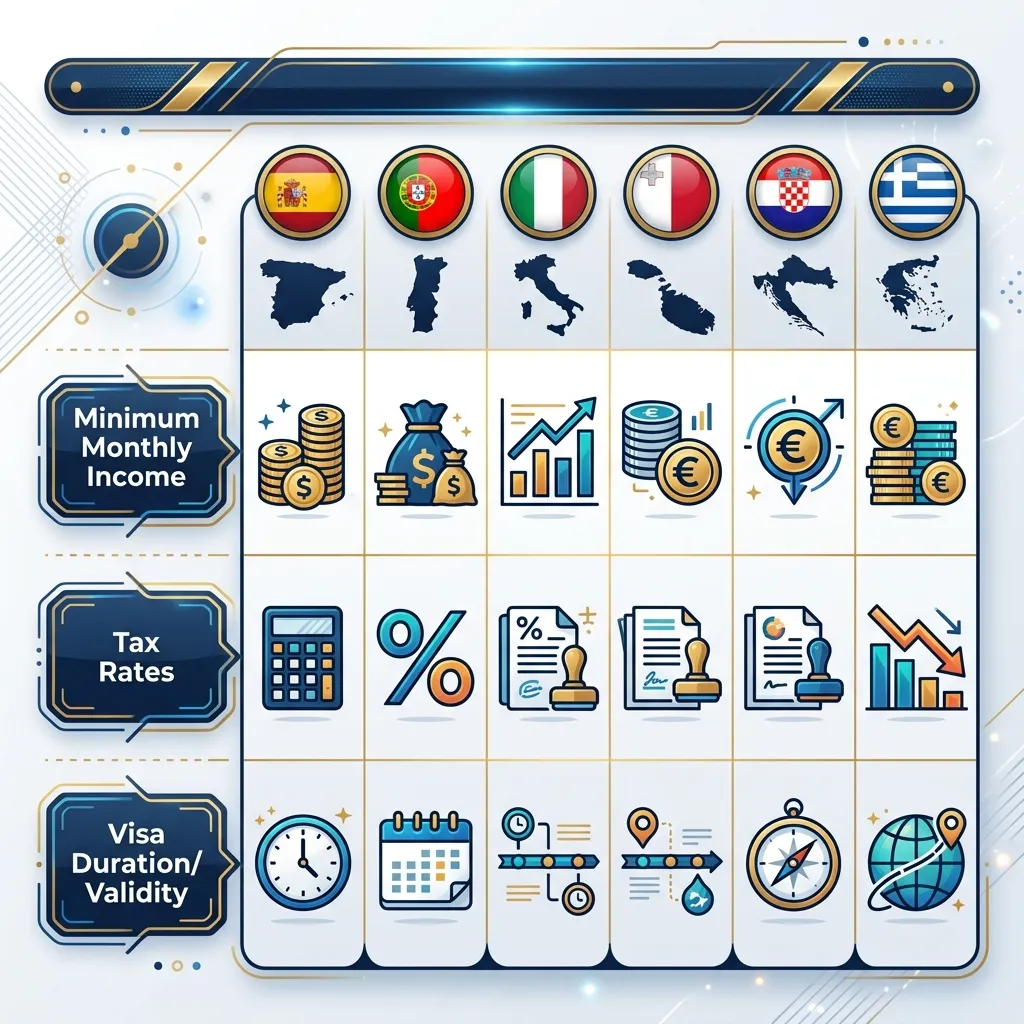
According to the Residency Malta Agency (RMA), the Malta Nomad Residence Permit was introduced to allow third-country nationals (non-EU/EEA/Swiss citizens) to reside in Malta while continuing to work remotely for foreign employers or clients. The permit is issued for 1 year and is renewable annually for up to 3 years at the discretion of the agency, provided the applicant continues to meet all requirements.
Since Malta is a full member of the European Union and the Schengen Area, holding this permit grants you complete visa-free travel throughout the Schengen zone. This allows you to explore other European destinations for up to 90 days within any rolling 180-day period. You can easily track your travel days using our Schengen 90-day calculator to avoid overstaying.
The permit is specifically tailored for three categories of remote workers:
- Employees: Working under an employment contract for a company registered outside of Malta.
- Freelancers/Contractors: Providing services under contracts to clients located outside of Malta.
- Business Owners: Offering services through a company registered outside of Malta in which they hold a majority share.
Eligibility & Income Requirements
The primary requirement to qualify for the Nomad Residence Permit in 2026 is demonstrating a stable, recurring gross income of at least €3,500/month (which totals €42,000/year). This threshold was updated from the previous €2,700/month requirement to align with Malta’s rising median wage and cost of living.
If you plan to relocate with family members, you must meet additional income requirements. Under the rules of the Residency Malta Agency:
- You must demonstrate an additional 20% of the Maltese median wage for each dependent.
- Dependents can include your spouse or common-law partner, minor children, and adult children who are financially dependent on you.
Income Requirements by Family Size
| Family Composition | Minimum Monthly Gross Income | Minimum Annual Gross Income |
|---|---|---|
| Single Applicant | €3,500 | €42,000 |
| Applicant + Spouse | €4,200 | €50,400 |
| Applicant + Spouse + 1 Child | €4,900 | €58,800 |
| Applicant + Spouse + 2 Children | €5,600 | €67,200 |
| Applicant + 1 Child | €4,200 | €50,400 |
Verifying Your Income
To satisfy the income requirement, you must submit detailed financial proof. The Residency Malta Agency requires:
- Bank Statements: Showing transactions for the last 3 months for your primary account, proving that your remote work income is deposited regularly and matches your contract.
- Tax Returns: Or tax payment certificates from your home country or country of previous tax residency.
- Employment/Service Contracts: Detailing your role, salary, and the foreign nature of your business.
- Payslips: From the last 3 months.
[!WARNING] Savings, investment portfolios, or inheritance funds cannot be used to meet the €3,500 monthly threshold. The income must be active, ongoing, and derived from your remote employment or self-employed activities.
The New 10% Flat Tax on Remote Work
Historically, digital nomads in Malta fell under the country’s traditional remittance basis of taxation. However, the Malta Commissioner for Revenue (CFR) has established a new tax regime specifically designed for Nomad Residence Permit holders.
How the 10% Flat Tax Works
Under the updated tax regulations, Nomad Residence Permit holders who establish tax residency in Malta (by spending more than 183 days in the country) are subject to a flat income tax rate of 10% on their foreign-sourced remote work income.
- 10% Flat Rate: This rate is applied directly to your gross remote work income.
- Exclusion of Other Income: It only applies to income derived from “authorized work” (remote work for foreign employers or clients).
- No Social Security: Since you are not working for local clients and are employed by foreign companies, you do not pay social security contributions in Malta.
This is a major change from Malta’s standard progressive tax rates, which quickly scale up to 35% on income over €60,000.
10% Flat Tax vs. Remittance Basis of Taxation
Malta also offers the traditional remittance basis of taxation for non-domiciled residents. Under this system, you pay 0% tax on foreign income that is not sent to Malta, and a flat 15% tax on foreign income that is remitted (brought into) Malta for living expenses, subject to a €5,000 annual minimum tax.
Let’s look at how these two options compare for a digital nomad earning €60,000/year and spending €25,000/year inside Malta for rent, food, and daily life.
Option A: Remittance Basis
- Gross Income: €60,000 (kept in a foreign account)
- Amount Remitted to Malta: €25,000 (to pay rent and living expenses)
- Tax on Remitted Income: €25,000 × 15% = €3,750
- Minimum Tax Rule: Because €3,750 is less than the mandatory minimum tax, you must pay the flat €5,000 minimum tax.
- Total Tax Paid: €5,000 (effective rate of 8.3% on your total income).
Option B: 10% Flat Tax Regime
- Gross Income: €60,000 (declared as remote work income)
- Tax on Remote Work Income: €60,000 × 10% = €6,000
- Minimum Tax Rule: The €5,000 minimum tax does not apply to the 10% flat tax regime; you pay exactly 10% of your remote earnings.
- Total Tax Paid: €6,000 (effective rate of 10%).
If your income increases to €100,000/year and you still only remit €25,000:
- Remittance Basis: You pay €5,000 (effective rate of 5%).
- 10% Flat Tax: You pay €10,000 (effective rate of 10%).
[!TIP] The remittance basis is highly beneficial for high earners who can keep most of their money in foreign bank accounts and spend minimally in Malta. However, for those who want to buy property, transfer all their savings to Malta, or earn lower incomes, the 10% flat tax is simpler, eliminates the risk of accidental remittance audits, and avoids the €5,000 minimum tax barrier. Read our detailed guide on the Malta remittance tax system to decide which system fits your profile.
Step-by-Step Application Guide
The application process for Malta’s Nomad Residence Permit is managed entirely online by the Residency Malta Agency, making it one of the most streamlined processes in Europe.
Step 1: Prepare the Required Documents
You must compile a comprehensive dossier of documents. All files must be in English or accompanied by certified English translations:
- Application Forms: Completed Forms N1, N2, and N4 (available on the RMA website).
- Letter of Intent: A cover letter detailing your background, why you want to move to Malta, and confirming your remote work setup.
- Passport: A color copy of all pages, including blank pages.
- CV/Resume: Detailing your professional experience.
- Employment Contract/Service Agreement: Detailing your remote work.
- 3 Months of Bank Statements: Proving the €3,500/month deposits.
- Health Declaration: Form confirming you are in good health.
- Private Health Insurance: A policy valid in Malta with a minimum coverage of €30,000 for medical expenses and hospitalization.
Step 2: Submit the Application and Pay the Fee
Email your complete application package to the Residency Malta Agency (nomad.residencymalta@gov.mt). Once they perform an initial check of your documents, they will send you a secure payment link to pay the administrative application fee of €300 for the main applicant (plus €300 for each dependent).
Step 3: Wait for Processing (30 to 60 Days)
The RMA will conduct background checks and review your application. Processing typically takes 30 to 60 days. Once approved, you will receive an Approval in Principle letter via email.
Step 4: Travel to Malta and Secure Housing
With your Approval in Principle letter, you have 30 days to travel to Malta (using a Schengen visa if required). Upon arrival, you must secure long-term accommodation. You must rent or buy a property and register the lease with the Housing Authority of Malta.
Step 5: Complete Biometrics and Collect Your Card
Book an appointment at the Residency Malta Agency office in Valletta to submit your biometrics (fingerprints and photo). You must bring:
- Your passport.
- The Approval in Principle letter.
- Your registered rental agreement.
- Your health insurance policy.
- A fee of €27.50 for the physical residence card.
Your physical Nomad Residence Permit card will be printed and ready for collection or delivery within 2 to 3 weeks.
Nomad Visas Comparison: Malta vs. Competitors
To see how Malta stacks up against other Mediterranean options, let’s compare its visa program with those of Spain, Greece, and Cyprus.
| Feature | Malta (NRP) | Spain (DNV) | Greece (DNV) | Cyprus (DNV) |
|---|---|---|---|---|
| Min. Income Requirement | €3,500/month | €2,640/month | €3,500/month | €3,500/month |
| Tax Rate on Remote Work | 10% flat (or remittance basis) | 24% flat (Beckham Law) | 50% exemption (progressive) | 0% on dividends/passive |
| Visa Duration | 1 year (renewable to 3) | 3 years (renewable to 5) | 2 years (renewable) | 1 year (renewable to 3) |
| Schengen Access | Yes (Full member) | Yes (Full member) | Yes (Full member) | Yes (EU, not Schengen) |
| Path to Citizenship | Extremely limited | Yes (after 10 years) | Yes (after 7 years) | Yes (after 5-7 years) |
| Application Fee | €300 | €73 | €75 | €70 |
While Spain has a lower income threshold, Malta’s 10% flat tax is significantly more attractive than Spain’s 24% Beckham Law rate. However, if your long-term goal is obtaining an EU passport, Spain or Portugal may be better options, as Malta’s NRP does not easily lead to permanent residency. Compare options with our guide on Portugal’s D8 Digital Nomad Visa.
Cost of Living in Malta
Malta offers a comfortable Mediterranean lifestyle at a cost that is lower than that of major cities in the US, UK, or Northern Europe.
Monthly Budget Estimates (2026)
| Expense Category | Sliema / St. Julian’s | Valletta / Cottonera | Gozo (Island) |
|---|---|---|---|
| Rent (1-Bedroom Apartment) | €1,000 – €1,400 | €850 – €1,200 | €550 – €750 |
| Utilities (Electricity, Water, Gas) | €100 – €160 | €90 – €140 | €75 – €120 |
| Groceries | €280 – €380 | €250 – €350 | €220 – €300 |
| Dining Out & Entertainment | €250 – €400 | €220 – €350 | €150 – €250 |
| Coworking Space | €180 – €260 | €150 – €220 | €100 – €150 |
| Health Insurance | €80 – €150 | €80 – €150 | €80 – €150 |
| Public Transport (Bus Pass) | Free (for residents) | Free (for residents) | Free (for residents) |
| Total Estimated Budget | €1,890 – €2,750 | €1,640 – €2,410 | €1,175 – €1,720 |
[!TIP] Gozo, Malta’s sister island, is significantly cheaper than the mainland. It offers a slower, peaceful pace of life, stunning cliffs, and is fully connected with high-speed fiber internet, making it highly popular among software developers and writers.
Frequently Asked Questions
Can I work for Maltese clients under the Nomad Residence Permit?
No. The Nomad Residence Permit is strictly for remote work for companies and clients located outside of Malta. If you provide services to a Maltese company or individual, you violate the terms of your permit, which can lead to revocation and deportation.
Does Malta’s 10% flat tax require me to register a local company?
No. You do not need to register a Maltese corporate entity or open a local branch. You simply register with the Commissioner for Revenue (CFR) as a tax-paying individual holding a Nomad Residence Permit, and you pay your taxes directly on your remote personal income.
What happens after the maximum 3-year limit of the permit?
After 3 years, you cannot renew the Nomad Residence Permit. If you wish to remain in Malta, you must transition to another residence pathway, such as the Ordinary Residence program (which requires local employment, starting a Maltese business, or investing in the country). Many nomads choose to relocate to other destinations, such as Croatia’s digital nomad visa which offers a 12-month stay.
Can I use public healthcare in Malta?
Nomad Residence Permit holders do not pay social security contributions in Malta, which means they are not entitled to free public healthcare. You must maintain your private health insurance policy for the entire duration of your stay to cover any medical consultations, prescriptions, or hospital visits.
How do I register my lease with the Housing Authority?
Under Maltese law, your landlord is legally obligated to register your lease agreement with the Housing Authority of Malta within 10 days of signing. Once registered, you will receive an official confirmation email, which you must print and present during your biometrics appointment at the Residency Malta Agency.
Is the €3,500 monthly income requirement gross or net?
The requirement is gross income (before tax deductions in your home country). You must demonstrate this through your official employment contract or client agreements, backed by matching bank deposits from the last 3 months.
Final Thoughts
Malta’s Nomad Residence Permit is a stellar option for remote workers looking for a sunny European base. The combination of an English-speaking environment, streamlined online processing, and the newly established 10% flat tax rate on remote income makes it one of the most tax-friendly and straightforward digital nomad visas in the European Union.
Before you apply, run your numbers through our Tax Calculator to see if Malta’s tax system will save you money compared to your current residence. And if you are still comparing Mediterranean bases, take a look at our guides on the Italy Digital Nomad Visa and Greece’s tax exemption rules to find your perfect match. Planning your tax status and residency requirements in advance is the key to a stress-free digital nomad life.