Greece 50% Tax Exemption: Complete Guide for Expats (2026)
Greece has emerged as one of Europe’s most attractive destinations for digital nomads and expats seeking favorable tax treatment. The country’s 50% income tax exemption — officially known as the special tax regime for foreign workers transferring their tax residence to Greece — effectively halves your taxable income for up to seven years, creating one of the lowest effective tax rates in the European Union.
TL;DR: Under Greek Law 4758/2020, individuals who transfer their tax residence to Greece can exempt 50% of their employment or self-employment income from income tax for 7 consecutive years. At €60,000 gross income, this brings the effective tax rate down to just 9.83%, as administered by the Hellenic Independent Authority for Public Revenue (AADE).
Combined with Greece’s affordable cost of living, Mediterranean lifestyle, and growing digital nomad infrastructure, this tax incentive positions the country as a serious contender alongside traditional low-tax destinations. In this 2026 guide, we walk through every detail of the program: eligibility criteria, the application process, concrete tax savings, and how it stacks up against alternatives.
How the Greece 50% Tax Exemption Works
According to the Hellenic Independent Authority for Public Revenue (AADE), the 50% exemption was introduced by Law 4758/2020 and has been updated through subsequent legislative amendments. The core concept is straightforward: if you transfer your tax residence to Greece and meet the eligibility requirements, only 50% of your employment or self-employment income earned in Greece is subject to income tax.
This means Greece’s standard progressive tax rates — which range from 9% to 44% — are applied to just half of your qualifying income. The result is an effective tax rate of approximately 4.5% to 22% depending on your income level.
Key Features
- 50% of qualifying income is exempt from income tax and the solidarity surcharge
- Duration: The exemption applies for 7 consecutive fiscal years starting from the year of your tax residence transfer
- Applies to: Employment income, self-employment income, and business profits earned in Greece
- Does not apply to: Investment income (dividends, interest, capital gains), rental income, or pension income — these are taxed at standard rates
[!IMPORTANT] The 50% exemption applies to income tax only. Social security contributions (EFKA) are calculated on your full gross income, not the reduced taxable amount. For self-employed individuals, this means social security of approximately 26.95% on your declared income.
Greece’s Progressive Income Tax Rates (2026)
Understanding Greece’s standard tax brackets is essential for calculating your actual savings under the 50% exemption.
Standard Income Tax Brackets
| Taxable Income (€) | Tax Rate |
|---|---|
| Up to €10,000 | 9% |
| €10,001 – €20,000 | 22% |
| €20,001 – €30,000 | 28% |
| €30,001 – €40,000 | 36% |
| Over €40,000 | 44% |
With 50% Exemption Applied
When you have the 50% exemption, only half your income enters the brackets above. Here’s how effective rates compare:
| Gross Annual Income (€) | Taxable Income (50%) | Tax Owed | Effective Rate (With Exemption) | Effective Rate (Without) |
|---|---|---|---|---|
| €20,000 | €10,000 | €900 | 4.5% | 9.0% |
| €40,000 | €20,000 | €3,100 | 7.75% | 15.5% |
| €60,000 | €30,000 | €5,900 | 9.83% | 21.5% |
| €80,000 | €40,000 | €9,500 | 11.88% | 24.5% |
| €100,000 | €50,000 | €13,900 | 13.9% | 28.4% |
| €150,000 | €75,000 | €24,900 | 16.6% | 33.8% |
[!TIP] At €60,000 of gross income, the 50% exemption brings your effective tax rate to just 9.83% — lower than most flat-tax regimes in Europe. Model your specific income with our Tax Calculator to see your exact savings.
Eligibility Requirements
To qualify for the 50% tax exemption, you must meet all of the following conditions:
-
Non-residency requirement: You must not have been a Greek tax resident for at least 5 of the 6 years preceding the year you transfer your tax residence to Greece. This is the cornerstone eligibility criterion.
-
Transfer from an EU/EEA country or DTA partner: You must be transferring your tax residence from an EU member state, an EEA country, or a country that has a bilateral administrative cooperation agreement with Greece on tax matters.
-
Employment or self-employment in Greece: You must be providing services in Greece under an employment contract with a Greek entity, or engaging in self-employment/business activity in Greece.
-
Commitment to remain: You must declare your intention to remain a Greek tax resident for at least two years following the year of transfer.
-
New employment or business: The regime is designed for individuals taking up new employment or starting new self-employment activities in Greece — not for those simply relocating existing arrangements.
[!WARNING] The “5 of 6 years” non-residency rule is strictly enforced. If you were a Greek tax resident for more than one year in the six-year period before your application, you will not qualify. Maintain clear documentation of your tax residency in other countries during this period.
Alternative Path: The 7 of 8 Years Rule
In addition to the standard 50% exemption, Greece offers a variation targeted specifically at individuals who have been living abroad for an extended period. Under this pathway:
- You must have been a non-resident of Greece for 7 of the previous 8 years
- You must transfer your tax residence to Greece
- You must work for a Greek employer or Greek-based entity
This alternative path is particularly relevant for Greek nationals returning from abroad and for long-term expats who can demonstrate extensive non-residency. The benefits are identical — 50% income tax exemption for 7 years.
Step-by-Step Application Process
Here is the complete process for applying for the 50% tax exemption in Greece:
-
Obtain a Greek AFM (Tax Identification Number) — Per AADE’s official process, visit your local DOY (tax office) or apply online through the AADE (Independent Authority for Public Revenue) platform. You will need your passport and proof of address.
-
Establish tax residency in Greece — Secure accommodation (rental contract or property ownership), and ensure you will meet the 183-day residency requirement or have your center of vital interests in Greece.
-
Secure qualifying employment or register self-employment — Sign an employment contract with a Greek entity, or register as a freelancer (eleftheros epangelmatias) with the tax authorities and social security (EFKA).
-
Gather supporting documentation — Prepare the following:
- Tax residency certificates from your previous country of residence for the relevant years
- Proof of non-residency in Greece for the 5-of-6 or 7-of-8 year period
- Employment contract or proof of self-employment registration
- Passport copies and proof of Greek address
-
Submit the application to AADE — File your application through the myAADE digital portal or in person at your competent DOY. The application should be submitted within the fiscal year you transfer your residence, or by the deadline specified in the applicable legislation.
-
Receive confirmation — AADE will review your application and issue a decision. Processing times vary but typically range from 4–8 weeks. The exemption applies retroactively to the beginning of the fiscal year of transfer.
-
File annual tax returns — Each year, file your Greek income tax return (Form E1) by June 30, declaring your worldwide income. The 50% exemption will be applied automatically to your qualifying income categories.
-
Maintain compliance — Ensure you remain a Greek tax resident throughout the 7-year exemption period. Losing your tax residency status will terminate the exemption.
Income Examples: With vs. Without the 50% Exemption
Example 1: Freelance Designer Earning €45,000/Year
| Item | Without Exemption | With 50% Exemption |
|---|---|---|
| Gross income | €45,000 | €45,000 |
| Taxable income | €45,000 | €22,500 |
| Income tax | ~€8,700 | ~€3,650 |
| Effective tax rate | 19.3% | 8.1% |
| Annual tax savings | — | €5,050 |
Example 2: Remote Software Engineer Earning €80,000/Year
| Item | Without Exemption | With 50% Exemption |
|---|---|---|
| Gross income | €80,000 | €80,000 |
| Taxable income | €80,000 | €40,000 |
| Income tax | ~€19,600 | ~€9,500 |
| Effective tax rate | 24.5% | 11.9% |
| Annual tax savings | — | €10,100 |
Example 3: High-Earning Consultant at €120,000/Year
| Item | Without Exemption | With 50% Exemption |
|---|---|---|
| Gross income | €120,000 | €120,000 |
| Taxable income | €120,000 | €60,000 |
| Income tax | ~€37,200 | ~€17,700 |
| Effective tax rate | 31% | 14.75% |
| Annual tax savings | — | €19,500 |
Over the full 7-year exemption period, these savings compound dramatically. The software engineer earning €80,000 would save approximately €70,700 in total over seven years compared to standard taxation.
Social Security Contributions
While the 50% exemption provides significant income tax savings, social security (EFKA) contributions remain a substantial cost:
For Employees
| Contribution | Rate |
|---|---|
| Employee contribution | ~14.12% of gross salary |
| Employer contribution | ~22.29% of gross salary |
| Total | ~36.41% |
For Self-Employed (Freelancers)
| Contribution Type | Monthly Amount (2026) |
|---|---|
| Main pension (EFKA) | €186 – €1,140 (income-dependent) |
| Health insurance | €55 – €340 |
| Supplementary pension | €42 – €260 |
| Total range | €283 – €1,740/month |
Self-employed individuals pay social security based on income tiers. The contributions are calculated on your actual declared income — not on the 50% reduced amount.
[!TIP] For freelancers earning under €10,000 annually, reduced social security rates may apply during the first few years of registration. Check with EFKA for current thresholds and discounts.
Greece vs. Other Digital Nomad Tax Destinations
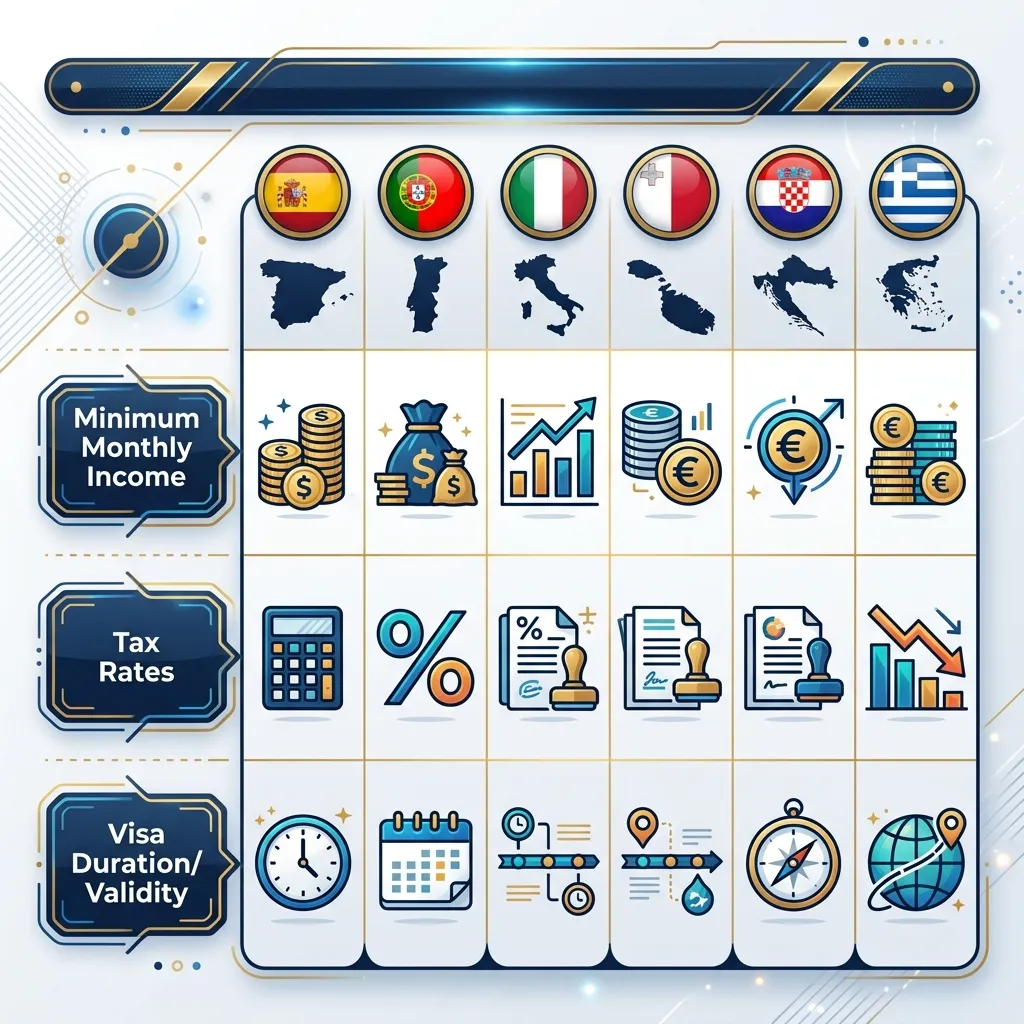
| Country | Tax Incentive | Effective Rate (€80k income) | Duration | Key Requirement |
|---|---|---|---|---|
| Greece (50% exemption) | 50% income discount | ~11.9% | 7 years | 5 of 6 years non-resident |
| Portugal (NHR) | 20% flat rate | 20% | 10 years | 5 years non-resident |
| Georgia (1% tax) | 1% small business | 1% | Ongoing | Revenue < GEL 500k |
| UAE/Dubai (0% tax) | Zero income tax | 0% | Ongoing | Residency visa |
| Spain (Beckham Law) | 24% flat rate | 24% | 6 years | Not resident in prior 5 years |
| Cyprus | Non-dom regime | ~12.5% | 17 years | 60-day rule |
Greece’s effective rate at the €80,000 income level is remarkably competitive — lower than Portugal’s NHR and Spain’s Beckham Law. The trade-off is that Greece’s benefits last for 7 years (versus Portugal’s 10), and social security costs can be higher for self-employed individuals.
Living in Greece as a Digital Nomad
Cost of Living
Greece offers one of the most affordable lifestyles in Western Europe:
| Expense | Athens (Monthly) | Thessaloniki (Monthly) | Islands (Monthly) |
|---|---|---|---|
| One-bedroom apartment | €550 – €900 | €400 – €650 | €450 – €800 |
| Utilities | €100 – €180 | €80 – €150 | €90 – €160 |
| Groceries | €250 – €350 | €200 – €300 | €250 – €350 |
| Dining out | €200 – €400 | €150 – €300 | €200 – €400 |
| Coworking space | €120 – €250 | €80 – €180 | Limited options |
| Total estimated | €1,220 – €2,080 | €910 – €1,580 | €990 – €1,710 |
Digital Nomad Visa (D7)
Greece launched its Digital Nomad Visa in 2021, allowing non-EU remote workers to live and work in Greece for up to 2 years (renewable). Requirements include:
- Minimum monthly income of €3,500 (or €4,200 for couples)
- Proof of remote employment or freelance contracts with non-Greek clients
- Health insurance valid in Greece
- Clean criminal record
To manage your client payments and international transfers while living in Greece, you should set up a robust digital nomad banking system. This allows you to avoid heavy transaction and wire fees.
The D7 visa is a pathway to establishing tax residency and subsequently applying for the 50% exemption.
Pros and Cons
Advantages
- Extremely low effective tax rates — As low as 4.5% at €20,000 income
- 7-year duration — Long enough to build meaningful savings
- Affordable cost of living — Particularly outside Athens
- EU membership — Full access to Schengen area and EU rights
- Growing digital infrastructure — Expanding coworking spaces and fiber internet
Disadvantages
- Social security costs — These remain high and are not reduced
- Bureaucracy — Greek administrative processes can be slow and require patience
- Limited to employment/self-employment income — Investment income doesn’t benefit
- Strict non-residency requirement — Must prove 5 of 6 (or 7 of 8) years abroad
- Greek language barriers — Many official processes still require Greek
Frequently Asked Questions
Can I qualify for the 50% exemption if I’m a Greek citizen?
Yes, Greek nationals can qualify for the 50% exemption, provided they meet the non-residency requirement (not a Greek tax resident for 5 of the previous 6 years, or 7 of the previous 8 years). Many Greeks who moved abroad for work and are now returning leverage this incentive.
Does the 50% exemption apply to income from foreign clients?
The exemption applies to employment and self-employment income earned in Greece. If you are a freelancer registered in Greece and perform your work from Greece — even for foreign clients — that income is generally considered Greek-sourced and qualifies for the exemption.
What happens if I leave Greece during the 7-year period?
If you lose your Greek tax residency status during the 7-year exemption period, the benefit terminates immediately. You cannot pause and resume the exemption. Any remaining years are forfeited.
Can I combine the 50% exemption with other Greek tax benefits?
The 50% exemption is generally the primary incentive and cannot be combined with other special tax regimes (such as the non-dom provisions for investment income). However, standard tax deductions and credits (medical expenses, donations, electronic payments) still apply to your taxable income.
How does the exemption interact with double taxation treaties?
Based on official data from AADE, Greece has an extensive network of Double Taxation Agreements (DTAs) with over 50 countries. The 50% exemption is a domestic Greek incentive under Law 4758/2020 and operates independently of DTAs. However, treaty provisions may affect the taxation of specific income categories, particularly if you have income from both Greek and foreign sources.
Is the 50% exemption guaranteed for all 7 years?
Once granted, the exemption is valid for 7 years provided you maintain Greek tax residency and continue to meet the conditions. The Greek government has not retroactively revoked the benefit for existing holders, but future legislative changes could theoretically affect the terms.
Can I apply for the exemption retroactively?
Applications should be submitted within the fiscal year of your tax residence transfer or within the prescribed deadline. Late applications may be accepted in certain circumstances, but timely filing is strongly recommended.
Final Thoughts
Greece’s 50% tax exemption is a powerful incentive that delivers some of the lowest effective income tax rates in Europe. At an income of €60,000, you’re looking at an effective rate of under 10% — competitive with many flat-tax regimes and significantly cheaper than most Western European countries.
The 7-year duration provides ample time to establish yourself, build your career or business, and accumulate meaningful savings. Combined with Greece’s affordable lifestyle, EU membership, and improving digital infrastructure, the program makes a compelling case for digital nomads and expats.
Ready to estimate your tax savings in Greece? Use our Tax Calculator to compare Greece with other top digital nomad destinations and find the setup that works best for your income and lifestyle.