Tax Residency Certificate (TRC): What It Is & How to Get One in Any Country

A Tax Residency Certificate (TRC) is the single most important document a digital nomad can possess. It is official, government-issued proof that you are a tax resident of a specific country — and it is your primary defense against being taxed by multiple jurisdictions simultaneously. Without one, you are exposed to the risk of double taxation, penalties from your former home country, and complications with banks, clients, and tax authorities worldwide.
TL;DR: A Tax Residency Certificate (TRC) is a government-issued document that proves you are a tax resident of a specific country for a given year. Every digital nomad needs one because it activates Double Taxation Agreement (DTA) protections, prevents two countries from taxing the same income, and satisfies banking compliance requirements under CRS and FATCA.
Despite its critical importance, most digital nomads don’t know what a TRC is, don’t have one, or don’t know how to get one. This guide explains everything: what a Tax Residency Certificate is, why you need one, how it interacts with Double Taxation Agreements, and the step-by-step process for obtaining a TRC in 12+ countries popular with digital nomads.
What Is a Tax Residency Certificate?
A Tax Residency Certificate — also called a Certificate of Tax Residence, Certificate of Fiscal Residence, or Tax Domicile Certificate — is an official document issued by a country’s tax authority confirming that you are a tax resident of that country for a specific tax year.
Key Characteristics
- Issued by the tax authority of the country where you are a tax resident (e.g., HMRC in the UK, IRS in the US, FTA in the UAE)
- Covers a specific period — usually one calendar year or fiscal year
- Confirms your tax status — it states that you are subject to tax in that country under domestic law
- Used to claim treaty benefits — TRCs are required to invoke Double Taxation Agreements (DTAs) between countries
- Recognized internationally — Tax authorities worldwide accept TRCs from other countries as proof of tax residency
What a TRC Looks Like
While formats vary by country, a TRC typically includes:
- Your full legal name and date of birth
- Your tax identification number in that country
- The tax year or period covered
- A statement confirming you are a tax resident
- The name of the issuing tax authority
- An official stamp or seal and signature of an authorized officer
- Reference to the specific DTA (if issued for treaty purposes)
Why Digital Nomads Need a Tax Residency Certificate
For digital nomads who move between countries, a TRC serves multiple critical functions:
1. Protection Against Double Taxation
The most important reason to have a TRC is to prevent being taxed by two countries on the same income. When you leave your home country and establish tax residency elsewhere, your former country’s tax authority may still consider you a resident — especially if you haven’t formally notified them of your departure.
A TRC from your new country of residence is the definitive proof that triggers DTA protections. Without it, you have no official basis to claim treaty benefits, and both countries can legally claim taxing rights over your income.
2. Withholding Tax Reduction
When your company or clients pay you from another country, they may be required to withhold tax at the source. DTAs typically reduce these withholding rates — for example, from 30% to 15% or even 0% on certain types of income. To benefit from reduced rates, you usually need to present a TRC from your country of residence to the payer or their tax authority.
3. Bank and Financial Account Compliance
Under the Common Reporting Standard (CRS) and FATCA frameworks, banks and financial institutions worldwide are required to determine your tax residency and report your account information to the relevant tax authorities. A TRC provides clear, unambiguous proof of where you are tax resident, preventing your financial information from being reported to the wrong country.
4. Proving Your Status to Your Former Country
When you deregister from your home country’s tax system, the tax authority may challenge your departure. Presenting a TRC from your new country of residence is the strongest evidence that you have genuinely relocated your tax life elsewhere. Without it, authorities may argue that you remain a tax resident of your former country based on ongoing ties (property, bank accounts, social connections).
5. Client and Employer Requirements
Some clients and employers — particularly large corporations and government entities — require a TRC before they will process payments to foreign contractors without withholding tax. Having a TRC readily available streamlines your client onboarding and payment processes.
[!IMPORTANT] A TRC does not create tax residency — it merely confirms it. You must first genuinely establish tax residency in a country (through physical presence, domicile, or other qualifying criteria) before you can obtain a TRC. Attempting to obtain a TRC without meeting the country’s residency requirements is not only unsuccessful but may constitute fraud.
How TRCs Interact with Double Taxation Agreements
TRCs are the operational mechanism that makes Double Taxation Agreements work in practice. Here’s how:
The DTA Tiebreaker
When two countries both claim you as a tax resident, the DTA between them contains tiebreaker rules to determine which country has primary taxing rights. According to the OECD Model Tax Convention (Article 4), the tiebreaker criteria, applied in order, are:
- Permanent home — Where do you have a permanent home available?
- Center of vital interests — Where are your closer personal and economic relations?
- Habitual abode — Where do you spend more time?
- Nationality — What is your citizenship?
- Mutual agreement — If none of the above resolves the conflict, the two countries’ tax authorities negotiate
The TRC’s Role
When you present a TRC from Country A to Country B’s tax authority, you are saying: “Country A has confirmed I am their tax resident. Under our DTA, this means Country B should not tax me as a resident — only on income specifically sourced within Country B.”
Country B’s tax authority will then:
- Accept the TRC and apply the DTA’s reduced rates or exemptions
- Reject the TRC if they believe you are also a resident of Country B and invoke the tiebreaker rules
- Request additional documentation to support your claim
Practical Example
Maria is a freelance designer who moved from Germany to Portugal. She obtains a Portuguese TRC from the Autoridade Tributária. She presents this TRC to the German Finanzamt (tax authority) when filing her final German tax return, proving she is now a Portuguese tax resident. Under the Germany-Portugal DTA, Germany can only tax her on German-sourced income going forward, not on her worldwide freelance income.
Without the TRC, Germany could continue treating Maria as a tax resident (based on her German bank accounts, driver’s license, or other ties) and demand tax on her worldwide income.
How to Get a TRC: Country-by-Country Guide
The process, requirements, and timeline for obtaining a Tax Residency Certificate vary significantly by country. Below is a detailed guide for 12+ countries popular with digital nomads.
UAE (Dubai, Abu Dhabi)
The UAE is one of the most popular destinations for digital nomads seeking zero-income-tax status. A UAE TRC is essential for proving your zero-tax status to other countries’ tax authorities.
| Detail | Information |
|---|---|
| Issuing authority | Federal Tax Authority (FTA) |
| Eligibility | UAE resident visa holder + 183 days physical presence (or permanent home in UAE) |
| Required documents | Valid Emirates ID, passport copy, UAE residence visa, certified tenancy contract, 6 months bank statements, entry/exit report from ICP/GDRFA |
| Application | Online through the FTA portal (EmaraTax) |
| Processing time | 5–10 business days |
| Cost | AED 500 (~$136 USD) |
| Validity | 1 year (specific tax period) |
[!TIP] The UAE’s 183-day requirement is strictly enforced for TRC purposes. Even if you have a UAE residence visa, you will not receive a TRC unless you can demonstrate sufficient physical presence through immigration entry/exit records. Plan your travel accordingly.
Georgia
Georgia offers one of the simplest TRC processes, consistent with its overall business-friendly approach.
| Detail | Information |
|---|---|
| Issuing authority | Revenue Service of Georgia |
| Eligibility | 183 days physical presence in a 12-month period, or center of vital interests in Georgia |
| Required documents | Passport, Georgian TIN, proof of address, IE registration (if applicable) |
| Application | In person at Revenue Service or via rs.ge online portal |
| Processing time | 5–10 business days |
| Cost | Free |
| Validity | 1 year |
Portugal
Portugal’s TRC is particularly important for NHR (Non-Habitual Resident) beneficiaries who need to prove their Portuguese tax residency to former home countries.
| Detail | Information |
|---|---|
| Issuing authority | Autoridade Tributária e Aduaneira (AT) |
| Eligibility | Portuguese tax resident (183 days, or habitual abode, or registered with AT) |
| Required documents | NIF (tax number), proof of Portuguese address, passport, AT registration confirmation |
| Application | Online through Portal das Finanças or in person at Finanças office |
| Processing time | 5–15 business days |
| Cost | Free |
| Validity | 1 year |
Thailand
Thailand has become a major digital nomad hub, and obtaining a TRC is important for those on the DTV (Destination Thailand Visa) who need to prove their tax status.
| Detail | Information |
|---|---|
| Issuing authority | Revenue Department of Thailand |
| Eligibility | 180 days physical presence in a tax year, or Thai tax resident under domestic law |
| Required documents | Passport, Thai TIN, proof of address, work permit or visa copy, tax filing receipts |
| Application | In person at the Revenue Department area office |
| Processing time | 7–15 business days |
| Cost | Free |
| Validity | 1 year |
Malaysia
Malaysia offers TRCs through LHDN (Inland Revenue Board) for tax residents under the DE Rantau or MM2H programs.
| Detail | Information |
|---|---|
| Issuing authority | Lembaga Hasil Dalam Negeri (LHDN) |
| Eligibility | 182 days physical presence in a calendar year |
| Required documents | Passport, Malaysian tax number, proof of residence, visa/pass copy, tax return receipts |
| Application | In person at LHDN branch or via MyTax portal |
| Processing time | 14–30 business days |
| Cost | Free |
| Validity | 1 year |
Romania
Romania issues TRCs for micro-enterprise owners and other tax residents through ANAF.
| Detail | Information |
|---|---|
| Issuing authority | Agenția Națională de Administrare Fiscală (ANAF) |
| Eligibility | 183 days physical presence, or center of vital interests in Romania |
| Required documents | Passport/ID, Romanian fiscal code (CIF), proof of address, company registration (if applicable) |
| Application | In person at the local ANAF office or online through SPV (Spațiul Privat Virtual) |
| Processing time | 15–30 business days |
| Cost | Free |
| Validity | 1 year |
Spain
Spain issues TRCs through the Agencia Tributaria, relevant for those under the Beckham Law or standard residency.
| Detail | Information |
|---|---|
| Issuing authority | Agencia Estatal de Administración Tributaria (AEAT) |
| Eligibility | 183 days physical presence, or center of economic interests, or habitual abode in Spain |
| Required documents | NIE (tax number), passport, proof of address (empadronamiento), tax return confirmation |
| Application | Online through AEAT sede electrónica (requires digital certificate or Cl@ve) |
| Processing time | 10–20 business days |
| Cost | Free |
| Validity | 1 year |
Italy
Italy issues TRCs for residents including those on the digital nomad visa or the flat-tax regime for new residents.
| Detail | Information |
|---|---|
| Issuing authority | Agenzia delle Entrate |
| Eligibility | Registered in the Anagrafe (civil registry) and enrolled in AIRE if previously Italian, or 183 days presence |
| Required documents | Codice Fiscale, passport, proof of Italian address, tax filing confirmation |
| Application | In person at local Agenzia delle Entrate office or via online portal |
| Processing time | 15–30 business days |
| Cost | Free |
| Validity | 1 year |
Cyprus
Cyprus is a popular choice for entrepreneurs using the IP box regime or non-domicile rules.
| Detail | Information |
|---|---|
| Issuing authority | Tax Department of the Republic of Cyprus |
| Eligibility | 183 days physical presence, or 60-day rule (for individuals with a Cyprus business and no other tax residency) |
| Required documents | Passport, TIC (Tax Identification Code), proof of address, bank statements showing Cyprus activity |
| Application | In person at the Tax Department or through TAXISnet online portal |
| Processing time | 7–14 business days |
| Cost | Free |
| Validity | 1 year |
United States
US TRCs are relevant for American expats who need to prove US tax residency to foreign tax authorities to claim DTA benefits.
| Detail | Information |
|---|---|
| Issuing authority | Internal Revenue Service (IRS) |
| Eligibility | US citizen, green card holder, or substantial presence test (183 days with weighted formula) |
| Required documents | SSN or ITIN, completed Form 8802, most recent tax return confirmation |
| Application | Mail Form 8802 to the IRS or submit online. Per IRS guidance, the approved TRC is issued as Form 6166, a letter on US Department of Treasury stationery that serves as the official US certificate of residency for treaty purposes. |
| Processing time | 30–45 business days (longer during peak season) |
| Cost | $85 per form |
| Validity | 1 year |
United Kingdom
UK TRCs are important for British nomads who have left the UK and need to prove they are no longer UK tax resident, or for those who remain UK resident and need treaty benefits.
| Detail | Information |
|---|---|
| Issuing authority | HM Revenue & Customs (HMRC) |
| Eligibility | UK tax resident under the Statutory Residence Test |
| Required documents | National Insurance number, UTR (Unique Taxpayer Reference), tax return confirmation |
| Application | Online through HMRC’s personal tax account or by post. Based on HMRC’s published guidance, individuals apply using Form RES1, and HMRC will issue the certificate only for tax years where residency is established under the Statutory Residence Test. |
| Processing time | 15–30 business days |
| Cost | Free |
| Validity | 1 year |
Germany
German TRCs are commonly requested by nomads deregistering from Germany, one of the most aggressive countries in asserting tax residency.
| Detail | Information |
|---|---|
| Issuing authority | Bundeszentralamt für Steuern (BZSt) or local Finanzamt |
| Eligibility | Registered residence in Germany, or habitual abode (183 days) |
| Required documents | Steuer-ID, passport, Meldebescheinigung (registration certificate), tax return confirmation |
| Application | In person at local Finanzamt or by post |
| Processing time | 10–20 business days |
| Cost | Free |
| Validity | 1 year |
Required Documents: Universal Checklist
While specific requirements vary by country, you will generally need:
- ✅ Valid passport or government-issued ID
- ✅ Local tax identification number (TIN, NIF, RFC, TIC, etc.)
- ✅ Proof of local address — utility bill, tenancy agreement, or bank statement with your local address
- ✅ Proof of physical presence — entry/exit stamps, immigration records, or flight records (some countries)
- ✅ Tax filing confirmation — receipt or confirmation of tax return submission for the relevant period
- ✅ Visa or residence permit — copy of your legal basis for being in the country
- ✅ Application form — specific to each country’s tax authority
- ✅ Completed DTA form — some countries require you to specify the DTA partner country for which you need the TRC
[!TIP] Always request your TRC after the end of the tax year it covers (or at least after you have met the residency threshold). Requesting a TRC mid-year, before you’ve completed 183 days of physical presence, will often result in rejection. Some countries issue provisional or current-year TRCs, but these are less common.
How Long Does It Take?
| Country | Processing Time | Cost | Notes |
|---|---|---|---|
| UAE | 5–10 business days | ~$136 | Strict 183-day enforcement |
| Georgia | 5–10 business days | Free | Very straightforward |
| Portugal | 5–15 business days | Free | Online application available |
| Thailand | 7–15 business days | Free | In-person only |
| Cyprus | 7–14 business days | Free | 60-day rule available |
| Spain | 10–20 business days | Free | Digital certificate required |
| Germany | 10–20 business days | Free | Can be slow during tax season |
| Italy | 15–30 business days | Free | In-person recommended |
| Malaysia | 14–30 business days | Free | Can be slow |
| Romania | 15–30 business days | Free | Online via SPV |
| UK | 15–30 business days | Free | Online application |
| USA | 30–45 business days | $85 | Plan well ahead |
Common Mistakes with Tax Residency Certificates
Mistake 1: Not Getting a TRC at All
The most common error. Many digital nomads assume that simply being physically present in a country is sufficient proof of tax residency. It is not. Tax authorities want official documentation, and a verbal claim or a rental contract is not a substitute for a government-issued TRC.
Mistake 2: Getting a TRC from the Wrong Country
Your TRC must come from the country where you are genuinely tax resident. If you spend 4 months in Portugal, 3 months in Thailand, and 5 months in various other countries, you may not qualify for a TRC from any of them. Establish clear tax residency in one jurisdiction before requesting a TRC.
Mistake 3: Requesting a TRC Before Meeting Residency Requirements
Applying for a TRC before spending 183 days in the country (or meeting whatever the local threshold is) will typically result in rejection. Time your application appropriately.
Mistake 4: Not Renewing Annually
TRCs cover a specific tax year. You need to request a new TRC each year to maintain continuous proof of tax residency. Letting your TRC lapse — even for one year — can create gaps that your former home country’s tax authority may exploit.
Mistake 5: Not Presenting the TRC to Your Former Country
A TRC sitting in your drawer doesn’t help you. You need to actively present it to your former country’s tax authority as part of your departure notification or final tax filing. In many cases, you should also provide it to banks, employers, and clients in your former country.
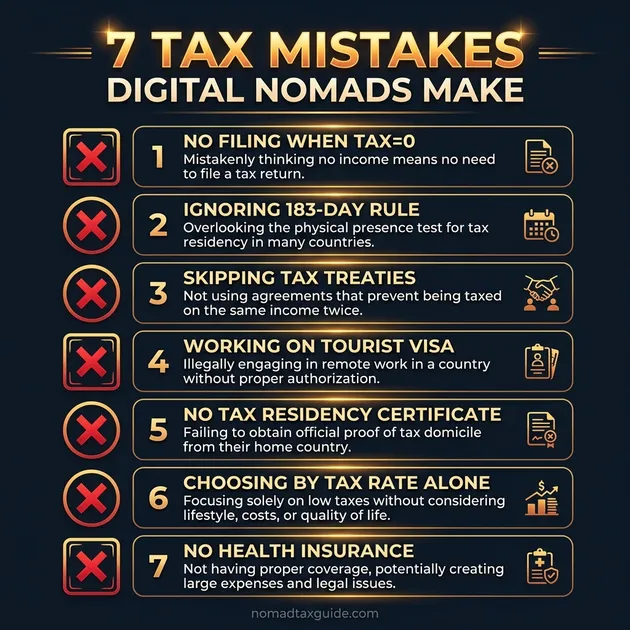
For more common tax errors digital nomads make, see our comprehensive guide to nomad tax mistakes.
Frequently Asked Questions
Can I have tax residency certificates from two countries at the same time?
Technically, yes — if you meet the residency requirements in two countries simultaneously (which is entirely possible if both countries use a 183-day test based on different calendar periods, or if one uses a domicile test). However, having two TRCs creates a dual residency situation that must be resolved using the DTA tiebreaker rules between those countries. This is a complex situation that requires professional tax advice.
What if my country doesn’t have a DTA with my new country of residence?
Without a DTA, a TRC has limited legal force in preventing double taxation. However, it still serves as official proof of your tax status, which can support unilateral relief claims (many countries allow foreign tax credits even without a DTA) and helps with banking/financial compliance. If you are choosing where to establish tax residency, prioritize countries with extensive DTA networks — check our guide to double taxation treaties.
Is a TRC the same as a tax identification number (TIN)?
No. A TIN (Tax Identification Number) is a permanent identification code assigned to you by a tax authority. You can have a TIN in a country without being a tax resident (e.g., you obtained it years ago). A TRC is a time-specific certificate that confirms you were a tax resident for a particular period. You need both, but they serve different purposes.
How do I prove 183 days of physical presence?
Methods vary by country, but common proof includes: passport entry/exit stamps, immigration authority records (many countries maintain electronic entry/exit logs), flight itineraries and boarding passes, bank transaction records showing local activity, and utility bills or rent payments demonstrating continuous local presence. Some countries (notably the UAE) can provide official entry/exit reports from immigration authorities.
Can I get a TRC if I’m on a tourist visa?
In most cases, no. Tourist visas/permits are generally not considered a basis for tax residency, even if you exceed the 183-day threshold. Most countries require a proper residence permit, registration with the tax authority, and filing of tax returns before they will issue a TRC. There are exceptions — for example, Georgia allows visa-free stays of up to one year, and it is possible to establish tax residency and obtain a TRC during that period by registering as a taxpayer and filing returns.
What if I’m a US citizen living abroad — do I still need a TRC from my new country?
Absolutely. US citizens are taxed on worldwide income regardless of where they live, but a TRC from your country of residence is essential for claiming FEIE (Foreign Earned Income Exclusion), foreign tax credits, and DTA benefits. It also helps establish your tax home for IRS purposes and demonstrates your bona fide residence in another country. Without a TRC, the IRS may challenge your foreign residence claims.
Final Thoughts
A Tax Residency Certificate is not optional for serious digital nomads — it is essential infrastructure for your international tax life. It is the document that activates DTA protections, satisfies banking compliance requirements, defends your position against aggressive home-country tax authorities, and provides legal certainty about your tax obligations.
The process for obtaining a TRC is straightforward in most countries: register as a taxpayer, meet the physical presence or domicile requirements, file your tax returns, and submit an application to the tax authority. The cost ranges from free (most countries) to $136 (UAE), and processing takes 5–45 days depending on the jurisdiction.
If you’ve relocated to a new country and don’t yet have a TRC, make it your immediate priority. And if you’re planning your next move, factor TRC accessibility into your decision — countries like Georgia, the UAE, and Portugal offer fast, cheap, and reliable TRC processes that make your tax life significantly simpler.
Use our Tax Calculator to compare tax obligations across jurisdictions and find the optimal setup for your situation.