Best Health Insurance for Digital Nomads: Complete Comparison Guide (2026)
[!NOTE] Affiliate & Insurance Disclosure: Nomad Tax Guide is a marketing platform. The information provided here represents personal opinions and general educational details, not professional insurance advice or licensing recommendations. We do not act as an insurance intermediary or broker. If you click on some links and purchase a plan (such as SafetyWing), we may earn a small referral commission at no additional cost to you. Always verify coverage details and terms directly on the official providers’ websites.
Finding the best health insurance for digital nomads is one of the most critical — and most confusing — decisions you will make when planning your remote lifestyle. You’re not a tourist on a two-week vacation, and you’re not an expat settled in one country for decades. You exist somewhere in between, which means traditional plans don’t work, and you need specialized digital nomad health insurance designed for location independence.
TL;DR: The best health insurance for digital nomads in 2026 depends on your budget and needs: SafetyWing ($45/month) is ideal for budget-conscious nomads needing basic emergency coverage, Genki World Explorer ($65/month) offers the best mid-range option with outpatient and mental health coverage, and Cigna Global ($200+/month) provides premium comprehensive coverage for families or those with pre-existing conditions. Always verify your plan meets the specific insurance requirements of your visa country.
The wrong insurance plan can leave you with uncovered medical bills, a rejected visa application, or a $50,000 emergency evacuation bill that comes straight out of your savings. The right plan gives you peace of mind to focus on your work and travel without worrying about what happens if you get sick or injured halfway around the world.
This 2026 guide compares the top health insurance options for digital nomads, breaks down what to look for in a policy, and helps you choose the right plan for your specific travel style and budget.
Why Digital Nomads Need Specialized Insurance
Standard health insurance doesn’t work for nomads. Here’s why:
- Domestic health plans (like US marketplace plans or UK NHS) typically provide no coverage abroad or only emergency coverage for short trips
- Travel insurance is designed for vacations of 2–4 weeks, not long-term stays of 3–12 months
- Expat insurance assumes you’re living in one country — it doesn’t accommodate frequent moves between countries
- Visa requirements — per the WHO’s International Health Regulations, over 30 countries with digital nomad visas require proof of health insurance as part of the application. Generic travel insurance is often rejected.
Digital nomad insurance bridges these gaps with global coverage, monthly billing, flexible start/stop dates, and policies designed for people who change countries regularly.
Types of Health Insurance for Nomads
Understanding the three main categories helps you choose the right level of coverage:
1. Travel Medical Insurance
- Best for: Short-term nomads (1–6 months), budget-conscious travelers
- Coverage: Emergency medical treatment, hospitalization, emergency evacuation
- Limitations: No routine care, no pre-existing conditions, no dental or vision
- Price range: $40–$100/month
- Examples: SafetyWing Nomad Insurance, World Nomads
2. International Health Insurance (Expat Plans)
- Best for: Long-term nomads (6+ months), families, those needing comprehensive coverage
- Coverage: Inpatient, outpatient, routine checkups, prescriptions, maternity, mental health
- Limitations: Higher cost, may require a “home base” country, annual commitment
- Price range: $150–$500/month
- Examples: Cigna Global, Allianz Care, Aetna International
3. Global Health Insurance (Hybrid Plans)
- Best for: Nomads wanting mid-tier coverage with nomad-friendly flexibility
- Coverage: Inpatient + outpatient, some routine care, flexible country coverage
- Limitations: May exclude US coverage or charge extra for it
- Price range: $80–$200/month
- Examples: Genki World Explorer, SafetyWing Nomad Health, Passport Card
Top 5 Insurance Providers Compared (2026)
Here’s a detailed comparison of the most popular insurance options among digital nomads:
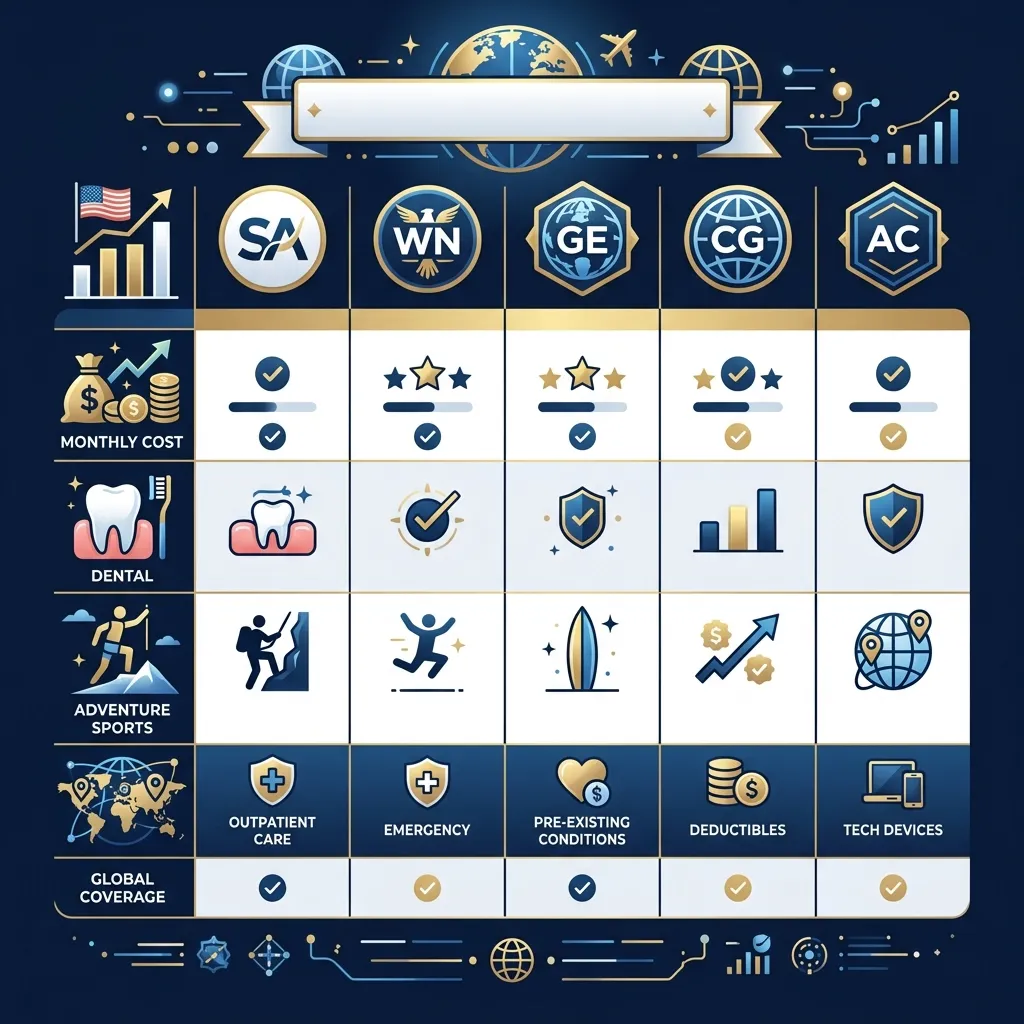
| Feature | SafetyWing Nomad Insurance | World Nomads | Genki World Explorer | Cigna Global | Allianz Care |
|---|---|---|---|---|---|
| Monthly price | ~$45/month | ~$120–$180/month | ~$65/month | ~$200–$400/month | ~$180–$350/month |
| Coverage type | Travel medical | Travel medical | Global health (hybrid) | International health | International health |
| Max coverage | $250,000/period | $100,000–$300,000 | €5,000,000+ | $1,000,000–unlimited | $1,000,000–unlimited |
| Deductible | $250/period | $100–$250 | €0–€1,000 (choice) | $0–$5,000 (choice) | $0–$2,500 (choice) |
| Outpatient care | Limited (urgent only) | No | Yes (included) | Yes (included) | Yes (included) |
| Dental | No | No | Optional add-on | Optional add-on | Optional add-on |
| Mental health | Limited | No | Yes (in-/outpatient) | Yes (in-/outpatient) | Yes (limited) |
| Pre-existing conditions | Not covered | Not covered | Waiting period applies | Covered (after moratorium) | Covered (after moratorium) |
| Emergency evacuation | $100,000 | $300,000 | Included | Included | Included |
| US coverage | Included (limited) | Included | Optional (add cost) | Optional (significant add cost) | Optional |
| Billing | Monthly (auto-renew) | Per-trip | Monthly or annual | Annual | Annual |
| Minimum commitment | None (cancel anytime) | Per-trip (no monthly) | 1 month | 12 months | 12 months |
| Age limit | 18–69 | 18–69 | 18–64 | No age limit | 18–75 |
| Best for | Budget nomads, short-term | Adventure travelers | Mid-budget nomads | Long-term, families | Corporate, families |
SafetyWing Nomad Insurance — Best Budget Option
SafetyWing has become the default choice for budget-conscious digital nomads, and for good reason. At approximately $45/month (age-dependent), it offers solid emergency medical coverage with the flexibility that nomads need.
Strengths:
- No minimum commitment — subscribe monthly, cancel anytime
- Covers you in 185+ countries simultaneously
- Includes a home country visit (up to 15 days per 90-day period for US citizens, 30 days for others)
- Simple online signup takes 2 minutes
- Covers COVID-19 treatment
Weaknesses:
- Limited outpatient coverage (urgent care only, not routine visits)
- $250 deductible per coverage period
- No dental, vision, or maternity
- Pre-existing conditions excluded
- May not be accepted for visa applications in all countries
World Nomads — Best for Adventure Activities
World Nomads is the go-to for nomads who prioritize adventure sports and activities — surfing, scuba diving, motorbike riding, rock climbing, and more are covered under their Explorer plan.
Strengths:
- Covers 200+ adventure activities (Explorer plan)
- Solid emergency evacuation coverage ($300,000)
- Trip cancellation and gear protection included
- Available to residents of 150+ countries
Weaknesses:
- Expensive for long-term stays ($120–$180/month)
- Per-trip billing — no monthly subscription
- No outpatient or routine care
- Lower maximum medical coverage ($100k–$300k)
- Pre-existing conditions excluded
Genki World Explorer — Best Mid-Range Option
Genki (a German insurtech) has quickly become a favorite among European digital nomads and is gaining traction globally. Their World Explorer plan offers a compelling middle ground between budget travel insurance and expensive expat health plans.
Strengths:
- Includes outpatient care and routine doctor visits
- Mental health coverage (inpatient and outpatient)
- Flexible deductible options (€0, €250, €500, €1,000)
- Monthly billing with no long-term commitment
- Telemedicine included
- Covers most Schengen visa applications
Weaknesses:
- US coverage costs extra
- Pre-existing conditions subject to 6-month waiting period
- Dental only as an add-on
- Less established global network than Cigna or Allianz
Cigna Global — Best Comprehensive Coverage
For nomads who want premium, no-compromise health coverage, Cigna Global is the gold standard. Their international health plans offer the same level of coverage you’d expect from a top-tier domestic plan — worldwide.
Strengths:
- Comprehensive inpatient, outpatient, dental, and vision coverage
- Pre-existing conditions covered after initial moratorium period
- Maternity and newborn coverage (after waiting period)
- Global network of hospitals and clinics with direct billing
- 24/7 customer support and emergency assistance
- No age limit
Weaknesses:
- Expensive ($200–$400+/month depending on age and coverage)
- Annual commitment (12 months minimum)
- US coverage adds significant cost
- Overkill for healthy, young nomads who rarely see a doctor
Allianz Care — Best for Families and Corporate
Allianz Care is a strong option for nomad families and those with corporate backing. Their global health plans are widely accepted for visa applications and offer robust family coverage.
Strengths:
- Well-recognized brand, accepted by most consulates for visa applications
- Family plans with dependent coverage
- Strong hospital network in Europe and Asia
- Mental health and wellness benefits
- Flexible plan tiers (Essential, Classic, Premium)
Weaknesses:
- Annual commitment required
- Pricing can be high for older applicants
- Claims process can be bureaucratic
- US coverage at premium pricing only
What to Look for in a Digital Nomad Insurance Plan
When evaluating any plan, consider these critical factors:
Emergency Medical Evacuation
This is the single most important coverage for nomads. According to the World Health Organization (WHO) travel health recommendations, a medical evacuation from a remote location can cost $50,000–$250,000+. Every plan you consider should include at least $100,000 in evacuation coverage. If you’re traveling to remote areas in Southeast Asia, Africa, or South America, aim for $250,000+.
Pre-Existing Conditions
Most budget plans exclude pre-existing conditions entirely. If you have any chronic health conditions (diabetes, asthma, heart conditions), you need a plan that covers them — even if it means paying more. Cigna and Allianz typically cover pre-existing conditions after a moratorium period (usually 12–24 months).
Mental Health Coverage
Mental health has become a growing concern among digital nomads dealing with isolation, burnout, and time-zone challenges. Only a few plans include meaningful mental health coverage:
- Genki World Explorer: Covers inpatient and outpatient mental health
- Cigna Global: Comprehensive mental health benefits
- SafetyWing: Limited to acute psychiatric emergencies
Geographic Coverage and Exclusions
Check which countries are covered — and which are excluded. Common exclusions include:
- US coverage: Almost all plans either exclude the US or charge a significant premium for it
- Sanctioned countries: Iran, North Korea, Cuba, Syria are typically excluded
- Home country: Some plans exclude your country of citizenship or limit coverage there
Insurance Requirements for Visa Applications
Many digital nomad visas require proof of health insurance as part of the application. Per Schengen visa insurance requirements, all Schengen-zone countries mandate a minimum of €30,000 in medical coverage for visa applicants. Here’s what specific countries require:
| Country | Insurance Required? | Minimum Coverage | Accepted Plans |
|---|---|---|---|
| Croatia | Yes | Full duration of stay | SafetyWing, Cigna, local Croatian plans |
| Portugal (D8) | Yes | Full duration of stay | Private international or Portuguese plans |
| Spain | Yes | Full coverage, no copays | Cigna, Allianz, Sanitas (local) |
| Cyprus | Yes | €30,000 minimum | Most international plans |
| Thailand (DTV) | Recommended | $50,000+ | SafetyWing, Cigna, local Thai plans |
| Indonesia | Yes | Full duration of stay | SafetyWing accepted, Cigna preferred |
| Germany | Yes | Comprehensive plan | Genki, TK (public), Allianz |
[!WARNING] Travel insurance is NOT the same as health insurance for visa purposes. Many consulates explicitly reject travel insurance policies (including basic SafetyWing plans) because they don’t provide comprehensive coverage. If applying for a visa, confirm with the specific consulate which providers and plan types they accept. Countries like Croatia and Cyprus have specific requirements that budget travel insurance may not satisfy.
Tax Deductibility of Health Insurance
For freelancers and self-employed nomads, health insurance premiums may be tax-deductible — potentially saving you hundreds or thousands per year.
United States
Self-employed individuals can deduct 100% of health insurance premiums as an above-the-line deduction (Form 1040, Line 17). This includes:
- Medical insurance for you, your spouse, and dependents
- Dental and vision insurance
- Qualifying long-term care insurance
This deduction is available whether you’re on SafetyWing at $45/month or Cigna Global at $400/month. The only requirement is that you cannot be eligible for coverage through an employer’s plan (including a spouse’s employer).
European Countries
Tax treatment varies by country:
- Germany: Health insurance is mandatory and fully deductible
- Netherlands: Basic health insurance (basisverzekering) is mandatory; premiums for zelfstandigen (self-employed) are deductible
- Portugal: Private health insurance premiums are deductible up to certain limits under IRS (Portuguese income tax)
- Spain: Deductible for autónomos (self-employed) up to certain limits
For Remote Employees
If you’re a remote employee (not self-employed), health insurance deductibility depends on whether your employer provides coverage. Employer-provided coverage is typically a tax-free benefit. If you purchase your own plan because your employer doesn’t offer international coverage, consult a tax advisor about deductibility in your specific jurisdiction.
How to Choose the Right Plan
Use this decision framework to find the best fit:
Choose SafetyWing if:
- You’re healthy, under 40, and rarely visit doctors
- Budget is a primary concern ($45/month)
- You want maximum flexibility (monthly billing, cancel anytime)
- You need basic emergency coverage while hopping between countries
Choose Genki World Explorer if:
- You want outpatient coverage and routine doctor visits included
- Mental health coverage is important to you
- You’re based primarily in Europe or Asia
- You need a plan accepted for Schengen visa applications
Choose Cigna Global if:
- You have pre-existing conditions that need coverage
- You’re traveling with family (spouse, children)
- You want premium comprehensive coverage without gaps
- Budget is less of a concern (quality and peace of mind are priorities)
Choose World Nomads if:
- Adventure activities are central to your lifestyle
- You need gear and trip cancellation coverage
- You’re on shorter trips (1–3 months per destination)
Choose Allianz Care if:
- You need a plan widely recognized by consulates for visa applications
- You’re a family with children
- You value a well-established brand with a large hospital network
Frequently Asked Questions
Can I use SafetyWing for a digital nomad visa application?
It depends on the country. SafetyWing Nomad Insurance is accepted by some countries (Croatia, Indonesia) but may be rejected by others (Spain, Germany) that require comprehensive health insurance rather than travel medical insurance. SafetyWing’s newer Nomad Health product (a full health insurance plan, not travel insurance) is more widely accepted. Always verify with the specific consulate before relying on any plan for a visa application.
What happens if I need emergency care in a country not covered by my plan?
If you receive emergency treatment in an excluded country, you will likely need to pay out of pocket and may not be able to claim reimbursement. Most plans exclude sanctioned countries entirely. For countries excluded for other reasons (like the US on some plans), emergency stabilization treatment may still be partially covered — check your policy’s specific terms. Consider plans with worldwide coverage (including the US) if you travel unpredictably.
Should I keep my home country health insurance while nomading?
This depends on your citizenship and tax situation. US citizens may want to maintain a marketplace plan (especially if they return home periodically) but should note that ACA plans provide virtually no international coverage. UK citizens can use the NHS when in the UK but need separate international coverage abroad. EU citizens can use their EHIC in other EU countries for public healthcare, but it doesn’t cover repatriation or private care. In most cases, maintaining a basic home country plan plus international nomad insurance is the safest approach.
Does digital nomad insurance cover dental emergencies?
Most travel medical plans (SafetyWing, World Nomads) cover dental emergencies only — meaning treatment for acute pain or injury, typically up to $500–$1,000 per incident. Routine dental care (cleanings, fillings, crowns) is not covered by budget plans. Comprehensive plans from Cigna and Allianz offer dental add-ons with broader coverage. Many nomads handle routine dental work in affordable destinations like Thailand, Mexico, or Turkey where out-of-pocket costs are lower than insurance premiums.
How do I file a claim with nomad insurance?
The claims process varies by provider:
- SafetyWing: Submit claims online through your dashboard. Upload receipts, medical reports, and itemized bills. Reimbursement typically takes 2–4 weeks.
- Cigna Global: Direct billing at network hospitals (no upfront payment). For non-network providers, submit claims online with receipts for reimbursement.
- Genki: Online claims portal. Telemedicine consultations are billed directly with no claim needed.
Always keep all receipts, medical reports, and itemized bills. Take photos of documents before leaving the medical facility. File claims within the timeframe specified in your policy (usually 30–90 days).
Is travel insurance sufficient for a Thailand DTV visa?
Thailand’s Destination Thailand Visa (DTV) recommends but doesn’t strictly mandate health insurance at the time of application. However, having comprehensive coverage is strongly advised given Thailand’s excellent but potentially expensive private hospital system. SafetyWing is generally accepted if proof of insurance is requested. For long-term stays, consider Genki or Cigna for more comprehensive coverage that includes outpatient care at Thai private hospitals.
Final Thoughts
Health insurance isn’t glamorous, but it’s the single most important safety net for your digital nomad lifestyle. A broken leg in Bali, food poisoning requiring hospitalization in Mexico, or an emergency evacuation from a remote island can cost tens of thousands of dollars without adequate coverage.
Here’s our bottom-line recommendation for 2026:
- Start with SafetyWing ($45/month) if you’re young, healthy, and budget-conscious
- Upgrade to Genki ($65/month) when you want outpatient coverage and mental health benefits
- Invest in Cigna Global ($200+/month) if you have pre-existing conditions, a family, or want zero gaps in coverage
- Always verify with the specific consulate which plans are accepted for your visa application
For more on building your nomad infrastructure, check out our visa guides for Croatia, Cyprus, and Portugal’s NHR tax regime.