Thailand DTV Visa 2026: Requirements, Costs & Tax Rules
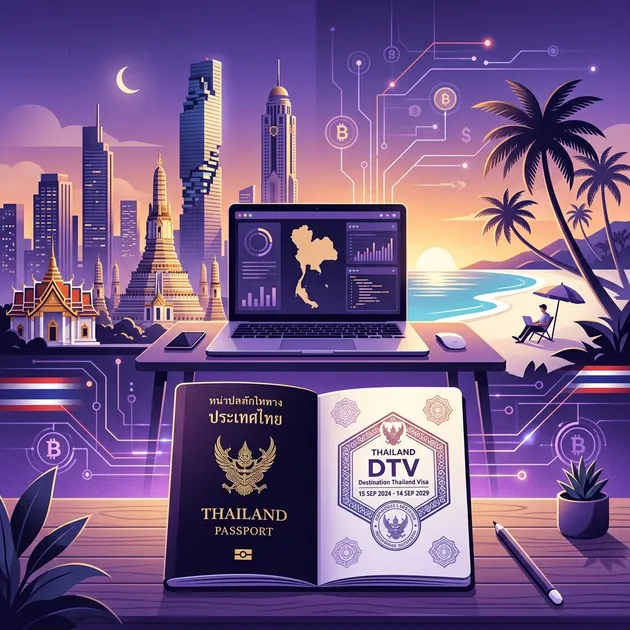
Thailand has long been the spiritual home of digital nomads — and with the Destination Thailand Visa (DTV), the country has finally created an official legal pathway for remote workers. Launched in mid-2024, the DTV offers a 5-year multiple-entry visa with 180-day stays per entry, and perhaps most importantly, Thailand’s territorial tax system means your foreign-sourced income is taxed at 0% if you manage it correctly. No more visa runs every 30 or 60 days, no more gray-area tourist visa stacking.
TL;DR: Thailand’s Destination Thailand Visa (DTV) is a 5-year, multiple-entry visa costing just 10,000 THB (~$280) that lets digital nomads stay up to 180 days per entry. Under Thailand’s territorial tax system, foreign-sourced income that is not remitted into Thailand is taxed at 0%, making the DTV one of the most cost-effective digital nomad visas in the world.
This comprehensive guide covers everything you need to know about the DTV in 2026: eligibility, application process, costs, tax implications, and how it compares to digital nomad visas in the rest of Southeast Asia.
What Is the Destination Thailand Visa (DTV)?
The DTV is a special long-term visa introduced by the Thai government. According to the Royal Thai Government Gazette (June 2024), the DTV is designed for four categories of visitors, with remote workers and digital nomads being the primary target group.
DTV Key Specifications
| Feature | Details |
|---|---|
| Visa validity | 5 years (multiple entry) |
| Stay per entry | 180 days |
| Extensions | Extendable by 180 days per entry at Thai Immigration |
| Re-entry permit | Built-in multiple re-entry (no separate permit needed) |
| Work permit required | No — for remote work for foreign entities |
| Eligible activities | Remote work, workcation, Muay Thai training, Thai cooking courses, medical treatment, seminars/events |
| Dependents | Spouse and children under 20 can apply on the same visa |
| Visa fee | 10,000 THB (~$280 USD) |
| Nationality restrictions | Available to citizens of most countries |
[!TIP] The 5-year validity is the headline feature. Unlike a tourist visa (60 days) or even the Thailand Elite visa (5-20 years but costing $16,000+), the DTV gives you long-term flexibility at a fraction of the cost. You can enter and exit Thailand multiple times, staying up to 180 days each time, for the entire 5-year window.
DTV Eligibility: Who Qualifies?
The DTV is available to individuals who fall into one of these four categories:
Category 1: Remote Workers & Digital Nomads (Most Common)
You work remotely for a company or clients based outside Thailand. This is the primary category for digital nomads.
Requirements:
- Proof of employment or freelance contracts with foreign entities
- Evidence of regular income (bank statements, pay slips, invoices)
- No minimum income threshold officially stated, but immigration officers may expect to see sufficient funds (generally $500,000 THB in savings or equivalent, approximately $14,000 USD)
Category 2: Workcation & Coworking
You’re combining travel with remote work in a semi-structured environment — attending coworking spaces, participating in digital nomad programs, or joining workcation retreats.
Category 3: Thai Soft Power Activities
You’re in Thailand to study or practice Thai cultural arts — specifically Muay Thai, Thai cooking, Thai massage, Thai language, or Thai festivals. You’ll need enrollment proof from a registered school or program.
Category 4: Medical & Wellness Tourism
You’re undergoing medical treatment or wellness programs at accredited Thai facilities.
[!WARNING] According to the Thai Immigration Bureau, the DTV does not allow you to work for Thai companies or earn Thailand-sourced income. It is strictly for remote work serving foreign entities. If you take on local Thai clients, you need a separate work permit — and that changes your tax situation entirely.
How to Apply for the DTV: Step-by-Step
Step 1: Gather Your Documents
Prepare the following (requirements may vary slightly by Thai embassy/consulate):
- Passport — valid for at least 6 months beyond your intended entry date
- Completed visa application form (TM.87 or the online equivalent)
- Recent passport photo (4x6 cm, white background)
- Proof of remote work — one or more of:
- Employment contract with a foreign company
- Freelance client contracts
- Business registration documents (if self-employed)
- Letter from employer confirming remote work arrangement
- Financial evidence — one or more of:
- Bank statements showing consistent income (last 6 months)
- Savings of at least 500,000 THB (~$14,000)
- Tax returns from your home country
- Accommodation proof — hotel booking, Airbnb reservation, or rental agreement (at least for initial stay)
- Health insurance — covering Thailand with minimum $50,000 coverage (recommended, may be required by some consulates)
- Visa fee: 10,000 THB (~$280), payable at the embassy/consulate
Step 2: Submit Your Application
You have two options:
- In-person at a Thai Royal Embassy or Consulate in your home country or current country of residence
- Online via e-Visa at thaievisa.go.th — available for many nationalities, with processing times of 15–25 business days
Step 3: Attend the Interview (If Required)
Some consulates require a brief interview. Be prepared to explain:
- What you do for work
- Who your employer/clients are (and that they are foreign-based)
- Your plan for staying in Thailand
- Your financial means
Step 4: Receive Your Visa
Once approved, the DTV sticker is placed in your passport (for in-person applications) or you receive an electronic visa approval (for e-Visa applications). You can then enter Thailand at any point within the visa’s validity window.
Step 5: Enter Thailand and Register
Upon arrival:
- Pass through immigration with your DTV visa
- You are admitted for 180 days
- Complete a TM.30 notification (your landlord or hotel typically handles this within 24 hours)
- If you plan to stay beyond 180 days, visit your local Immigration office to apply for a 180-day extension before your initial stay expires
[!TIP] Unlike the old tourist visa process, you do not need to do visa runs every 30-60 days. With the DTV, you get a full 180 days per entry, extendable to 360 days, and you can re-enter as many times as you want within the 5-year validity period.
Thailand Tax Rules for DTV Holders
This is where things get interesting — and favorable — for digital nomads.
The Territorial Tax Principle
Thailand uses a modified territorial tax system. Per the Thai Revenue Department’s interpretation of the Revenue Code, tax residents (those present in Thailand for 180+ days in a calendar year) are taxed on:
- Thailand-sourced income: Always taxable, regardless of residency status
- Foreign-sourced income brought into Thailand in the same year it is earned: Taxable since 2024 (previously, only income brought in within the same calendar year was taxed; a 2024 Revenue Department order expanded this)
- Foreign-sourced income earned in a prior year and brought into Thailand: This is the critical planning point
The 2024 Tax Rule Change
In September 2023, the Thai Revenue Department announced that starting January 1, 2024, foreign income remitted to Thailand would be taxable regardless of when it was earned. This closed the previous “prior year” loophole where you could earn income in Year 1, keep it abroad, and bring it into Thailand in Year 2 tax-free.
However, key nuances remain:
- Foreign income not remitted to Thailand is still 0% taxed. If you earn from foreign clients and keep the money in a foreign bank account, Thailand does not tax it.
- Income earned before you became a Thai tax resident is generally not taxable upon remittance.
- Double Tax Treaties may reduce or eliminate Thai tax on certain types of remitted foreign income.
Practical Tax Scenario for DTV Digital Nomads
| Scenario | Thai Tax |
|---|---|
| Earn $5,000/mo from US clients, keep all money in US bank account, spend from US debit card in Thailand | 0% (not remitted) |
| Earn $5,000/mo from US clients, transfer $2,000/mo to Thai bank account | Taxable on the $2,000 remitted (progressive rates apply) |
| Earn $5,000/mo from US clients, spend via Wise/Revolut card (non-Thai account) | Gray area — technically spending foreign funds in Thailand may or may not constitute remittance; conservative view says it could be |
| Earn income from Thai company while on DTV | Illegal without a work permit; fully taxable |
Thailand Progressive Income Tax Rates (2026)
If you do remit foreign income, here are the personal income tax rates:
| Taxable Income (THB/year) | Taxable Income (USD approx.) | Rate |
|---|---|---|
| 0 – 150,000 | $0 – $4,200 | 0% |
| 150,001 – 300,000 | $4,200 – $8,400 | 5% |
| 300,001 – 500,000 | $8,400 – $14,000 | 10% |
| 500,001 – 750,000 | $14,000 – $21,000 | 15% |
| 750,001 – 1,000,000 | $21,000 – $28,000 | 20% |
| 1,000,001 – 2,000,000 | $28,000 – $56,000 | 25% |
| 2,000,001 – 5,000,000 | $56,000 – $140,000 | 30% |
| Over 5,000,000 | Over $140,000 | 35% |
Exchange rate: approximately 35.7 THB = 1 USD.
[!WARNING] The safest strategy for most DTV holders is to keep all foreign income in foreign accounts and avoid remitting to Thailand. If you need Thai baht for daily expenses, use a Wise or Revolut card linked to your foreign account — though the tax treatment of this is debated. Consult a Thai tax advisor for your specific situation.
Cost of Living: Chiang Mai vs Bangkok
Thailand’s affordability is a major draw. Here’s what your budget looks like in the two most popular digital nomad hubs:
| Expense | Chiang Mai | Bangkok |
|---|---|---|
| 1BR apartment (central) | $300–$500/mo | $500–$900/mo |
| 1BR apartment (suburban) | $150–$300/mo | $300–$550/mo |
| Coworking space | $50–$120/mo | $80–$200/mo |
| Street food meal | $1–$2 | $1.50–$3 |
| Restaurant meal (mid-range) | $3–$7 | $5–$12 |
| Coffee (specialty café) | $2–$4 | $3–$5 |
| Gym membership | $25–$50/mo | $40–$80/mo |
| Internet (fiber, 200+ Mbps) | $15–$25/mo | $15–$30/mo |
| Motorbike rental | $80–$120/mo | N/A (use BTS/MRT) |
| Monthly transport | $30–$60 | $50–$100 (BTS/MRT) |
| Health insurance (intl.) | $80–$150/mo | $80–$150/mo |
| Total (comfortable) | $800–$1,300/mo | $1,200–$2,000/mo |
Chiang Mai remains the undisputed king of digital nomad value — a comfortable life for under $1,000/month is entirely realistic. Bangkok offers more cosmopolitan living with world-class food and nightlife, but at roughly 50-60% higher costs.
DTV vs Other Southeast Asia Digital Nomad Visas
How does Thailand’s DTV stack up against the competition?
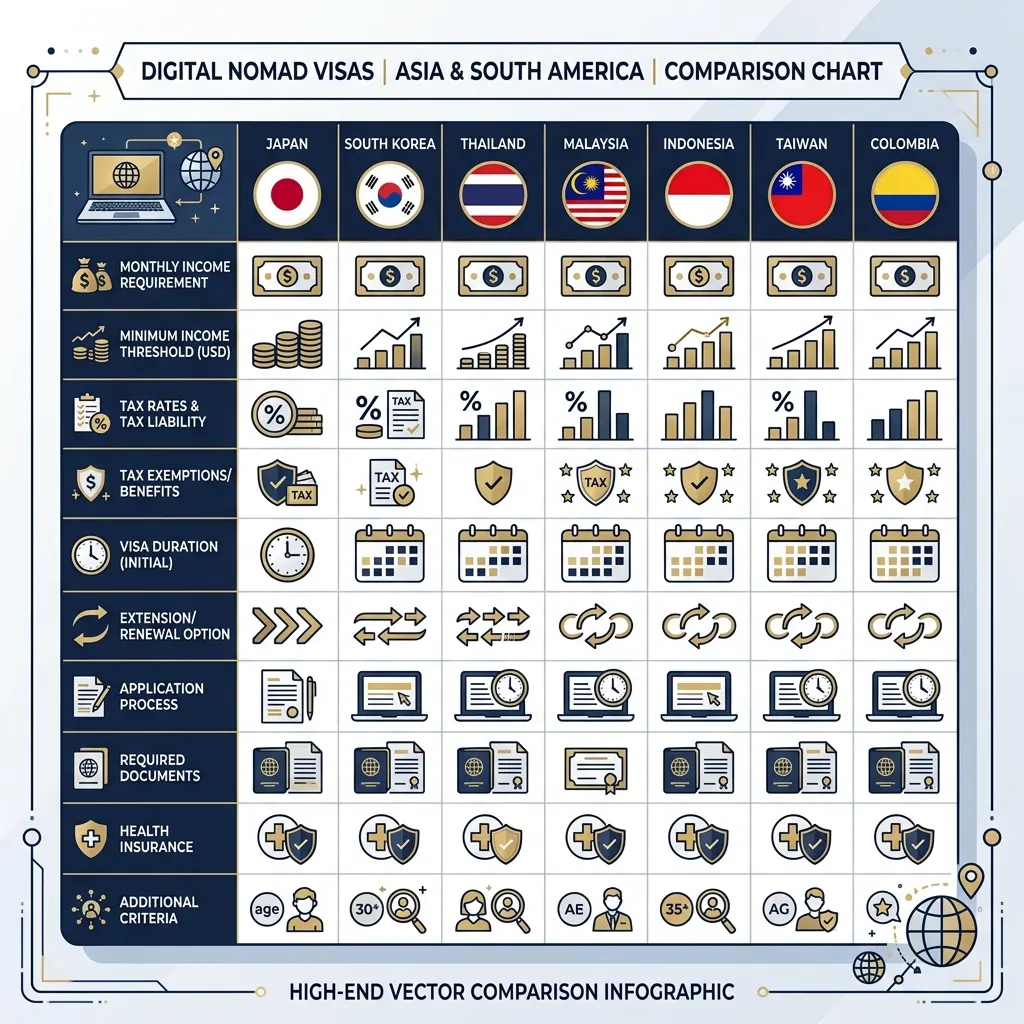
| Feature | Thailand DTV | Malaysia DE Rantau | Indonesia B211A | Vietnam (Tourist + Extensions) | Cambodia (Ordinary Visa) |
|---|---|---|---|---|---|
| Visa duration | 5 years (multiple entry) | 1 year (renewable) | 6 months | 90 days (extendable) | 1 year (renewable) |
| Stay per entry | 180 days (+180 extension) | 12 months | 180 days | 90 days | 12 months |
| Visa fee | ~$280 | ~$218 | ~$170 | ~$50–$80 | ~$30–$50 |
| Min. income | Not officially stated (~$14K savings) | $24,000/year | ~$2,000/month | None | None |
| Tax on foreign income | 0% (if not remitted) | 0% (foreign-sourced) | 0% (for remote workers) | 5–35% (if resident) | 0% (on foreign income) |
| Work permit needed | No (remote work) | No (remote work) | No (remote work) | Gray area | Gray area |
| Internet quality | Good (50–500 Mbps) | Good (100+ Mbps) | Variable (10–100 Mbps) | Excellent (100+ Mbps) | Moderate (20–50 Mbps) |
| Cost of living | $800–$2,000/mo | $1,000–$1,800/mo | $800–$1,500/mo | $800–$1,500/mo | $600–$1,200/mo |
[!TIP] Thailand’s DTV is the clear winner for long-term flexibility. The 5-year validity eliminates visa anxiety, and the 0% tax on non-remitted foreign income makes it financially compelling. Malaysia’s DE Rantau is the strongest competitor for those who want a formal digital nomad program with clear legal status.
DTV vs Thailand Elite Visa
Many digital nomads wonder whether the DTV or the Thailand Privilege (Elite) Card is better. Here’s the comparison:
| Feature | DTV | Thailand Elite (Gold) |
|---|---|---|
| Duration | 5 years | 5 years |
| Cost | ~$280 | |
| Stay per entry | 180 days (+180 extension) | 1 year per entry |
| Airport service | No | VIP lounge + limousine |
| Work authorization | Remote work for foreign entities | No work authorization |
| Renewal | Must reapply after 5 years | Upgrade/renewal options |
| Tax implications | Same (territorial system) | Same (territorial system) |
Bottom line: The DTV offers 98% of the practical benefits at 1.7% of the cost. The Elite visa makes sense only for those who highly value the VIP services and want the longer 1-year stays without extensions.
Practical Tips for DTV Holders
-
Get a Thai bank account. Open a bank account at Bangkok Bank, Kasikorn Bank (KBank), or SCB — it makes daily life easier. You’ll need your passport, DTV visa, and a Thai phone number. Some branches are more foreigner-friendly than others; the Bangkok Bank head office on Silom Road is a reliable choice.
-
Register a Thai phone number. Get a local SIM from AIS, TrueMove, or DTAC for excellent 5G coverage. Unlimited data plans run $10–$20/month.
-
Use a coworking space. Top options include Punspace (Chiang Mai), Hubba (Bangkok), The Hive (multiple locations), and AIS Design Centre (free in Bangkok). These also help establish your “workcation” bona fides for the visa.
-
Keep meticulous financial records. Separate your Thai spending from your foreign income accounts. If questioned by the Revenue Department, clean records make everything simpler.
-
Set calendar reminders for the 180-day mark. Overstaying in Thailand incurs fines of 500 THB/day (up to 20,000 THB) and can result in detention or a ban on re-entry. Either extend or exit before your 180 days expire.
-
Consider health insurance carefully. Thailand has excellent private hospitals (Bumrungrad, Bangkok Hospital) but costs add up without insurance. International health plans from SafetyWing ($45/month), Cigna Global, or Allianz Care are popular among nomads.
Frequently Asked Questions
Can I work for Thai clients on a DTV?
No. The DTV explicitly prohibits employment by Thai entities or earning Thailand-sourced income. You must work exclusively for foreign companies or foreign clients. Violating this can result in visa revocation, fines, and deportation.
Do I need to file a Thai tax return on the DTV?
If you don’t remit any foreign income to Thailand and have no Thai-sourced income, you generally don’t need to file a tax return. However, if you stay 180+ days in a calendar year (making you a tax resident) and do remit income, you are obligated to file a return by March 31 of the following year. US citizens must still file US returns regardless — see our guide to the Foreign Earned Income Exclusion (FEIE).
Can my family join me on the DTV?
Yes. Your spouse and children under 20 can apply for their own DTV visas. Each family member must submit a separate application and pay the 10,000 THB fee, but they can reference your primary application.
Is the DTV really better than visa runs on a tourist visa?
Absolutely. Tourist visa stacking (repeated 60-day entries) is technically legal but increasingly scrutinized by Thai immigration. Officers may deny entry if they see a pattern of back-to-back tourist visas. The DTV provides legitimate, long-term status with no ambiguity. The $280 fee pays for itself in avoided visa-run costs (flights, border transport) within 1-2 trips.
What happens when my 5-year DTV expires?
You’ll need to apply for a new visa. As of 2026, there is no automatic renewal mechanism for the DTV. However, given the program’s success, the Thai government is expected to continue and potentially expand it. You could also transition to a Thailand Elite visa, a Non-Immigrant B visa (if you establish a Thai business), or a retirement visa (if over 50).
Can I open a Thai company while on a DTV?
The DTV does not authorize you to work in Thailand, so actively managing a Thai-registered company could be problematic. However, you can be a shareholder (investor) in a Thai company without a work permit, as long as you don’t perform day-to-day management functions within Thailand. Consult a Thai immigration lawyer for your specific situation.
Final Thoughts
The Destination Thailand Visa has transformed Thailand from a place where digital nomads operated in legal gray areas into a destination with clear, affordable, and generous visa provisions. At just $280 for 5 years, with 180-day stays, multiple entries, and 0% tax on non-remitted foreign income, the DTV is arguably the best-value digital nomad visa in the world.
Whether you’re drawn to Chiang Mai’s temples and mountain air, Bangkok’s electric energy, or the islands of the south, the DTV lets you build a real life in Thailand — legally, affordably, and with minimal tax burden.
Run the numbers for your specific income through our Tax Calculator, and check out our guides on Vietnam’s tax system and Malta’s remittance basis for alternative strategies across different regions.
Thailand is calling — and for the first time, it’s rolling out the red carpet for digital nomads.