Georgia 1% Tax for Digital Nomads: Small Business Status Guide

Georgia has become one of the world’s most popular destinations for tax-conscious digital nomads, and for good reason. The country offers a 1% flat tax rate on gross revenue through its Small Business Status program — one of the lowest tax rates available anywhere on Earth. Combined with a remarkably simple setup process, affordable cost of living, and welcoming attitude toward foreign entrepreneurs, Georgia presents a compelling package for remote workers and freelancers.
TL;DR: Under Georgia’s Small Business Status, Individual Entrepreneurs earning up to GEL 500,000 (~€180,000) per year pay just 1% tax on gross revenue — per Article 88 of the Georgian Tax Code. There is no VAT obligation, no requirement to track expenses, and the entire setup as an Individual Entrepreneur can be completed in 3–5 business days through the Georgia Revenue Service.
In this guide, we cover everything you need to know about Georgia’s 1% tax regime for 2026: how Small Business Status works, the step-by-step process for becoming an Individual Entrepreneur, banking options, residency permits, and a realistic look at living costs. Whether you’re a freelance developer billing €5,000 per month or a remote consultant earning six figures, this guide will help you navigate the Georgian tax system.
How Georgia’s 1% Tax Works
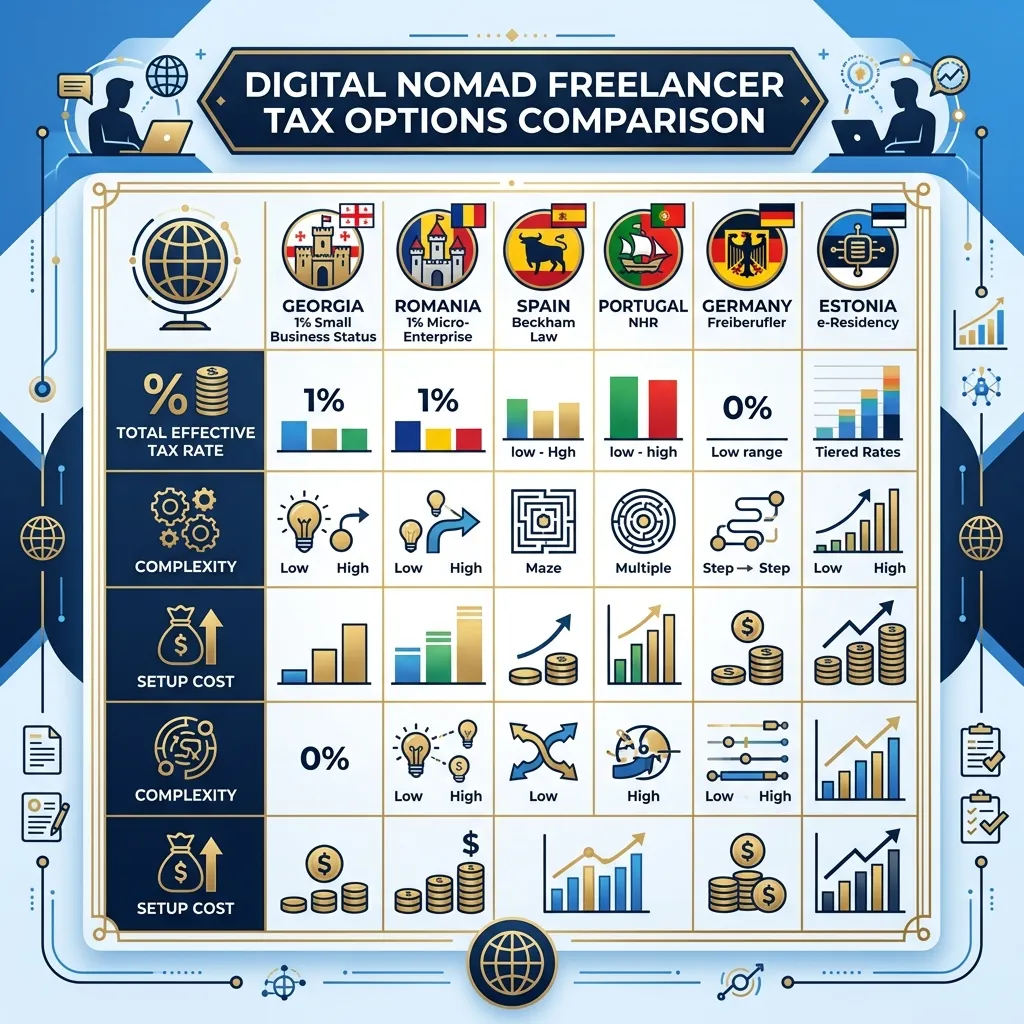
According to the Georgia Revenue Service, Small Business Status (SBS) is a preferential tax regime available to Individual Entrepreneurs (IEs) whose annual gross revenue does not exceed GEL 500,000 (approximately €180,000 at 2026 exchange rates). Per Article 88 of the Georgian Tax Code, qualifying entrepreneurs pay a flat 1% tax on gross revenue — not on profit, but on total income received.
Key Features
- 1% flat tax on gross revenue (total income, not net profit)
- Revenue threshold: GEL 500,000 (~€180,000) per year
- No VAT obligation for Small Business Status holders
- No requirement to track expenses for tax purposes (since tax is on revenue, not profit)
- Monthly or quarterly filing depending on your revenue level
- Available to foreign nationals who establish tax residency in Georgia
What Happens if You Exceed the GEL 500,000 Threshold?
If your annual revenue exceeds GEL 500,000, you lose Small Business Status and are automatically reclassified. At that point, two main options exist:
| Revenue Level | Tax Status | Tax Rate |
|---|---|---|
| Up to GEL 500,000 (~€180,000) | Small Business | 1% on gross revenue |
| GEL 500,001 – GEL 2,000,000 | Medium Business | 3% on gross revenue |
| Above GEL 2,000,000 or standard | Standard taxation | 20% on profit (CIT rate) |
[!WARNING] The 1% tax is applied to gross revenue, not net profit. This means you cannot deduct business expenses to reduce your tax base. If your business has significant expenses (equipment, subcontractors, software), the effective tax rate on your actual profit will be higher than 1%. For most digital nomads with low overhead, this distinction is minimal.
Georgia’s Tax System Overview
Before diving into the Small Business setup, it’s helpful to understand Georgia’s broader tax framework:
| Tax Type | Rate |
|---|---|
| Personal income tax (standard) | 20% flat |
| Corporate income tax | 15% (only on distributed profits under the Estonian model) |
| Small Business Status | 1% on gross revenue |
| VAT | 18% (not applicable for SBS holders) |
| Social security contributions | 2% employee contribution (employer: 2%) |
| Capital gains tax | 20% (with exemptions) |
| Dividend withholding tax | 5% |
Based on official data from the Georgia Revenue Service, Georgia uses a territorial-plus system for taxation. Residents are taxed on worldwide income, but the Small Business Status effectively overrides the standard 20% personal income tax rate for qualifying entrepreneurs.
Eligibility for Small Business Status
To obtain Small Business Status in Georgia, you must meet these criteria:
- Register as an Individual Entrepreneur (IE) with the Georgian tax authorities (Revenue Service)
- Annual gross revenue must not exceed GEL 500,000 (~€180,000)
- The activity must not be on the excluded list — certain activities like financial services, gambling, and regulated professions may not qualify
- You must be a tax resident of Georgia — typically achieved by spending 183 days in the country within a 12-month period, or by registering as a tax resident
Activities That Qualify
Almost all typical digital nomad activities qualify for Small Business Status, including:
- Software development and programming
- Web design and graphic design
- Digital marketing and SEO consulting
- Content writing and copywriting
- Online tutoring and coaching
- Video production and editing
- E-commerce (with certain conditions)
- Business consulting
Activities That May Not Qualify
- Currency exchange and financial trading
- Gambling and betting operations
- Activities requiring special licenses (legal, medical in some cases)
- Import/export of excisable goods
[!TIP] Georgia’s Revenue Service publishes a list of excluded activities. If your work involves anything unusual, confirm eligibility with the Revenue Service before registering. For standard digital nomad freelancing, there are rarely any issues.
Step-by-Step Guide: Setting Up as an Individual Entrepreneur
Follow these steps to register as an Individual Entrepreneur with Small Business Status in Georgia:
-
Arrive in Georgia and obtain a residence permit — EU, US, Canadian, UK, and many other passport holders can enter Georgia visa-free for up to one year. For longer stays, you’ll need a residence permit (covered below).
-
Open a Georgian bank account — You’ll need a local bank account to receive income and pay taxes. Major banks include Bank of Georgia, TBC Bank, and Liberty Bank. Most require an in-person visit with your passport. Account opening typically takes 1–3 business days.
-
Obtain a Georgian taxpayer identification number — Visit the Revenue Service (or use their online platform rs.ge) to register. You’ll need your passport and Georgian address. The process is usually completed same day.
-
Register as an Individual Entrepreneur — This can be done simultaneously with your taxpayer registration at the Revenue Service office. You’ll need to specify your business activity code (NACE code). For freelance IT/consulting, common codes include 62.01 (computer programming) and 70.22 (business consulting).
-
Apply for Small Business Status — Submit an application to the Revenue Service requesting SBS. This is a separate step from IE registration. The application is typically processed within 1–5 business days. You can apply in person or through the rs.ge online portal.
-
Receive your SBS certificate — Once approved, you’ll receive confirmation of your Small Business Status. Your 1% tax rate applies from the date of registration.
-
Set up your accounting and invoicing — While SBS holders don’t need to track expenses for tax purposes, you do need to maintain revenue records and issue invoices. Many digital nomads use simple spreadsheet tracking or tools like the free rs.ge invoicing system.
-
File and pay taxes — Small Business Status holders typically file and pay taxes monthly by the 15th of the following month. Payment is made through the Revenue Service online system.
[!TIP] The entire setup process — from arriving in Georgia to having a registered IE with Small Business Status — can be completed in as little as 3–5 business days. Georgia is one of the fastest countries in the world for business registration, consistently ranked in the top 10 globally for ease of doing business.
Banking in Georgia
A Georgian bank account is essential for your IE operations. Here’s a comparison of the major options:
| Bank | Account Opening | Online Banking | Multi-Currency | Monthly Fee |
|---|---|---|---|---|
| Bank of Georgia | In-person, 1–2 days | Excellent (app + web) | GEL, USD, EUR, GBP | ~GEL 0–5 |
| TBC Bank | In-person, 1–2 days | Excellent (app + web) | GEL, USD, EUR | ~GEL 0–3 |
| Liberty Bank | In-person, 1–3 days | Good (app + web) | GEL, USD, EUR | ~GEL 0–5 |
| Basis Bank | In-person, 2–3 days | Basic | GEL, USD, EUR | ~GEL 3–5 |
Important Banking Considerations
- SWIFT transfers: All major Georgian banks support international SWIFT transfers. Expect fees of GEL 20–50 per incoming international transfer.
- Wise integration: Many digital nomads use Wise (formerly TransferWise) to receive payments internationally and transfer to their Georgian account at lower fees.
- Currency accounts: Open accounts in GEL, USD, and EUR to avoid unnecessary conversion fees. Most banks offer multi-currency accounts at no additional cost.
- Crypto-friendly: Georgian banks are generally tolerant of crypto-related income, though it’s advisable to disclose the source of funds transparently.
[!WARNING] Some banks may ask about your source of income during account opening. Be prepared to explain your freelance/consulting activities and show client contracts or invoices. “Digital nomad” may not be well understood — framing your work as “IT consulting” or “software development” tends to go smoother.
Residency Permits
While many nationalities can stay in Georgia visa-free for up to one year, establishing long-term tax residency typically requires a residence permit.
Options for Digital Nomads
| Permit Type | Duration | Requirements | Processing Time |
|---|---|---|---|
| Short-term visa-free stay | Up to 1 year | Valid passport only | Immediate |
| Work residence permit | 1 year (renewable) | Employment contract or IE registration | 2–4 weeks |
| Investment residence permit | 1 year (renewable) | Investment of GEL 300,000+ | 2–4 weeks |
| Remotely from Georgia program | 1 year (renewable) | Monthly income ≥ $2,000, foreign employer | 2–3 weeks |
The “Remotely from Georgia” Program
Georgia’s Remotely from Georgia program is specifically designed for digital nomads and remote workers. Key requirements:
- Minimum monthly income of $2,000 (or equivalent)
- Employment with a foreign company or proof of freelance income from foreign clients
- Valid passport with at least 6 months remaining
- Health insurance
- Clean criminal record
This program provides a streamlined path to legal residency and helps establish the tax residency needed for Small Business Status.
Tax Filing and Compliance
Monthly Tax Filing
As an SBS holder, you must file a monthly tax return and pay 1% of your gross revenue by the 15th of the following month.
Example: If you earn GEL 10,000 in January, you owe GEL 100 in tax, due by February 15.
Annual Declaration
In addition to monthly filings, you must submit an annual income declaration by April 1 of the following year.
Record Keeping
While you don’t need to track expenses for tax purposes, you must maintain:
- Revenue records (invoices issued and payments received)
- Bank statements
- Client contracts
- Tax payment receipts
[!TIP] The Georgian Revenue Service’s online portal (rs.ge) is surprisingly user-friendly and available in English. Most digital nomads handle their own tax filing without needing an accountant. However, a local accountant typically charges GEL 100–300/month (~€35–€110) if you prefer professional assistance.
Cost of Living in Georgia
One of Georgia’s biggest draws is its remarkably low cost of living, particularly in Tbilisi:
Monthly Cost Breakdown (Tbilisi)
| Expense | Budget (€) | Mid-Range (€) | Comfortable (€) |
|---|---|---|---|
| One-bedroom apartment (city center) | 350 – 500 | 500 – 750 | 750 – 1,200 |
| Utilities (electricity, water, gas, internet) | 50 – 80 | 80 – 120 | 120 – 160 |
| Groceries | 150 – 200 | 200 – 300 | 300 – 450 |
| Dining out | 100 – 200 | 200 – 400 | 400 – 700 |
| Transportation | 20 – 40 | 40 – 80 | 80 – 150 |
| Coworking space | 80 – 120 | 120 – 200 | 200 – 350 |
| Health insurance | 30 – 60 | 60 – 120 | 120 – 250 |
| Total | €780 – €1,200 | €1,200 – €1,970 | €1,970 – €3,260 |
How Georgia Compares
| City | Average Monthly Cost (Mid-Range) |
|---|---|
| Tbilisi, Georgia | €1,200 – €1,970 |
| Lisbon, Portugal | €2,000 – €3,200 |
| Athens, Greece | €1,500 – €2,500 |
| Bangkok, Thailand | €1,100 – €1,800 |
| Dubai, UAE | €2,800 – €4,500 |
| Bali, Indonesia | €1,000 – €1,600 |
Georgia offers a cost of living comparable to Southeast Asian destinations, but with European infrastructure, a rich cultural scene, and one of the world’s most hospitable cultures.
Real-World Tax Savings
Let’s compare the tax burden in Georgia with other popular digital nomad destinations for different income levels:
Freelancer Earning €60,000/Year
| Country | Tax Regime | Annual Tax | Effective Rate |
|---|---|---|---|
| Georgia (SBS) | 1% on gross revenue | €600 | 1% |
| Portugal (NHR) | 20% flat rate | €12,000 | 20% |
| Greece (50% exemption) | 50% income discount | ~€5,900 | 9.83% |
| UAE/Dubai | 0% income tax | €0 | 0% |
| Germany | Progressive rates | ~€16,000 | ~26.7% |
| United Kingdom | Progressive rates | ~€13,500 | ~22.5% |
Freelancer Earning €100,000/Year
| Country | Tax Regime | Annual Tax | Effective Rate |
|---|---|---|---|
| Georgia (SBS) | 1% on gross revenue | €1,000 | 1% |
| Portugal (NHR) | 20% flat rate | €20,000 | 20% |
| Greece (50% exemption) | 50% income discount | ~€13,900 | 13.9% |
| UAE/Dubai | 0% income tax | €0 | 0% |
[!TIP] Georgia’s 1% rate produces the lowest tax bill of any country that actually charges tax. Only truly zero-tax jurisdictions like the UAE beat it. Use our Tax Calculator to model your specific income scenario.
Pros and Cons of Georgia’s 1% Tax
Advantages
- Incredibly low 1% tax rate — The lowest percentage-based tax available globally
- Simple setup — Complete registration in 3–5 business days
- No VAT obligations — SBS holders are exempt from Georgia’s 18% VAT
- Very low cost of living — Stretch your income significantly in Tbilisi
- Minimal bureaucracy — User-friendly online tax portal, straightforward compliance
- Visa-free entry for most Western nationalities (up to 1 year)
- No social security for IEs — Individual Entrepreneurs are not required to pay social security contributions
Disadvantages
- Tax on gross revenue — You cannot deduct expenses; if you have high costs, the effective rate on profit is higher
- Revenue cap of GEL 500,000 — High earners above ~€180,000 lose SBS eligibility
- Limited banking infrastructure — International transfers can be slow and involve fees
- Geographic location — Georgia is further from Western Europe than Mediterranean alternatives
- Healthcare quality — While improving, medical facilities don’t match EU standards
- Currency risk — The Georgian Lari (GEL) can be volatile against EUR and USD
- Limited EU integration — Georgia is not an EU/EEA member, so no Schengen access
Frequently Asked Questions
Do I need to spend 183 days in Georgia to maintain Small Business Status?
To be a tax resident, you generally need to spend 183 days in Georgia within a 12-month period, or have your center of vital interests (home, family, business registration) in Georgia. However, the tax residency rules can be nuanced — registering as an IE and having your business operations in Georgia can support your residency claim even with shorter physical presence.
Can I have clients from any country?
Yes, Georgian Individual Entrepreneurs can work with clients from any country worldwide. There are no restrictions on the source of your income. The 1% tax applies to all revenue received, regardless of where your clients are based.
Is crypto income eligible for the 1% rate?
Crypto trading income is generally not eligible for Small Business Status. However, if you are paid in cryptocurrency for legitimate services (e.g., freelance work paid in Bitcoin), that revenue can be declared under your IE at the 1% rate. The distinction is between crypto trading (not eligible) and service income received in crypto (potentially eligible). Consult a Georgian tax advisor for your specific situation.
What about double taxation if my home country still claims me as a resident?
Per the Georgia Revenue Service, Georgia has Double Taxation Agreements (DTAs) with over 50 countries, including most EU member states, the UK, and the US. However, some countries (notably the US) tax their citizens regardless of residency. If your home country still considers you a tax resident, you may face double taxation. The DTA provisions and foreign tax credits can help mitigate this, but professional advice is essential.
Can I hire employees under Small Business Status?
SBS holders are not allowed to hire employees. If you need to bring on staff, you would need to either switch to standard taxation or establish a Georgian LLC (which has a separate 15% CIT rate under the Estonian model — tax only on distributed profits).
How do I convert my GEL tax obligation to EUR or USD?
Your tax is calculated and paid in Georgian Lari (GEL). If you earn in EUR or USD, the Revenue Service uses the official National Bank of Georgia exchange rate on the date the income was received to determine the GEL equivalent for tax purposes.
Final Thoughts
Georgia’s 1% Small Business Status is one of the most attractive tax regimes available to digital nomads anywhere in the world. The combination of a rock-bottom tax rate, simple registration process, no VAT obligations, no social security costs, and a very affordable cost of living makes it an ideal base for freelancers and remote workers earning under €180,000 per year.
The trade-offs are real — limited EU integration, a developing banking system, and distance from Western Europe — but for many digital nomads, the financial benefits far outweigh these drawbacks. If you’re earning €60,000 per year, your total tax bill in Georgia would be just €600 — compared to €12,000 under Portugal’s NHR or €5,900 under Greece’s 50% exemption.
Ready to calculate your potential tax savings? Head to our Tax Calculator to compare Georgia with other digital nomad destinations and find the optimal setup for your situation.