UAE/Dubai 0% Tax Guide for Remote Workers (2026)
The United Arab Emirates remains the world’s most prominent zero personal income tax jurisdiction, and Dubai in particular has become a global magnet for digital nomads, freelancers, and remote workers seeking to legally eliminate their income tax burden. With 0% tax on personal income, no capital gains tax, and a sophisticated infrastructure that rivals any Western city, the UAE offers a unique combination of fiscal freedom and modern convenience.
TL;DR: The UAE charges 0% personal income tax on all individuals — covering salaries, freelance income, capital gains, dividends, and crypto. Digital nomads can establish legal residency through the Dubai Virtual Working Programme (~$280/year) or a freezone freelance permit (from ~€1,500/year), while the 9% corporate tax introduced in 2023 only applies to business entities, not individuals.
But zero income tax doesn’t mean zero cost. Between visa fees, freezone licenses, higher living expenses, and VAT obligations, the true cost of establishing yourself in Dubai requires careful calculation. In this 2026 guide, we break down everything: the different permit options, the real costs involved, banking setup, VAT considerations, and how the UAE compares to other zero-tax and low-tax destinations.
Understanding UAE’s 0% Personal Income Tax
The UAE does not levy any personal income tax on individuals. This applies to all residents regardless of nationality, income level, or source of income. There are no progressive brackets, no flat rates, no withholding — your personal earnings are entirely tax-free.
What’s Covered by the 0% Rate
- Employment income — Salaries, bonuses, commissions: all tax-free
- Self-employment and freelance income — Revenue from freelance activities: tax-free
- Capital gains — Profits from selling investments, property, or assets: tax-free for individuals
- Dividends — Dividend income received by individuals: tax-free
- Interest income — Bank interest and investment returns: tax-free
- Rental income — Income from property rentals: tax-free (no personal income tax, though property fees apply)
- Crypto gains — Profits from cryptocurrency trading: tax-free for individuals
What IS Taxed in the UAE
While personal income is untaxed, the UAE does have other taxes and fees:
| Tax/Fee | Rate | Applies To |
|---|---|---|
| Corporate tax | 9% on profits above AED 375,000 (~€95,000) | Companies and businesses (introduced June 2023) |
| VAT | 5% | Most goods and services |
| Tourism tax | 5–10% | Hotel stays and hospitality |
| Municipality fee | 5% of annual rent | Residential tenants (Dubai) |
| Customs duty | 5% | Imported goods |
| Excise tax | 50–100% | Tobacco, energy drinks, sugary beverages |
[!IMPORTANT] Per the UAE Ministry of Finance’s Federal Decree-Law No. 47 of 2022 on Corporate and Business Tax, the UAE introduced a 9% corporate income tax effective June 2023 for businesses earning above AED 375,000 (~€95,000) in profit. This applies to mainland LLCs and freezone companies that don’t meet the qualifying conditions for the 0% freezone rate. However, personal income remains completely tax-free — the corporate tax does not affect individuals earning employment or freelance income.
Visa and Permit Options for Digital Nomads
To legally reside and work in the UAE, you need a valid visa or residence permit. Here are the main options for digital nomads and remote workers in 2026:
1. Dubai Virtual Working Programme (Digital Nomad Visa)
According to the Dubai Virtual Working Programme (administered by Dubai’s Department of Economy and Tourism), remote workers employed by companies outside the UAE can live in Dubai for one year (renewable).
| Feature | Details |
|---|---|
| Duration | 1 year (renewable) |
| Income requirement | Minimum $3,500/month (or equivalent) |
| Eligibility | Remote employees or freelancers with foreign clients |
| Cost | |
| Work for UAE clients? | No — only for foreign-sourced remote work |
| Dependents | Can be included (spouse and children) |
| Tax residency | Can be used to establish UAE tax residency |
2. Freezone Freelance Permit
Freezone freelance permits allow you to legally operate as a freelancer within the UAE, invoice clients (both local and international), and sponsor your own residency visa.
| Freezone | Annual Cost (AED) | Annual Cost (€) | Popular For |
|---|---|---|---|
| Dubai Multi Commodities Centre (DMCC) | 15,000 – 25,000 | 3,800 – 6,400 | Trading, consulting |
| Dubai Internet City (DIC) | 12,000 – 22,000 | 3,000 – 5,600 | Tech, media, IT |
| Dubai Media City (DMC) | 12,000 – 22,000 | 3,000 – 5,600 | Media, content creation |
| IFZA (International Free Zone Authority) | 10,500 – 15,000 | 2,700 – 3,800 | General freelancing |
| Ajman Free Zone | 7,500 – 12,000 | 1,900 – 3,000 | Budget-friendly option |
| Sharjah Media City (Shams) | 5,750 – 12,000 | 1,500 – 3,000 | Most affordable |
3. Mainland Freelance Permit
Dubai’s Department of Economy and Tourism (DET) issues mainland freelance permits for specific activity categories. These allow you to work with UAE-based clients as well as international ones.
| Feature | Details |
|---|---|
| Duration | 1–3 years |
| Cost | AED 7,500 – 15,000 (~€1,900 – €3,800) annually |
| Eligible activities | Technology, media, education, consulting, marketing |
| UAE clients | Yes — can invoice UAE-based businesses |
| Visa sponsorship | Self-sponsored residency visa included |
4. Golden Visa (Long-Term Residency)
For those planning a longer stay, the UAE Golden Visa provides 5 or 10-year residency without the need for a national sponsor.
| Eligibility Category | Duration | Key Requirement |
|---|---|---|
| Investors | 10 years | AED 2 million+ investment |
| Entrepreneurs | 5 years | Approved startup or existing business |
| Specialized talents | 10 years | Recognized expertise in science, art, tech |
| Skilled professionals | 5 years | Bachelor’s degree + AED 30,000/month salary |
| Real estate investors | 5 years | Property worth AED 2 million+ |
[!TIP] For most digital nomads, the Freezone Freelance Permit offers the best balance of cost, flexibility, and legal clarity. It provides a proper residency visa, allows you to open bank accounts, and establishes clear UAE tax residency. The Sharjah Media City (Shams) freezone is the most budget-friendly option starting at around €1,500/year.
Step-by-Step Guide: Setting Up in Dubai
Here’s the complete process for establishing yourself as a digital nomad in Dubai:
-
Choose your visa/permit type — Decide between the Virtual Working Programme (if you only work for foreign clients), a Freezone Freelance Permit (if you want more flexibility), or a Mainland Permit (if you want to serve UAE clients).
-
Select a freezone (if applicable) — Compare costs, included services, and activity categories across freezones. Consider proximity to your preferred neighborhood and the freezone’s reputation with banks.
-
Submit your application — Apply online through the chosen freezone’s portal or the Virtual Working Programme website. Required documents typically include:
- Passport copy (valid for 6+ months)
- Passport-sized photographs
- Proof of income or employment
- Health insurance (or purchase through the freezone)
- Bank statements (last 3 months)
-
Receive your e-visa or entry permit — Processing typically takes 3–10 business days. Once approved, you’ll receive an entry permit if you’re outside the UAE, or your visa will be stamped if you’re already in the country.
-
Complete the Emirates ID process — Visit an approved typing center to submit your biometric data and apply for your Emirates ID — the essential identification card for all UAE transactions.
-
Medical fitness test — Complete the mandatory medical examination at an approved health center. This includes a blood test and chest X-ray. Results are typically available within 24–48 hours.
-
Visa stamping — Once your medical clearance and Emirates ID application are processed, your residency visa will be stamped in your passport or issued as an e-visa.
-
Open a UAE bank account — With your Emirates ID and residency visa, approach a bank to open your account (see banking section below).
-
Obtain a UAE Tax Residency Certificate (if needed) — If you need to prove your UAE tax residency to your home country or clients, apply through the UAE Federal Tax Authority (FTA) EmaraTax portal. Based on official data from the FTA, processing takes 2–4 weeks and costs AED 1,000 (~€255).
[!WARNING] The total setup process from application to having a bank account typically takes 3–6 weeks. Plan accordingly and ensure you have sufficient funds accessible during the transition period. Some freezones offer “package deals” that streamline the process for an additional fee.
Banking in the UAE
Opening a bank account is one of the most important (and sometimes frustrating) steps for new UAE residents. Here’s what to expect:
Major Banks for Digital Nomads
| Bank | Account Opening | Minimum Balance | Online Banking | Digital Nomad Friendly |
|---|---|---|---|---|
| Mashreq Neo | Fully digital | AED 0 | Excellent app | ★★★★★ |
| Wio Bank | Fully digital | AED 0 | Excellent app | ★★★★★ |
| Emirates NBD | In-branch | AED 3,000 – 5,000 | Good | ★★★★☆ |
| ADCB | In-branch | AED 5,000 | Good | ★★★★☆ |
| Liv (by ENBD) | Digital | AED 0 | Good app | ★★★★☆ |
| RAK Bank | In-branch | AED 5,000 | Fair | ★★★☆☆ |
Key Banking Tips
- Digital-first banks like Mashreq Neo and Wio Bank are the easiest options for freelancers and offer instant account opening with just your Emirates ID
- Traditional banks may require a salary certificate or minimum deposit of AED 3,000–5,000 (~€770–€1,280)
- Multi-currency accounts are available at most banks, supporting AED, USD, EUR, and GBP
- Wise and Payoneer integrate well with UAE bank accounts for receiving international payments
- Crypto-friendly: UAE banks are increasingly open to customers with crypto income, especially with the country’s progressive regulatory framework (VARA in Dubai)
[!TIP] Start with Mashreq Neo or Wio Bank for instant account access while your traditional bank application processes. You can always open additional accounts later. Having a digital bank account from day one ensures you can receive payments without interruption.
VAT Considerations
While personal income is tax-free, the UAE’s 5% VAT does affect businesses and freelancers:
VAT Registration Thresholds
| Threshold | Amount (AED) | Amount (€) | Requirement |
|---|---|---|---|
| Mandatory registration | Taxable supplies > AED 375,000 | > ~€95,000 | Must register for VAT |
| Voluntary registration | Taxable supplies > AED 187,500 | > ~€48,000 | Can choose to register |
| Below threshold | < AED 187,500 | < ~€48,000 | No VAT obligations |
Do Digital Nomads Need to Register for VAT?
- Freelancers with a UAE freezone license providing services to clients outside the UAE: These services are generally zero-rated (0% VAT) as exported services. You still need to register if you exceed the threshold, but you won’t charge VAT on these exports.
- Freelancers serving UAE-based clients: If your taxable supplies exceed AED 375,000, you must register for VAT and charge 5% to your UAE clients.
- Virtual Working Programme holders: Since this visa is for remote work for foreign employers, VAT generally doesn’t apply.
[!TIP] Most digital nomads earning under €95,000 from a mix of international clients won’t need to worry about VAT registration. If you do cross the threshold, VAT compliance in the UAE is relatively straightforward with quarterly filings through the FTA portal.
Cost of Living: The Real Picture
Dubai is significantly more expensive than other popular digital nomad destinations. Here’s an honest breakdown:
Monthly Cost Breakdown (Dubai)
| Expense | Budget (€) | Mid-Range (€) | Comfortable (€) |
|---|---|---|---|
| Studio/1-bedroom (Dubai Marina/JLT) | 1,200 – 1,800 | 1,800 – 2,500 | 2,500 – 4,000 |
| Utilities (DEWA + cooling) | 120 – 200 | 200 – 350 | 350 – 500 |
| Groceries | 300 – 450 | 450 – 700 | 700 – 1,000 |
| Dining out | 200 – 400 | 400 – 800 | 800 – 1,500 |
| Transportation (metro + occasional taxi) | 80 – 150 | 150 – 300 | 300 – 600 |
| Health insurance | 100 – 200 | 200 – 400 | 400 – 800 |
| Coworking space | 150 – 300 | 300 – 500 | 500 – 800 |
| Total | €2,150 – €3,500 | €3,500 – €5,550 | €5,550 – €9,200 |
Dubai vs. Abu Dhabi vs. Other Emirates
| Location | Avg. Monthly Cost (Mid-Range) | Lifestyle |
|---|---|---|
| Dubai | €3,500 – €5,550 | Premium, vibrant, high energy |
| Abu Dhabi | €2,800 – €4,500 | Slightly cheaper, more spacious |
| Sharjah | €1,800 – €3,000 | Budget-friendly, 30 min from Dubai |
| Ajman | €1,500 – €2,500 | Most affordable, quieter |
| Ras Al Khaimah | €1,800 – €2,800 | Emerging, nature-focused |
[!WARNING] Dubai’s cost of living means you need to earn significantly more to benefit from the 0% tax rate. A digital nomad earning €60,000/year might save €12,000 in taxes compared to Portugal’s NHR, but spend €15,000–€25,000 more on living costs. Run the numbers carefully using our Tax Calculator.
UAE vs. Other Zero-Tax and Low-Tax Destinations
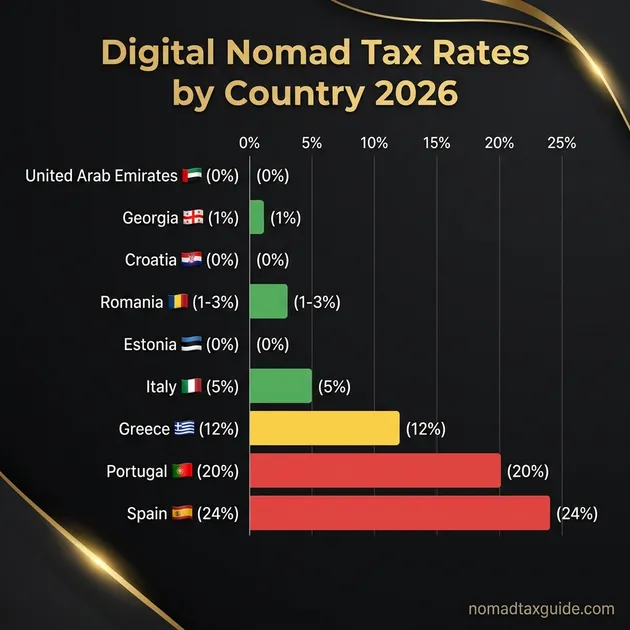
How does the UAE compare with other countries that offer zero or near-zero personal income tax?
| Country | Income Tax Rate | Corporate Tax | VAT/GST | Setup Cost (Annual) | Cost of Living (Monthly) |
|---|---|---|---|---|---|
| UAE/Dubai | 0% | 9% (above AED 375k) | 5% | €1,500 – €6,400 | €2,150 – €5,550 |
| Bahrain | 0% | 0% (except oil) | 10% | €2,000 – €4,000 | €1,500 – €3,000 |
| Qatar | 0% | 10% | 0% | €3,000 – €8,000 | €2,000 – €4,500 |
| Cayman Islands | 0% | 0% | 0% | €5,000 – €15,000 | €3,000 – €6,000 |
| Bermuda | 0% | 0% | 0% | €4,000 – €10,000 | €4,000 – €7,000 |
| Georgia (SBS) | 1% | 15% | 18% | €100 – €300 | €780 – €1,970 |
| Paraguay | 10% | 10% | 10% | €500 – €1,500 | €700 – €1,500 |
UAE vs. Low-Tax European Alternatives
| Country | Effective Tax Rate (€80k income) | EU/Schengen Access | Setup Complexity | Infrastructure |
|---|---|---|---|---|
| UAE/Dubai | 0% | No | Medium | Excellent |
| Portugal (NHR) | 20% | Yes | Medium | Excellent |
| Greece (50% exemption) | ~11.9% | Yes | Medium | Good |
| Georgia (1%) | 1% | No | Easy | Good |
| Bulgaria | 10% flat | Yes (EU) | Easy | Fair |
Pros and Cons of the UAE for Digital Nomads
Advantages
- Absolute zero personal income tax — No income tax, no capital gains tax, no dividend tax
- World-class infrastructure — Ultra-fast internet, modern coworking spaces, excellent transport
- Strategic location — Hub between Europe, Asia, and Africa, with direct flights worldwide
- Safety and stability — One of the world’s safest countries with robust rule of law
- Tax residency certificates — Easy to obtain, widely recognized globally
- Networking opportunities — Massive international business community
- Crypto-friendly regulation — Progressive framework through VARA and ADGM
- No currency controls — Free movement of capital in and out of the country
Disadvantages
- High cost of living — Significantly more expensive than most digital nomad hubs
- Visa/license costs — Annual freezone fees of €1,500–€6,400 add up
- Extreme heat — Summer temperatures exceed 45°C (June–September)
- Cultural adjustments — Conservative social norms in some areas, alcohol restrictions
- No EU/Schengen access — Separate visa required for European travel. Consider Croatia’s DN visa or Malta’s remittance-based tax if EU access is important to you
- 9% corporate tax — Businesses earning above AED 375,000 in profit now pay corporate tax
- Healthcare costs — Quality healthcare is available but expensive without comprehensive insurance
- Social isolation risk — Transient population can make deep social connections challenging
Corporate Tax: What Digital Nomads Need to Know
Since June 2023, the UAE levies a 9% corporate income tax on business profits exceeding AED 375,000 (~€95,000). Here’s how it affects digital nomads:
Freezone Companies and the 0% Rate
Qualifying freezone entities can still enjoy a 0% corporate tax rate on qualifying income, provided they:
- Maintain adequate substance in the UAE (office, employees, or demonstrable operations)
- Earn “qualifying income” (generally income from transactions with entities outside the freezone or within the same freezone)
- Do not elect to be subject to the standard rate
- Meet the de minimis requirements (non-qualifying revenue must not exceed the lower of AED 5 million or 5% of total revenue)
Freelancers vs. Companies
| Structure | Tax Treatment |
|---|---|
| Freelance permit (individual) | 0% — personal income is not subject to corporate tax |
| Freezone company (entity) | 0% on qualifying income if conditions met; 9% otherwise |
| Mainland company | 9% on profits above AED 375,000 |
[!TIP] If you operate as an individual freelancer (not through a company), the corporate tax does not apply to you. Your income is treated as personal income and remains at 0%. This is the simplest and most tax-efficient structure for most digital nomads.
Health Insurance Requirements
Health insurance is mandatory for all UAE residents. Here’s what to expect:
| Plan Type | Annual Cost (AED) | Annual Cost (€) | Coverage |
|---|---|---|---|
| Basic (DHA minimum) | 2,000 – 4,000 | 510 – 1,020 | Emergency + basic outpatient |
| Mid-range | 5,000 – 10,000 | 1,280 – 2,550 | Comprehensive outpatient + inpatient |
| Premium | 12,000 – 25,000 | 3,060 – 6,380 | Full coverage including dental + optical |
Some freezones include basic health insurance in their license package. Always verify what’s included before purchasing additional coverage.
Frequently Asked Questions
Do I need to spend 183 days in the UAE to maintain tax residency?
The UAE’s tax residency rules were updated in 2023. You can obtain a Tax Residency Certificate if you:
- Are present in the UAE for 183 days or more within a 12-month period, OR
- Have your primary residence and center of financial interests in the UAE, with a minimum of 90 days physical presence
The 90-day rule with center-of-interest requirements provides flexibility for digital nomads who travel frequently.
Can I use the UAE as a tax base while traveling extensively?
Yes, many digital nomads use Dubai as their home base while traveling for portions of the year. As long as you maintain your UAE residency (visa, Emirates ID, bank accounts, accommodation) and meet the tax residency requirements, your income remains tax-free. However, be cautious about triggering tax residency in other countries where you spend extended time.
What about my home country’s taxes?
Moving to the UAE doesn’t automatically release you from tax obligations in your home country. You must formally exit your home country’s tax system by:
- Deregistering as a tax resident
- Obtaining a UAE Tax Residency Certificate to present to your home country’s authorities
- Complying with any exit tax or departure obligations
US citizens are taxed on worldwide income regardless of residency and must continue filing US tax returns. The Foreign Earned Income Exclusion (FEIE) of $130,000 (2026) can help offset the US tax burden.
Is cryptocurrency legal in the UAE?
Yes, the UAE has established a progressive regulatory framework for cryptocurrency. The Virtual Assets Regulatory Authority (VARA) in Dubai and the ADGM (Abu Dhabi Global Market) regulate crypto activities. Individuals can buy, sell, and hold crypto assets legally. Personal gains from crypto trading are tax-free as there is no capital gains tax on individuals.
Can I open a business bank account as a freelancer?
With a freezone freelance permit, you can open a business bank account in the UAE. Some banks also allow freelancers to use enhanced personal accounts for business purposes. Digital banks like Mashreq Neo and Wio Bank make the process particularly easy with minimal documentation.
How does the UAE handle double taxation?
The UAE has signed Double Taxation Agreements (DTAs) with over 130 countries, one of the most extensive treaty networks globally. These treaties prevent double taxation and often help establish your UAE tax residency for the purposes of your home country’s tax authorities. See our complete guide to double taxation treaties for details on how DTAs work.
Is it worth moving to Dubai just for the 0% tax rate?
This depends entirely on your income level and lifestyle preferences. As a general rule:
- Earning under €50,000/year: The higher cost of living in Dubai may offset your tax savings. Consider lower-cost alternatives like Georgia (1% tax).
- Earning €50,000–€100,000/year: The math starts to work, especially if you choose a more affordable emirate like Sharjah or Ajman.
- Earning over €100,000/year: Dubai becomes highly attractive. At €150,000, you’re saving €30,000+ compared to Portugal’s NHR, more than covering the higher living costs.
Use our Tax Calculator to model your specific scenario and compare total costs (tax + living expenses) across destinations.
Final Thoughts
The UAE’s 0% personal income tax is unbeatable on paper — no other major, well-connected country offers the same combination of zero taxation and world-class infrastructure. For high-earning digital nomads (€100,000+), Dubai delivers the most significant absolute tax savings of any destination in the world.
However, the equation isn’t purely about tax rates. Dubai’s higher cost of living, visa fees, and the reality of desert heat during summer months are all factors that affect your bottom line and quality of life. For digital nomads earning under €60,000, more affordable destinations like Georgia or Greece may deliver better overall value despite their nominal tax rates.
The key is to look at the total picture: tax savings, setup costs, living expenses, lifestyle preferences, and long-term goals. Start with our Tax Calculator to compare the UAE against other digital nomad destinations and find the optimal setup for your income level and lifestyle.