Romania 1% Micro-Enterprise Tax: Step-by-Step Setup Guide

Romania’s 1% micro-enterprise tax is one of the lowest corporate tax rates in the entire European Union — and it’s not a loophole. It’s the official tax regime for small companies with at least one employee, generating revenue under €500,000/year. For digital nomads looking to establish a legitimate EU-based business structure, a Romanian SRL (Societate cu Răspundere Limitată, equivalent to an LLC) offers an unbeatable combination of low taxes, EU credibility, and affordable cost of living.
TL;DR: Under Romania’s Fiscal Code (Codul Fiscal), micro-enterprises with at least one employee pay just 1% tax on gross revenue (3% with no employees), up to €500,000/year. Including minimum salary taxes, social contributions, and 8% dividend tax, the total effective rate comes to approximately 14.7% — one of the lowest in the EU.
This guide walks you through everything: the tax math, the setup process, residency requirements, banking, and the real costs of running a Romanian micro-enterprise in 2026.
What Is Romania’s Micro-Enterprise Tax?
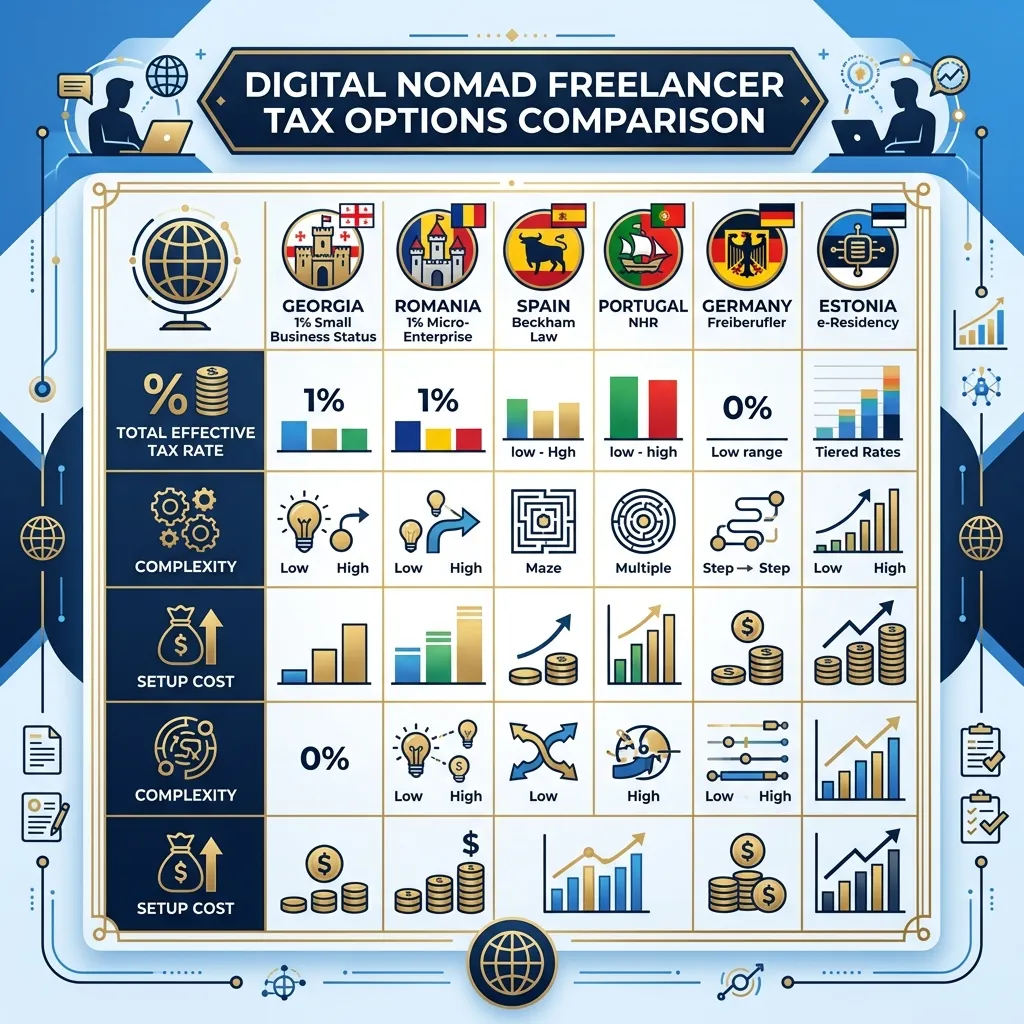
According to Romania’s Fiscal Code (Codul Fiscal), Romania’s micro-enterprise tax (impozit pe veniturile microîntreprinderilor) is a simplified tax regime for small companies. Instead of paying the standard 16% corporate income tax on profits, qualifying micro-enterprises pay a tax on gross revenue at dramatically lower rates.
2026 Micro-Enterprise Tax Rates
| Condition | Tax Rate |
|---|---|
| Micro-enterprise with 1+ employees | 1% of gross revenue |
| Micro-enterprise with 0 employees | 3% of gross revenue |
Qualification Requirements
To use the micro-enterprise regime, your SRL must meet all of the following:
- Annual revenue under €500,000 (approximately 2,500,000 RON)
- At least 50% of revenue comes from activities other than consulting and management (CAEN code restrictions — more on this below)
- Share capital is held by individuals (not other companies, except in specific circumstances)
- The company has not opted out of the micro-enterprise regime
- The company is not in banking, insurance, gambling, or oil/gas exploration
[!WARNING] The consulting restriction is the biggest trap for digital nomads. If more than 50% of your revenue comes from consulting or management activities (CAEN codes 6920, 7010, 7021, 7022, etc.), you cannot use the micro-enterprise regime and must pay the standard 16% corporate income tax. Structure your activities carefully — “software development” (CAEN 6201) and “IT services” (CAEN 6202, 6209) are fine.
Why 1% Is Better Than You Think
The 1% rate is on gross revenue, not profit. This means you don’t deduct expenses before calculating your tax. At first glance, this might seem less attractive than a profit-based tax — but for service-based digital nomads with low operating costs, it’s a massive win. The only comparable regime is Georgia’s 1% Small Business Status, which also taxes on revenue.
Comparison: 1% Revenue Tax vs 16% Profit Tax
Let’s compare for a freelance developer earning €60,000/year with €10,000 in business expenses:
| Metric | Micro-Enterprise (1%) | Standard CIT (16%) |
|---|---|---|
| Gross revenue | €60,000 | €60,000 |
| Deductible expenses | N/A | €10,000 |
| Taxable base | €60,000 (revenue) | €50,000 (profit) |
| Tax | €600 | €8,000 |
| Effective rate | 1% | 13.3% |
The micro-enterprise regime saves €7,400 in this scenario. And the gap widens at higher revenues — at €200,000/year with €30,000 expenses, the micro-enterprise pays €2,000 vs €27,200 under standard CIT.
[!TIP] Even at €500,000/year revenue (the maximum threshold), the micro-enterprise tax is just €5,000. That’s less than what many US freelancers pay in quarterly estimated taxes alone. Use our Tax Calculator to compare Romania against other jurisdictions.
The Full Cost Picture: Not Just 1%
While the 1% headline rate is real, you need to account for other mandatory costs:
Mandatory Social Contributions (If You’re the Employee)
Most solo digital nomads hire themselves as the single employee to qualify for the 1% rate. As an employee, you’ll pay:
| Contribution | Rate | Base | Monthly Cost (at min. salary) |
|---|---|---|---|
| Income tax (salary) | 10% | Gross salary | ~€370 |
| Social insurance (CAS) | 25% | Gross salary | ~€925 |
| Health insurance (CASS) | 10% | Gross salary | ~€370 |
| Work insurance (CAM) | 2.25% | Gross salary | ~€83 (employer cost) |
| Total employee cost | — | — | ~€1,665 |
| Employer cost (CAM) | 2.25% | Gross salary | ~€83 |
Based on Romania’s 2026 minimum gross salary of approximately 3,700 RON/month (~€740).
The smart strategy: Pay yourself the minimum gross salary (3,700 RON/month) to minimize social contributions while satisfying the “1 employee” requirement. Then, based on ANAF guidelines, distribute remaining profits as dividends, which are taxed at a flat 8% under the Romanian Fiscal Code.
Total Tax Burden Example: €60,000/Year Revenue
| Item | Amount |
|---|---|
| Micro-enterprise tax (1%) | €600 |
| Employee salary (12 months × €740 gross) | €8,880 |
| Income tax on salary (10%) | €888 |
| Social insurance – CAS (25%) | €2,220 |
| Health insurance – CASS (10%) | €888 |
| Employer contribution – CAM (2.25%) | €200 |
| Total salary-related taxes | €4,196 |
| Remaining for dividends | €60,000 - €600 - €8,880 - €200 = €50,320 |
| Dividend tax (8%) | €4,026 |
| Total all taxes | €8,822 |
| Effective total rate | ~14.7% |
An effective rate of 14.7% — including full health insurance and pension contributions — is exceptionally competitive for an EU-based setup. And this is with a relatively modest €60,000 income. At higher revenues, the effective rate drops further because the salary-related costs are fixed.
Step-by-Step: Setting Up a Romanian SRL
Step 1: Obtain a Romanian Address
You need a registered office (sediu social) for your SRL. Options include:
- Virtual office: €30–€100/month from providers like Regus, Spaces, or local Romanian firms
- Rented apartment: Your lease can double as the registered address (with landlord consent)
- Coworking space: Some offer registered office services
Step 2: Choose Your CAEN Codes
CAEN codes define your business activities. For digital nomads, common eligible codes include:
- 6201 — Computer programming activities
- 6202 — Computer consultancy activities (caution: ensure this is <50% of revenue)
- 6209 — Other IT service activities
- 6311 — Data processing, hosting
- 6312 — Web portal activities
- 7311 — Advertising agencies
- 7410 — Specialised design activities
- 7420 — Photographic activities
- 9001/9003 — Creative arts activities
[!TIP] Choose 6201 (computer programming) as your primary CAEN code if possible. It’s clearly outside the consulting restriction and covers most software development, web development, and app development activities.
Step 3: Register the SRL at the Trade Registry (ONRC)
The registration process typically takes 3–5 business days and requires:
- Articles of incorporation (drafted by a notary or lawyer)
- Specimen signatures (notarized)
- Proof of registered office (lease + landlord consent or virtual office agreement)
- Founder’s ID (passport for foreigners)
- Declaration that you meet micro-enterprise conditions
- Capital contribution: Minimum 200 RON (~€40) — yes, that’s the minimum share capital
Cost of registration: €200–€500 (including notary fees, translations, stamps)
If you don’t speak Romanian, budget an additional €300–€800 for a lawyer or accountant to handle the process.
Step 4: Register with the Tax Authority (ANAF)
Per ANAF (Agenția Națională de Administrare Fiscală, Romania’s National Agency for Fiscal Administration), after Trade Registry registration, your SRL is automatically enrolled with ANAF. You’ll need to:
- Confirm micro-enterprise status (submit Declaration 010)
- Register for VAT only if revenue exceeds €88,500 (the 2026 VAT threshold). Below this, you are VAT-exempt.
Step 5: Hire Yourself as an Employee
Draft an employment contract (contract individual de muncă) for yourself as the sole employee. This can be:
- Full-time (8 hours/day, 40 hours/week) — required to get full social insurance benefits
- Part-time (minimum 2 hours/day) — lower contributions but also lower pension/benefits
Most digital nomads choose full-time at minimum salary for the cleanest setup.
Step 6: Open a Business Bank Account
Romanian business banking options:
| Bank | Monthly Fee | Online Banking | Foreigner-Friendly |
|---|---|---|---|
| ING Romania | €0–€5 | Excellent | Yes |
| Banca Transilvania | €3–€8 | Good | Yes |
| BCR | €5–€10 | Good | Moderate |
| Revolut Business | €0–€25 | Excellent | Yes |
| Wise Business | €0 | Excellent | Yes |
[!TIP] Revolut Business and Wise Business have become the go-to options for Romanian SRLs, especially for receiving international payments. They integrate well with Romanian accounting software and ANAF reporting. Traditional bank accounts at ING or Banca Transilvania are useful for domestic transactions and salary payments.
Step 7: Hire an Accountant
Romanian accounting and tax filing are complex. A local accountant (contabil) typically charges €80–€200/month for:
- Monthly bookkeeping
- Payroll processing
- Quarterly and annual tax filings
- ANAF submissions
Do not skip this step. Romanian tax compliance requires monthly filings, and mistakes trigger penalties. A good English-speaking accountant is worth every euro.
Residency Requirements for Non-EU Nationals
EU/EEA citizens can freely establish and operate an SRL in Romania. For non-EU nationals, you’ll need:
Option A: Digital Nomad Visa (Viză de Nomad Digital)
Romania introduced its Digital Nomad Visa in 2023. For other EU digital nomad visa options, see our guide to Croatia’s DN visa.
- Duration: 12 months, renewable
- Income requirement: Minimum €3,500/month (3x average Romanian gross salary)
- Eligibility: Remote workers for foreign entities or self-employed with foreign clients
- Application fee: ~€120
- Work permit: Not required (remote work only)
Option B: Long-Stay Visa for Business (Viză de Lungă Şedere)
If you’re establishing an SRL and intend to run it actively:
- Duration: 90 days initially, extendable to a 1-year residence permit
- Requirement: Invest minimum €100,000 and create at least 2 jobs (the investment requirements may be reduced for certain business types)
- More complex than the digital nomad route
Option C: EU Long-Term Residence (After 5 Years)
After 5 continuous years of legal residence, you can apply for EU long-term resident status in Romania, providing stability and additional rights across the EU.
Romania vs Other Low-Tax EU Jurisdictions
| Feature | Romania (Micro SRL) | Estonia (e-Residency) | Bulgaria (Flat Tax) | Hungary (KATA – suspended) |
|---|---|---|---|---|
| Corporate/Revenue tax rate | 1% (with employee) | 0% (reinvested) / 20% (distributed) | 10% CIT | KATA suspended since 2022 |
| Dividend tax | 8% | 7% (personal, Estonian resident) | 5% | N/A |
| Total effective rate | ~14.7% (with min salary) | ~25.5% (distribution) | ~14.5% | N/A |
| Physical presence required | Minimal | None (e-Residency) | Yes (for residency) | Yes |
| EU membership | Yes | Yes | Yes | Yes |
| Schengen access | Yes (2024+) | Yes | Yes | Yes |
| Cost of living | Very low | Moderate | Very low | Low |
| English proficiency | Moderate-High | High | Moderate | Low |
[!TIP] Romania beats Estonia for most digital nomads because Estonia’s 20% distribution tax makes the total burden higher. Romania’s 1% + 8% dividend structure is hard to beat within the EU. For a different EU approach, see Portugal’s NHR regime which offers a flat 20% rate on qualifying income.
Cost of Living: Romania in 2026
| Expense | Bucharest | Cluj-Napoca | Timișoara |
|---|---|---|---|
| 1BR apartment (central) | €500–€750 | €450–€650 | €350–€550 |
| Coworking space | €100–€200 | €80–€150 | €70–€130 |
| Groceries | €200–€300 | €180–€280 | €170–€250 |
| Dining out | €150–€250 | €120–€200 | €100–€180 |
| Transport | €30–€50 | €25–€40 | €20–€35 |
| Internet (1 Gbps!) | €8–€12 | €8–€12 | €8–€12 |
| Health (private supplement) | €50–€100 | €50–€100 | €50–€100 |
| Total | €1,040–€1,660 | €910–€1,430 | €770–€1,260 |
Romania’s internet is legendary — Gigabit fiber for under €12/month — and the cost of living is among the lowest in the EU. Cluj-Napoca and Timișoara offer excellent tech communities with lower costs than Bucharest.
Common Mistakes to Avoid
- Not having an employee. Without at least one employee, your tax rate jumps from 1% to 3%. Hire yourself on minimum wage.
- Exceeding the €500,000 threshold. If your annual revenue crosses €500,000, you automatically switch to the 16% standard CIT regime. Monitor revenue closely.
- Choosing restricted CAEN codes. If >50% of revenue comes from consulting/management, you’re disqualified from the micro regime. Choose your codes and invoicing descriptions carefully.
- Skipping VAT registration when required. Once you cross the €88,500 VAT threshold, you must register. Late registration incurs penalties and back-taxes.
- Not engaging an accountant. DIY accounting in Romania is a recipe for fines. Monthly filing obligations are strict and detailed.
- Ignoring dividend documentation. Distribute dividends properly — through documented board decisions and bank transfers. Cash distributions without documentation attract scrutiny.
Frequently Asked Questions
Can I set up a Romanian SRL remotely?
Partially. You can initiate the process remotely with the help of a Romanian lawyer via power of attorney. However, you’ll likely need to be present (or have a representative) for the notary appointment and bank account opening. Some banks now offer remote onboarding, but traditional banks usually require physical presence.
Do I need to live in Romania to run a micro-enterprise?
No. There is no requirement to be physically present in Romania. Your SRL can operate globally. However, if you want personal tax benefits (like the low Romanian personal income tax rate of 10%), you’d need to be a Romanian tax resident (183+ days/year or center of vital interests). Understanding double taxation treaties is essential if you live in one country while operating a Romanian SRL.
What if I’m a solo freelancer — do I really need to hire myself?
To get the 1% rate, yes. Without an employee, you pay 3%. At €60,000/year revenue, that’s €600 vs €1,800 — the salary setup cost is worth it.
Can I use the micro-enterprise regime for a SaaS business?
Yes. SaaS revenue typically falls under CAEN codes 6201 (computer programming) or 6311 (data processing/hosting), which are fully eligible. This is one of the best structures for EU-based SaaS founders.
How does Romania tax crypto income through an SRL?
Crypto trading profits earned through your SRL are included in your gross revenue and taxed at the 1% micro-enterprise rate. This makes Romania one of the most favorable jurisdictions for crypto-related business activities in the EU.
Is Romania in the Schengen Area?
Yes, as of 2024, Romania joined the Schengen Area. This means no border checks when traveling to/from other Schengen countries — a significant convenience boost for EU-based digital nomads. See our Schengen 90-day rule guide for details on travel limits for non-EU nationals.
Final Verdict
Romania’s 1% micro-enterprise tax is the real deal — a fully legal, EU-compliant tax regime that delivers an effective total tax rate of approximately 14.7% including salary taxes, social contributions, and dividend tax. For digital nomads earning €30,000–€500,000/year in non-consulting activities, it’s arguably the best business structure available in the European Union.
The setup costs are minimal (under €1,000), ongoing costs are manageable (€80–€200/month for accounting), and Romania’s cost of living lets you keep more of what you earn. Pair it with gigabit internet, a growing tech scene, and Schengen access, and you have a compelling base for your location-independent business.
Crunch your numbers with our Tax Calculator and see how Romania stacks up against your current jurisdiction.