Taiwan Gold Card: The Ultimate Guide for Remote Professionals (2026)

Taiwan has positioned itself as one of the most technologically advanced and welcoming hubs for remote workers in Asia. The Taiwan Employment Gold Card program is the premier pathway for foreign talent to establish a long-term base in this vibrant democratic nation. Offering a combination of a resident visa, work permit, alien resident certificate, and re-entry permit, this card is the ultimate tool for high-earning remote professionals.
TL;DR: The Taiwan Employment Gold Card is a 4-in-1 visa program allowing remote professionals earning at least NT$160,000/month (~$5,000 USD) to live and work in Taiwan for up to 3 years. Key benefits include a 50% tax deduction on salary income exceeding NT$3 million, a fast-track 3-year path to permanent residency, and complete freedom to work for foreign employers or local entities. Applications are submitted online directly through Taiwan’s National Immigration Agency portal.
This comprehensive 2026 guide walks you through the eligibility criteria, substantial tax incentives, application procedures, and permanent residency options available to Gold Card holders.
What is the Taiwan Employment Gold Card?
The Taiwan Employment Gold Card (就業金卡) is a specialized initiative launched by the Taiwan government to attract highly skilled global professionals. Unlike standard work visas, which tie your residency to a specific local employer, the Gold Card is an open personal work permit. This means you have the complete freedom to work as a remote employee for a company abroad, run a freelance business, or transition to a local job within Taiwan without needing to change your visa status.
According to the official Taiwan National Development Council (NDC), the Gold Card functions as a 4-in-1 document that consolidates the following essential components:
- State-backed Work Permit: Allows you to seek employment, work freelance, or establish a business in Taiwan.
- Resident Visa: Authorizes your entry and long-term stay in Taiwan.
- Alien Resident Certificate (ARC): Serves as your official physical identity card in Taiwan.
- Re-entry Permit: Permits unlimited entries and exits from Taiwan during the card’s validity period.
The card can be requested with a validity of 1 year, 2 years, or 3 years. You can easily renew the card before its expiration date, provided you still meet the eligibility criteria or have transitioned to another resident status.
Eligibility Criteria and the 9 Professional Fields
To qualify for a Gold Card, applicants must demonstrate exceptional expertise in one of 9 designated professional fields. These fields are defined and regulated by their respective ministries under the oversight of the National Development Council (NDC):
- Science & Technology (Ministry of Science and Technology)
- Economy (Ministry of Economic Affairs)
- Finance (Ministry of Financial Supervisory Commission)
- Culture & Arts (Ministry of Culture)
- Education (Ministry of Education)
- Law (Ministry of Justice)
- Architecture (Ministry of the Interior)
- Sports (Ministry of Education)
- National Defense (Ministry of National Defense)
For remote professionals and digital nomads, the Economy field is by far the most popular and accessible route. This is because the Economy category contains a specific, objective criteria based purely on your past monthly earnings, avoiding the need to prove specialized academic achievements or patent portfolios.
The NT$160,000 Salary Requirement (Economy Field)
Under the rules established by the Ministry of Economic Affairs, you can qualify for the Gold Card in the Economy sector if you can prove that your monthly salary in any of the previous three years was at least NT$160,000 (approximately $5,000 USD or €4,600 depending on exchange rates).
Documenting Your Income
To satisfy the Taiwan National Immigration Agency (NIA) during the review process, you must submit formal financial documentation. The authorities require high-quality, verifiable evidence of your salary. The following documents are accepted:
- Official Tax Assessment Documents: Federal tax returns (e.g., IRS Form 1040 or W-2 for US citizens, P60 for UK citizens, or official notices of assessment from your local tax authority).
- Employment Contracts: Signed contracts showing your salary, duration, and job role, combined with pay slips.
- Bank Statements: Personal bank statements displaying the regular monthly deposit of your salary over a sustained period of at least 12 consecutive months.
[!WARNING] The NT$160,000 requirement applies specifically to salary income. If you are a freelancer or business owner, your income must be classified as salary or individual employment compensation. Pure investment dividends, rental income, or capital gains do not count toward the NT$160,000 threshold.
If your tax returns show a yearly gross salary exceeding NT$1.92 million (NT$160,000 multiplied by 12), you are considered to meet this requirement.
Taiwan Gold Card Tax Benefits: The 50% Deduction
One of the most compelling reasons for high-earning remote professionals to apply for the Gold Card is the generous tax incentive package. Under Article 9 of the Act for the Recruitment and Employment of Foreign Professionals, qualified Gold Card holders can access significant tax relief.
The NT$3 Million Tax Exemption Rule
For the first 5 years of living in Taiwan, any Gold Card holder who has not previously been a resident for tax purposes in Taiwan enjoys a 50% income tax deduction on the portion of their salary that exceeds NT$3 million (approximately $93,000 USD).
Here is how the exemption works in practice:
- The first NT$3 million of your salary is taxed at Taiwan’s standard progressive tax rates.
- Any salary earned above NT$3 million is only taxed on 50% of its value. The other 50% is completely tax-free.
- This incentive applies for a cumulative total of 5 years within your first 10 years of residency.
Concrete Tax Calculation Example
Let us look at a practical example of a remote senior software architect who moves to Taipei on a Gold Card with a salary of NT$5,000,000 per year.
| Salary Portion | Standard Treatment | Gold Card Treatment | Taxable Amount under Gold Card |
|---|---|---|---|
| First NT$3,000,000 | Taxed fully | Taxed fully | NT$3,000,000 |
| Excess NT$2,000,000 | Taxed fully | 50% Exempted | NT$1,000,000 |
| Total Taxable Income | NT$5,000,000 | NT$4,000,000 | NT$4,000,000 |
By applying the Gold Card exemption, this remote professional reduces their taxable income by NT$1,000,000. Given Taiwan’s top marginal tax bracket of 40%, this yields substantial annual savings.
To estimate your tax liabilities under Taiwan’s local rules and compare them with other destinations, you can utilize our Tax Calculator.
Overseas Income and Alternative Minimum Tax (AMT)
As a remote worker, you must also consider how Taiwan taxes overseas income. Under the Taiwan Ministry of Finance (MOF) regulations:
- If you spend 183 days or more in Taiwan in a calendar year, you become a tax resident in Taiwan.
- Tax residents are subject to Taiwan’s Alternative Minimum Tax (AMT) system under the Income Basic Tax Act.
- Overseas income (income earned outside Taiwan, such as from foreign clients or employers) is exempt from AMT if it is under NT$1 million per year.
- If your overseas income exceeds NT$1 million, the entire amount must be declared. However, you still receive a generous basic exclusion of NT$6.7 million before any AMT is calculated at a flat 20% rate.
[!TIP] If your remote income is classified as foreign-sourced (because the services are performed for a company with no permanent establishment in Taiwan and the funds are paid from abroad), you may qualify for the AMT exclusion, reducing your Taiwanese tax liability significantly. However, tax classification can be complex, and you should seek professional counsel.
Step-by-Step Application Process
The application for the Taiwan Employment Gold Card is handled entirely online. You do not need to visit an embassy or consulate initially.
graph TD
    A[Determine Eligibility & Gather Documents] --> B[Submit Application via Online Portal]
    B --> C[Pay Application Processing Fee]
    C --> D[Ministry Review & Document Verification]
    D --> E[Passport Submission to Overseas Mission]
    E --> F[Receive Electronic Approval & Travel to Taiwan]
    F --> G[Collect Physical Gold Card ARC in Taiwan]
Step 1: Create an Account on the Portal
Visit the official portal hosted by the National Immigration Agency (NIA) and register an account. Select the specific ministry and professional field under which you are applying (for most remote workers, this is the Economy field, based on the NT$160,000 monthly income).
Step 2: Upload Required Documents
Upload high-resolution scans of your documents, including:
- Your passport bio page (must have at least 6 months of validity remaining).
- A passport-sized digital photograph with a white background.
- Proof of income, such as tax statements showing you earned at least NT$160,000/month over a cumulative 12-month period within the last three years.
- A detailed CV or resume describing your work history.
Step 3: Pay the Application Fee
The application fee depends on your nationality and the desired duration of the card (1, 2, or 3 years). For US citizens, the fee for a 3-year card is approximately NT$9,400 ($300 USD), while for other nationalities, it is around NT$7,400 ($230 USD).
Step 4: Passport Verification (The “Passport Check”)
Once the relevant ministry approves your professional qualifications, you will receive an email instruction to bring your physical passport to a selected Taiwan Representative Office or consulate in your home country for verification. If you are already in Taiwan on another visa, you can perform this verification at the NIA office in Taipei.
Step 5: Receive the Gold Card and Travel
After passport verification, your application status will update to “Approved”. You will receive an electronic Foreign Special Professional Online Application Receipt (which acts as a temporary entry permit). Print this document and use it to board your flight to Taiwan. Within 15 days of arriving in Taiwan, you must visit the designated NIA service center to collect your physical Gold Card.
The Path to Permanent Residency (APRC)
One of the standout features of the Taiwan Gold Card is its accelerated pathway to an Alien Permanent Resident Certificate (APRC). For typical foreigners, obtaining permanent residency in Taiwan requires living in the country for 5 consecutive years. However, under the upgraded recruitment frameworks:
- Gold Card Holders (Foreign Special Professionals) can apply for an APRC after living in Taiwan for only 3 consecutive years.
- You must maintain an average of at least 183 days per year in Taiwan during this 3-year period.
- For individuals who hold a Master’s or Doctoral degree from an accredited institution, the residency requirement can be reduced by an additional 1 to 2 years.
Benefits of the APRC
Once you hold an APRC, you no longer need to renew your Gold Card. You enjoy permanent residency status independent of income requirements, access to Taiwan’s local social security programs, and the ability to sponsor your parents for long-term visitor visas.
Taiwan Gold Card vs. Other Asian Nomad Visas
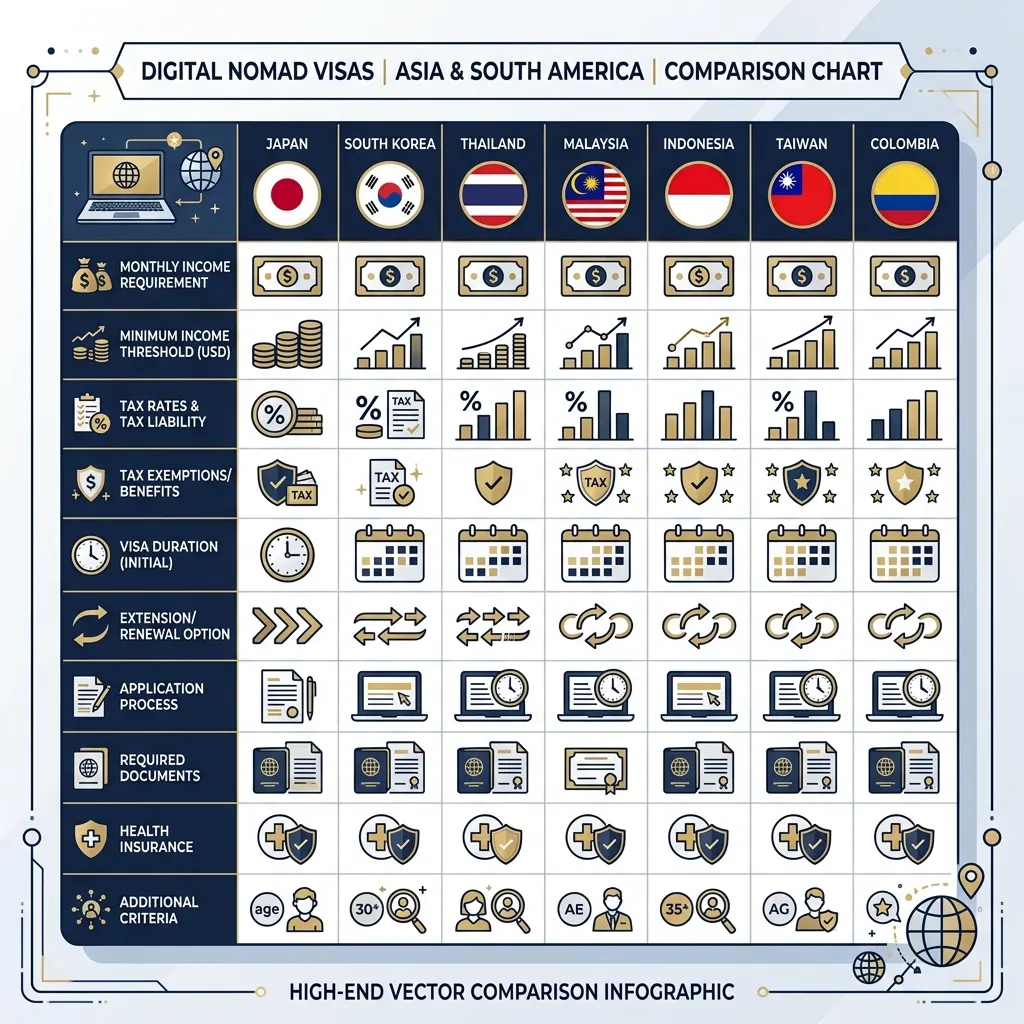
Asia has seen several new digital nomad visas launch recently. Here is how Taiwan’s Gold Card compares to neighboring programs:
| Feature | Taiwan Gold Card | Japan Digital Nomad Visa | South Korea Workcation Visa | Thailand DTV |
|---|---|---|---|---|
| Validity | Up to 3 years (Renewable) | Up to 6 months (Non-renewable) | Up to 2 years (Renewable) | Up to 5 years (180 days per entry) |
| Monthly Income | NT$160,000 (~$5,000 USD) | ¥833,000 (~$5,300 USD) | ₩7,000,000 (~$5,100 USD) | Show savings of ฿500,000 (~$13,600 USD) |
| Tax Residency | Resident if >183 days (Tax breaks apply) | Exempt from local income tax | Exempt from local income tax | Only taxed if funds remitted to Thailand |
| Path to PR | Yes (3 years) | No | No | No |
| Local Work Allowed | Yes (Unrestricted) | No (Foreign clients only) | No (Foreign clients only) | No (Foreign clients only) |
For details on other options in the region, explore our Japan Digital Nomad Visa guide, the South Korea Workcation Visa guide, or the Thailand DTV Visa guide.
Living and Working in Taiwan
Cost of Living
Taiwan offers an exceptionally high quality of life at a fraction of the cost of cities like San Francisco, London, or Tokyo. While Taipei is the most expensive city in Taiwan, rent and dining remain highly affordable for remote professionals earning NT$160,000 per month.
A typical monthly budget for a single remote professional in Taipei looks like this:
- Studio Apartment in central Taipei: NT$20,000 - NT$35,000 ($620 - $1,100 USD)
- Utilities and High-Speed Fiber Internet: NT$3,000 ($90 USD)
- Dining Out (mix of local night markets and western restaurants): NT$15,000 ($460 USD)
- Public Transportation (MRT & Ubike): NT$1,200 ($37 USD)
- Entertainment & Coworking Membership: NT$8,000 ($250 USD)
- Total Estimated Budget: NT$47,200 - NT$62,200 ($1,457 - $1,937 USD)
Internet and Coworking Infrastructure
Taiwan has some of the fastest internet in the world, with average fixed broadband speeds exceeding 150 Mbps. High-speed Wi-Fi is ubiquitous, and cafes are generally welcoming to remote workers.
Popular coworking spaces include:
- Keepworking (Taipei) — Known for a quiet working environment and premium amenities.
- Dappei Coworking (Taipei) — Popular among foreign tech professionals and startups.
- Desk+1 (Kaohsiung) — An excellent option if you choose to base yourself in the sunnier, more affordable south of the island.
National Health Insurance (NHI)
Taiwan’s National Health Insurance is widely regarded as one of the best healthcare systems in the world. Gold Card holders are eligible to join the NHI scheme. If you are employed by a local company, you join immediately. If you are a remote professional or freelancer (self-employed), you can register for NHI after 6 months of continuous residency in Taiwan. Once enrolled, your medical visits, dental checkups, and prescriptions are heavily subsidized.
Frequently Asked Questions
Can I apply for a Gold Card if I am currently unemployed but have historically met the income threshold?
No. The Ministry of Economic Affairs requires applicants to show they are currently earning the NT$160,000/month equivalent or have held a contract guaranteeing that amount recently. The application requires proof of income from the previous three years, and you must demonstrate that this income level is either active or was sustained over a significant block of time.
Does the Taiwan Gold Card allow me to bring my family?
Yes. Gold Card holders are permitted to bring their spouses and minor children to Taiwan. Spouses can obtain a dependent visa and are eligible to apply for open work permits, allowing them to work in Taiwan without restriction. Additionally, parents of Gold Card holders can apply for multi-entry visitor visas valid for up to one year.
How long does the Gold Card application process take?
The entire process typically takes between 4 to 8 weeks. This depends on which ministry is reviewing your case and whether additional documentation is requested. To avoid delays, ensure that all tax documents and employment certificates are clearly translated into English or Traditional Chinese and are fully legible.
Can I renew my Gold Card?
Yes, you can apply for an extension of your Gold Card online within 4 months of its expiration date. You must choose an extension of 1, 2, or 3 years. During the extension review, you must show that you still meet the initial eligibility requirements or have made significant professional contributions to Taiwan.
Am I required to stay in Taiwan for a minimum number of days?
There is no physical presence requirement to maintain your Gold Card. However, if you wish to apply for permanent residency (APRC) after 3 years, you must be physically present in Taiwan for at least 183 days per year during that time. If you do not meet this, your Gold Card remains valid, but your clock toward permanent residency will reset.
Is the Gold Card the same as Taiwanese citizenship?
No. The Gold Card is a residency permit (ARC). It does not grant you a Taiwanese passport or voting rights. To obtain citizenship, you must undergo naturalization, which typically requires residing in Taiwan for a set period and, in most cases, renouncing your original citizenship (though recent legal reforms have relaxed this for high-level special professionals).
Final Thoughts
The Taiwan Employment Gold Card is one of the most flexible and tax-efficient visa options in Asia. By providing open work rights, substantial tax deductions on high salaries, and a shortened pathway to permanent residency, it offers a secure and rewarding base for remote professionals.
Before you make the move, use our Tax Calculator to plan your finances and understand how Taiwan’s progressive rates and Alternative Minimum Tax will interact with your home country obligations. Taiwan is ready to welcome you to its world-class infrastructure, safe streets, and rich cultural landscape. Let the Gold Card be your passport to a new professional life in Asia.