Territorial Taxation Countries: Where Nomads Pay 0% Tax Legally

For digital nomads, remote business owners, and location-independent professionals, the dream of legally reducing your tax bill to zero is not just a fantasy—it is a reality made possible through the strategic use of territorial taxation. By establishing tax residency in a country that only taxes income generated within its borders, you can entirely shield your foreign-sourced business profits, freelance fees, and investment returns from local tax obligations. Understanding how to structure your residency and corporate entities is the key to unlocking this compliance-first approach to tax optimization.
TL;DR: Territorial taxation allows individuals and corporations to pay 0% income tax on earnings generated outside the host country’s borders. By obtaining tax residency in nations like Panama, Paraguay, Costa Rica, or Singapore and combining it with a clean corporate setup (such as a US LLC), digital nomads can legally eliminate their income tax liability. This comprehensive guide details the mechanics of territorial tax systems, compares top destinations, and provides a step-by-step blueprint for compliance.
Understanding Taxation Systems: Worldwide vs. Territorial
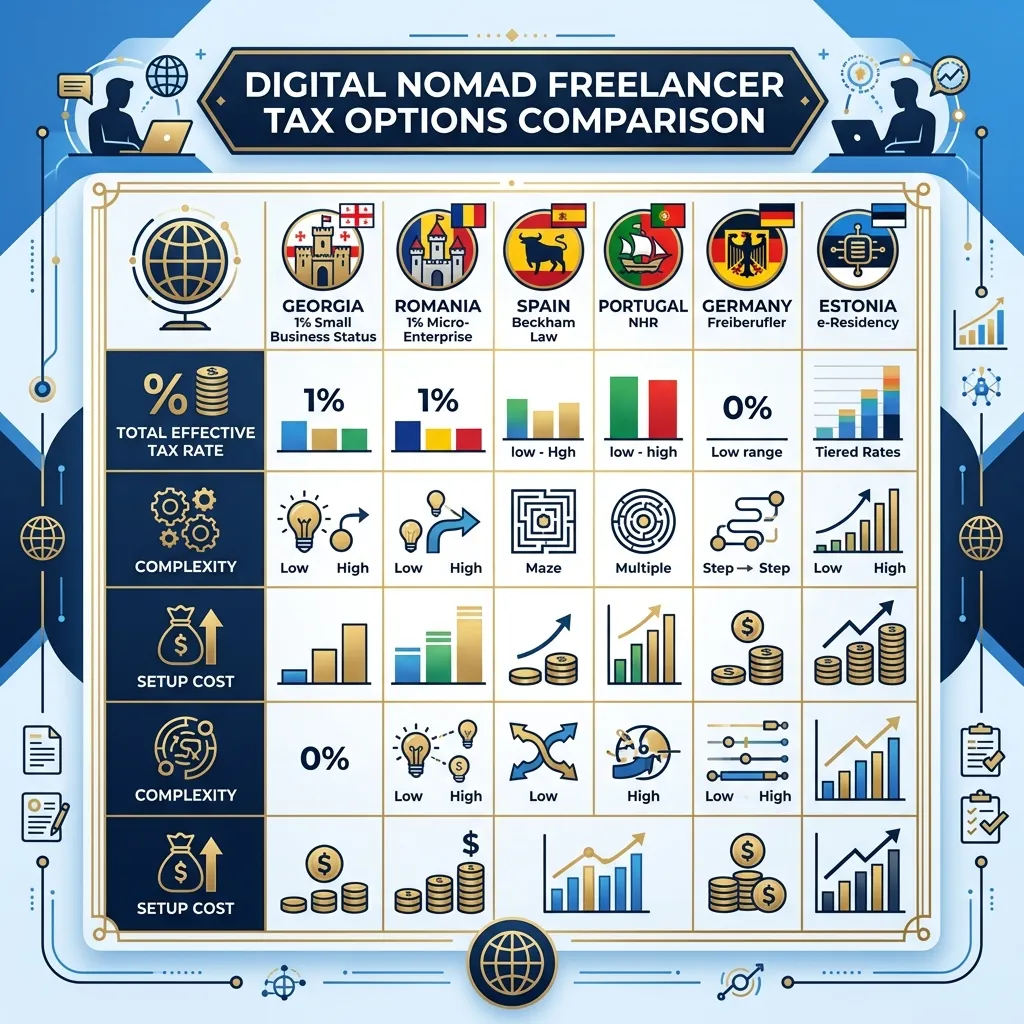
To navigate the world of international tax optimization, you must first understand how different countries claim the right to tax your income. Governments typically use one of three main systems to tax individuals:
1. Citizenship-Based Taxation
Under this system, a country taxes its citizens on their worldwide income, regardless of where they live, work, or establish residency. Only two countries in the world utilize this system: the United States (under the Internal Revenue Code) and Eritrea. If you are a US citizen, you cannot escape the US tax net simply by moving abroad; you must actively use exclusions like the Foreign Earned Income Exclusion (FEIE) or foreign tax credits, or renounce your citizenship entirely.
2. Worldwide (Residence-Based) Taxation
The vast majority of countries (including Canada, the United Kingdom, Germany, Australia, and Spain) tax their residents on their worldwide income. If you meet the local criteria for tax residency in these countries—such as staying for more than 183 days in a calendar year—you must pay local tax on everything you earn, whether it comes from a local job, a US stock dividend, or a freelance client in Japan.
3. Territorial Taxation
Territorial tax countries only tax income that is physically or economically sourced within their borders. If a tax resident of a territorial country earns income from services performed abroad, foreign investments, or a business operating outside the country, that foreign-sourced income is subject to a 0% tax rate. This makes territorial taxation the ultimate framework for digital nomads who operate global, location-independent businesses.
How Territorial Taxation Works for Digital Nomads
The core principle of territorial taxation is the distinction between domestic-source income and foreign-source income.
If you are a tax resident of Panama and you open a local coffee shop in Panama City, your earnings are domestic-source and taxed at normal progressive rates. However, if you are a copywriter living in Panama and you write copy for clients based in London, or if you run a SaaS company registered in the United States serving customers in Germany, that income is classified as foreign-source. Under a territorial system, the host country does not tax this foreign income.
To implement this strategy legally, you must satisfy three conditions:
- Break tax ties with your home country: You must legally cease to be a tax resident of your high-tax origin country (e.g., by passing the UK Statutory Residence Test or declaring non-residency with the Australian Taxation Office).
- Establish residency in a territorial tax country: You must obtain a residency visa and set up a physical base in a territorial jurisdiction.
- Structure your income as foreign-sourced: You must ensure that your business entity and billing methods align with the host country’s definition of foreign-source income.
[!WARNING] Simply moving to a territorial tax country does not automatically exempt you from taxes in your home country. If your home country still considers you a tax resident, they will claim taxing rights over your global income. You must formally exit your previous tax residency before relying on territorial tax exemptions.
Top Territorial Tax Countries for Digital Nomads
Several countries offer territorial tax systems, but they vary significantly regarding entry requirements, lifestyle, and corporate friendliness. Below is a detailed look at the four most popular territorial tax havens for remote workers.
1. Panama: The Gold Standard
Panama is widely regarded as one of the best tax havens in the world. Under Article 694 of the Panama Fiscal Code, income tax is levied only upon income produced from sources within the territory of the Republic of Panama.
Panama’s definition of foreign-source income is incredibly broad. Even if you manage your foreign business from an office in Panama City, the income is considered foreign-source because the economic transactions and services take place abroad.
- Residency Options: The most popular route is the Friendly Nations Visa, which allows citizens of 50+ countries to obtain residency by investing $200,000 in real estate or placing a $200,000 deposit in a Panamanian bank. Alternatively, the Digital Nomad Visa allows remote workers earning at least $36,000 annually to reside in the country for up to 18 months tax-free.
- Physical Presence Requirements: To maintain permanent residency, you only need to visit Panama once every two years for a few days, making it an incredibly flexible “paper residency” option.
2. Costa Rica: The Eco-Nomad Haven
Costa Rica has traditionally operated a strict territorial tax system under the Income Tax Law No. 7092. Article 1 of this law states that tax is levied on profits obtained from activities of Costa Rican source.
For years, digital nomads operated in a legal gray area in Costa Rica. However, with the introduction of the official Digital Nomad Visa (Law No. 10008), the government clarified that visa holders are fully exempt from local income tax on their foreign-sourced earnings.
- Residency Options: The Costa Rica Digital Nomad Visa requires a minimum monthly income of $3,000 for single applicants (or $4,000 for families) from foreign sources.
- Physical Presence Requirements: The visa is granted for one year and can be extended for a second year, provided you spend at least 180 days in the country during the first year.
3. Paraguay: The Easiest Entry Point
Paraguay is currently the easiest territorial tax country in the world for digital nomads to obtain residency. Under Law No. 6380/2019, Paraguay taxes residents on their domestic income under the IRE (corporate tax) or IRP (personal income tax), while foreign-sourced income remains taxed at 0%.
Paraguay defines foreign-sourced income as any income derived from capital, rights, or activities located and developed outside its national borders.
- Residency Options: Paraguay offers a straightforward residency program through its temporary and permanent residency visas. By working with a local lawyer, you can obtain residency with minimal paperwork, no major investment requirements, and a clean criminal record. For a deep dive into this process, read our dedicated guide on Paraguay Tax Residency.
- Physical Presence Requirements: Unlike most countries, Paraguay does not require you to live there full-time to keep your residency. Visiting the country once per year is sufficient to keep your permit active.
4. Singapore: The Premium Asian Hub
Singapore operates a territorial tax system under the Income Tax Act 1947. Income is only subject to Singaporean income tax if it is accrued in or derived from Singapore, or if it is foreign-sourced income received in Singapore by a resident.
Crucially, under Section 13(7A) of the Income Tax Act, foreign-sourced passive income (such as dividends or interest) and foreign-sourced active income received in Singapore by individuals is generally exempt from tax, provided certain conditions are met.
- Residency Options: Singapore is a high-cost, premium jurisdiction. The most common pathways for business owners are the Employment Pass (EP) or the EntrePass for innovative startups.
- Physical Presence Requirements: To maintain tax residency and receive a Tax Residency Certificate (TRC), you typically need to reside in Singapore for at least 183 days in a calendar year.
Comparison Table of Territorial Tax Countries
To help you decide which jurisdiction best fits your needs, here is a comparison of key features for 2026:
| Country | Personal Income Tax (Foreign Source) | Personal Income Tax (Domestic Source) | Minimum Income / Investment to Qualify | Physical Presence Needed to Keep Residency | Path to Citizenship |
|---|---|---|---|---|---|
| Panama | 0% | Progressive up to 25% | $200,000 (Friendly Nations) or $3,000/mo (Nomad Visa) | Once every 2 years | Yes (after 5 years of permanent residency) |
| Paraguay | 0% | Flat 10% (IRP) | Nominal fees (approx. $1,500–$2,500 setup costs) | Once every 3 years (temporary) or 1 year (permanent) | Yes (after 3 years of permanent residency) |
| Costa Rica | 0% | Progressive up to 25% | $3,000/month (Digital Nomad Visa) | 180 days per year | Yes (after 7 years of residency) |
| Singapore | 0% | Progressive up to 24% | High salary requirement for EP (minimum SGD 5,000+/mo) | 183 days per year | Yes (highly selective, after 2+ years of PR) |
The Ultimate 0% Tax Setup: Territorial Residency + Remote Company
Simply living in a territorial tax country is only half the battle. To legally pay zero taxes, you must structure your business entity correctly. If you operate as a sole proprietor and bill clients directly, some territorial tax offices might argue that your work is being performed physically within their borders, making it domestic-sourced.
To prevent this, digital nomads use a corporate buffer. The most popular and robust structure is the US Single-Member LLC (Limited Liability Company).
graph TD
    Client[Foreign Clients: US, UK, EU] -- Pays USD/EUR --> LLC[US Single-Member LLC]
    LLC -- Distributes Profit 0% Tax --> Nomad[Nomad Resident in Panama/Paraguay]
    Nomad -- Declares Foreign Distribution --> LocalTax[Local Tax Office: 0% Tax Sourced Externally]
Why the US LLC is the Perfect Corporate Buffer
- Tax Pass-Through: For US tax purposes, a single-member LLC owned by a non-US citizen who does not reside in the US is classified as a Disregarded Entity. This means the LLC itself pays no US federal corporate income tax.
- No US Tax Liability: If you do not have physical operations, employees, or dependent agents in the United States, your LLC income is not considered Effectively Connected Income (ECI). Under the US Internal Revenue Code, you pay 0% US tax.
- Foreign-Sourced Distribution: The profits from the US LLC flow directly to you, the owner. When you receive these distributions as a tax resident of a territorial country (like Paraguay or Panama), your local tax office views the income as a distribution from a foreign entity. Since the source of the funds is foreign, it is subject to a 0% tax rate.
- Professional Credibility: Your clients deal with a prestigious US corporate entity and pay into a US bank account, bypassing the compliance friction often associated with sending money to offshore tax havens.
[!TIP] Setting up a US LLC can be completed online within a few days for under $500. It is crucial to file Form 5472 and Form 1120 with the IRS every year to maintain the LLC’s active, tax-free status, even if you owe zero taxes. For a detailed walkthrough on setting up these corporate buffers, see our Digital Nomad Business Setup Guide.
Practical Examples: Two Income Scenarios
Let’s look at how this structure functions in real life using two typical digital nomad income profiles under 2026 tax regulations.
Scenario A: Jane, the Freelance UI/UX Designer
- Gross Income: €90,000 per year
- Clients: Tech startups in Germany, France, and the UK
- Residency: Paraguay (Temporary Resident status)
- Structure: US Single-Member LLC (Delaware)
Jane sets up a Delaware LLC and opens a business account with a digital banking provider. She invoices her European clients through her LLC. Her clients pay in Euros or US Dollars. At the end of each month, Jane transfers the profits from her US business account to her personal bank account in Paraguay.
- US Tax Liability: $0 (No US trade or business, disregarded entity status).
- Paraguay Tax Liability: $0 (The income is distributed from a US entity and sourced from clients outside Paraguay, qualifying as 0% foreign-sourced income).
- Total Tax Paid: $0 (Jane only pays minor annual LLC renewal fees of approximately $300 and local accounting fees of $500).
Scenario B: Mark, the E-commerce Founder
- Gross Income: €350,000 per year (Net profit)
- Customers: Worldwide (primarily US and Canada)
- Residency: Panama (Friendly Nations Visa holder)
- Structure: Panama Corp or US LLC combined with a Panamanian personal tax residency
Mark resides in Panama City. He manages his e-commerce store, which utilizes third-party logistics (3PL) warehouses in the US to ship products. Because he has inventory in the US, he might have US sales tax obligations, but his personal income tax remains shielded. His business entity distributes dividend income directly to his Panamanian personal account.
- Panama Tax Liability: $0 (Under Article 694, the sales are generated from inventory and customers outside Panama. The operations are directed from Panama, but the economic transaction occurs abroad).
- Total Tax Saved: Compared to living in Germany, where he would face progressive tax rates up to 45% plus solidarity surcharges, Mark saves over €140,000 per year in income taxes.
Step-by-Step Guide to Transitioning to a Territorial Tax System
If you want to transition your lifestyle to a territorial tax model, you should execute your plan in a structured, compliant order:
- Calculate Your Potential Savings: Use our Tax Calculator to input your current income, expenses, and home country tax rate to see exactly how much you would save by relocating to a 0% territorial tax jurisdiction.
- Formally Exit Your Current Tax Residency: This is the most critical step. For example, if you are a UK citizen, you must ensure you meet the non-resident requirements of the Statutory Residence Test. If you are an Australian citizen, you must cut ties in accordance with the ATO residency tests. Keep records of flight tickets, lease terminations, and bank account closures.
- Apply for Residency in Your Chosen Country: Gather your background checks, birth certificates, and proof of income. Hire a local immigration lawyer to submit your visa application in Panama, Paraguay, or Costa Rica.
- Set Up Your Corporate Buffer: Register a US LLC or a UK LLP. Set up business banking and payment processors (like Stripe or Wise) in the name of the new entity.
- Update Your Billing and Invoicing: Shift all client contracts to your new corporate entity. Ensure that no payments go directly to your personal accounts in your country of residency unless they are documented distributions from your foreign company.
- Obtain a Tax Residency Certificate (TRC): Once you have lived in your new country for the required period, apply for a TRC. This official document is your ultimate defense if your home country’s tax agency ever audits you and asks why you are no longer paying them taxes.
Frequently Asked Questions
Is it legal to pay 0% tax using territorial taxation?
Yes, it is entirely legal. Tax systems are established by sovereign nations, and every country has the right to decide how it taxes individuals within its borders. When you establish tax residency in a territorial tax country and ensure your income is foreign-sourced, you are fully complying with local laws. This is known as tax avoidance (legal planning), which is completely different from tax evasion (illegal non-declaration of taxes owed).
Do I need to live in the territorial tax country all year?
It depends on the country. Paraguay only requires you to visit once a year (or once every three years for temporary residents) to maintain your residency status. Panama requires a visit once every two years. However, to qualify as a tax resident and receive a Tax Residency Certificate (TRC) to prove your status to foreign tax authorities, you may need to spend at least 183 days in the country or prove that it is your primary center of life.
If my home country has a Double Taxation Treaty with my new country, does that help?
Yes. Double Taxation Treaties (DTTs) include “tie-breaker rules” that determine which country has the primary right to tax you if both claim you as a resident. Having residency in a territorial tax country that has an active DTT with your home country provides an extra layer of legal protection. Read our guide on Double Taxation Treaties to see how these agreements prevent dual taxation.
Can US citizens use territorial taxation to pay 0% tax?
Not on its own. Because the US uses citizenship-based taxation, US citizens are taxed on their worldwide income regardless of where they live. However, a US citizen living in a territorial tax country can combine the local 0% tax rate with the Foreign Earned Income Exclusion (FEIE) to exclude up to $126,500 (for 2026) of foreign-earned income from US taxes, and use the Foreign Tax Credit or housing exclusions to reduce the rest.
What happens if I perform work physically while inside the territorial country?
This is a common point of concern. Technically, if you are sitting at a laptop in Costa Rica or Panama and writing code, the work is being performed physically inside the country. Some tax authorities could argue this makes the income domestic-sourced. To mitigate this risk, digital nomads use a US LLC or foreign corporation. The contract is between the client and the foreign corporation, and the individual receives corporate distributions rather than active salary, which classifies the income as foreign-sourced passive or corporate distributions under local tax definitions.
Do I need a local bank account in the territorial tax country?
While not always legally required to maintain your tax status, having a local bank account is highly recommended. It helps demonstrate “economic ties” to your new country of residence, which is valuable if your home country audits you. It also provides a practical way to pay local expenses like rent, utilities, and groceries.
Final Thoughts
Transitioning to a territorial tax system is one of the most effective ways to accelerate your wealth building as a digital nomad. By legally positioning yourself in a jurisdiction that respects territorial boundaries and utilizing a clean corporate structure, you can redirect thousands of dollars every month from tax payments into your business, investments, and personal savings.
Make sure to use our Tax Calculator to model your transition, and consult with an international tax strategist to ensure your exit from your home country is fully compliant with local regulations.